Center for Population Biology and Department of Evolution and Ecology, University of California, Davis, California, United States of America.
Department of Plant and Microbial Biology, University of Minnesota, Saint Paul, Minnesota, United States of America.
PLoS Genet. 2021 Oct 14;17(10):e1009768. doi: 10.1371/journal.pgen.1009768. eCollection 2021 Oct.
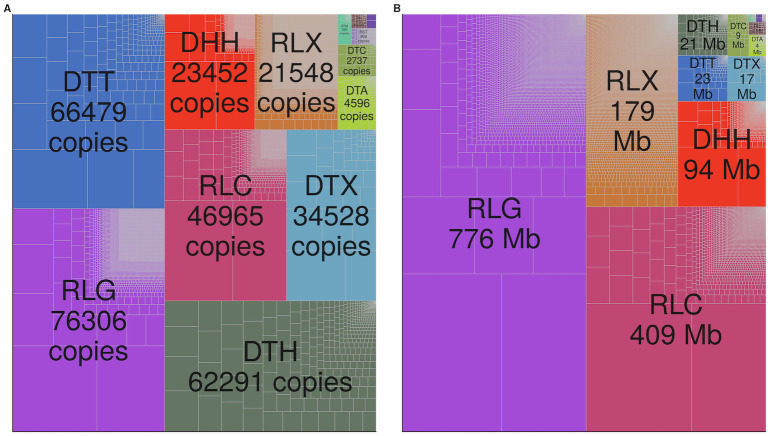
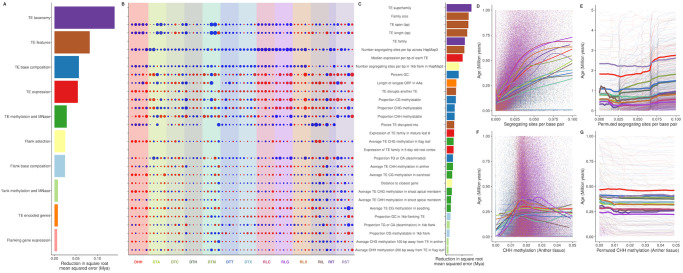
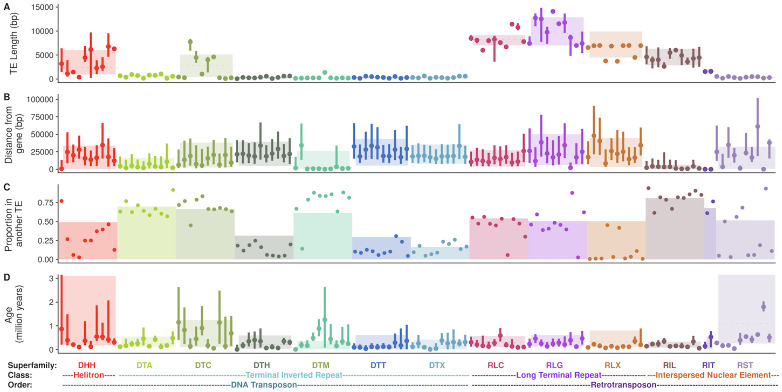
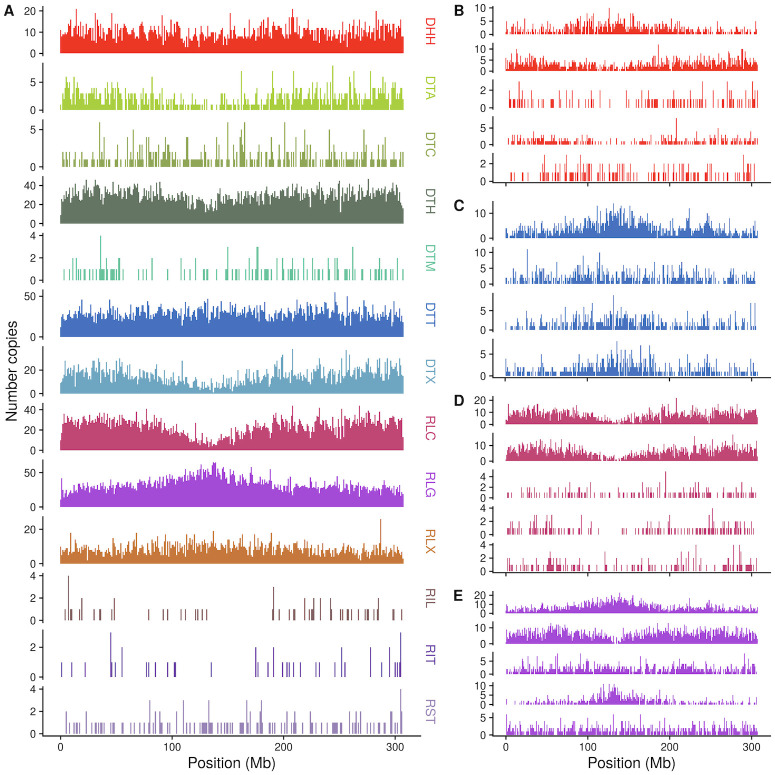
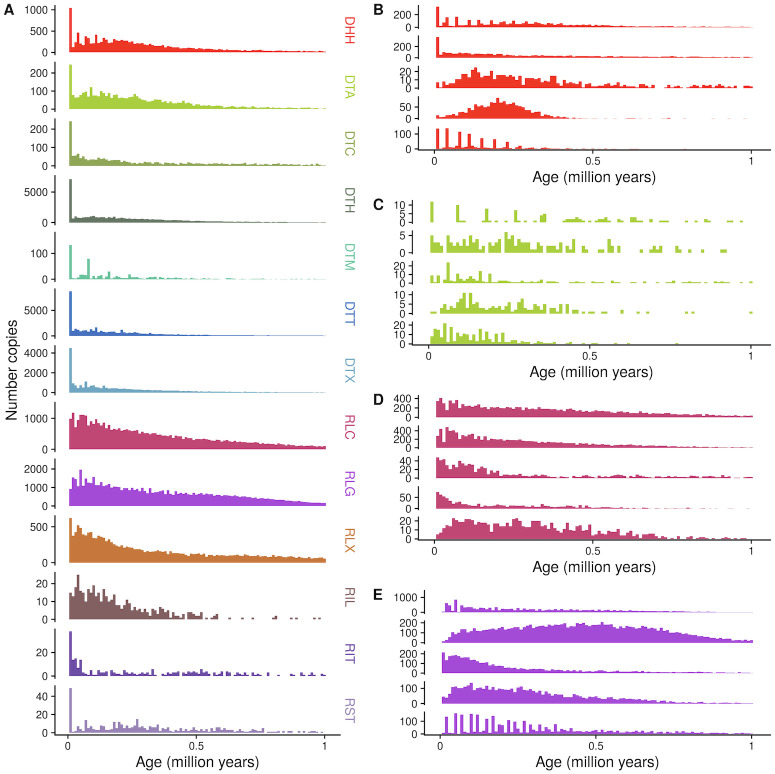
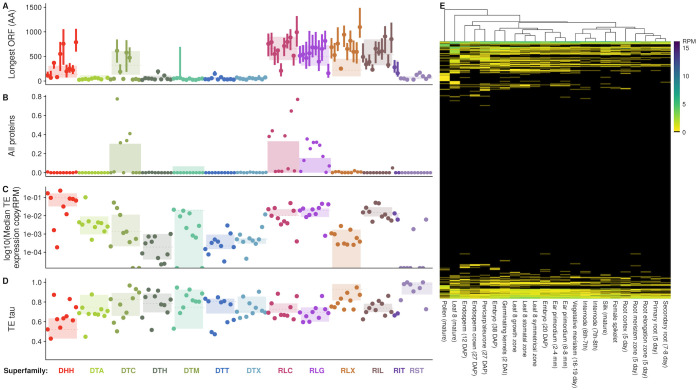
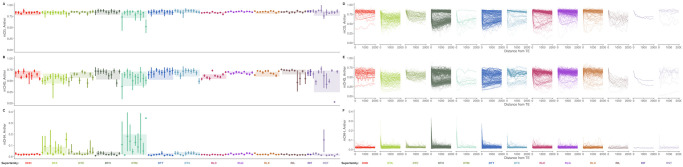
Transposable elements (TEs) constitute the majority of flowering plant DNA, reflecting their tremendous success in subverting, avoiding, and surviving the defenses of their host genomes to ensure their selfish replication. More than 85% of the sequence of the maize genome can be ascribed to past transposition, providing a major contribution to the structure of the genome. Evidence from individual loci has informed our understanding of how transposition has shaped the genome, and a number of individual TE insertions have been causally linked to dramatic phenotypic changes. Genome-wide analyses in maize and other taxa have frequently represented TEs as a relatively homogeneous class of fragmentary relics of past transposition, obscuring their evolutionary history and interaction with their host genome. Using an updated annotation of structurally intact TEs in the maize reference genome, we investigate the family-level dynamics of TEs in maize. Integrating a variety of data, from descriptors of individual TEs like coding capacity, expression, and methylation, as well as similar features of the sequence they inserted into, we model the relationship between attributes of the genomic environment and the survival of TE copies and families. In contrast to the wholesale relegation of all TEs to a single category of junk DNA, these differences reveal a diversity of survival strategies of TE families. Together these generate a rich ecology of the genome, with each TE family representing the evolution of a distinct ecological niche. We conclude that while the impact of transposition is highly family- and context-dependent, a family-level understanding of the ecology of TEs in the genome can refine our ability to predict the role of TEs in generating genetic and phenotypic diversity.
转座元件 (TEs) 构成了开花植物 DNA 的大部分,这反映了它们在颠覆、回避和逃避宿主基因组防御以确保自身自私复制方面的巨大成功。玉米基因组的 85%以上的序列都可以归因于过去的转座,这为基因组的结构做出了重大贡献。来自个别基因座的证据使我们能够了解转座如何塑造基因组,并且一些个别 TE 插入已经与显著的表型变化有关。在玉米和其他分类群中的全基因组分析经常将 TEs 表示为过去转座的相对同质的片段遗迹类群,掩盖了它们的进化历史及其与宿主基因组的相互作用。使用玉米参考基因组中结构完整的 TEs 的更新注释,我们研究了玉米中 TE 的家族水平动态。整合了各种数据,从单个 TE 的描述符(如编码能力、表达和甲基化)以及它们插入的序列的类似特征,我们模拟了基因组环境的属性与 TE 副本和家族存活之间的关系。与将所有 TEs 一概而论地归为垃圾 DNA 类别的做法相反,这些差异揭示了 TE 家族生存策略的多样性。这些共同构成了基因组的丰富生态,每个 TE 家族都代表了一个独特生态位的进化。我们的结论是,尽管转座的影响高度依赖于家族和上下文,但对基因组中 TE 生态的家族级理解可以提高我们预测 TE 在产生遗传和表型多样性方面的作用的能力。