Department of Genome Sciences, University of Washington, Seattle, WA, USA.
Department of Pathology, Case Western Reserve University School of Medicine, Cleveland, OH, 44106, USA.
Genome Med. 2021 Oct 14;13(1):165. doi: 10.1186/s13073-021-00984-x.
PTEN is a multi-functional tumor suppressor protein regulating cell growth, immune signaling, neuronal function, and genome stability. Experimental characterization can help guide the clinical interpretation of the thousands of germline or somatic PTEN variants observed in patients. Two large-scale mutational datasets, one for PTEN variant intracellular abundance encompassing 4112 missense variants and one for lipid phosphatase activity encompassing 7244 variants, were recently published. The combined information from these datasets can reveal variant-specific phenotypes that may underlie various clinical presentations, but this has not been comprehensively examined, particularly for somatic PTEN variants observed in cancers.
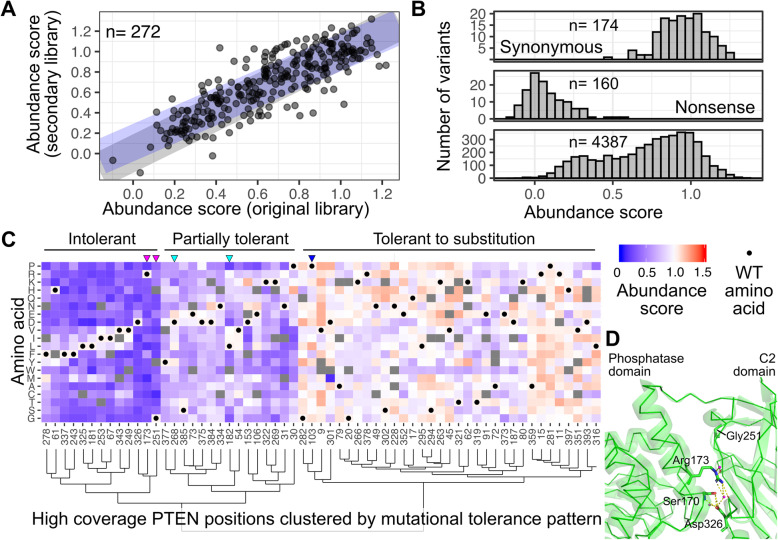
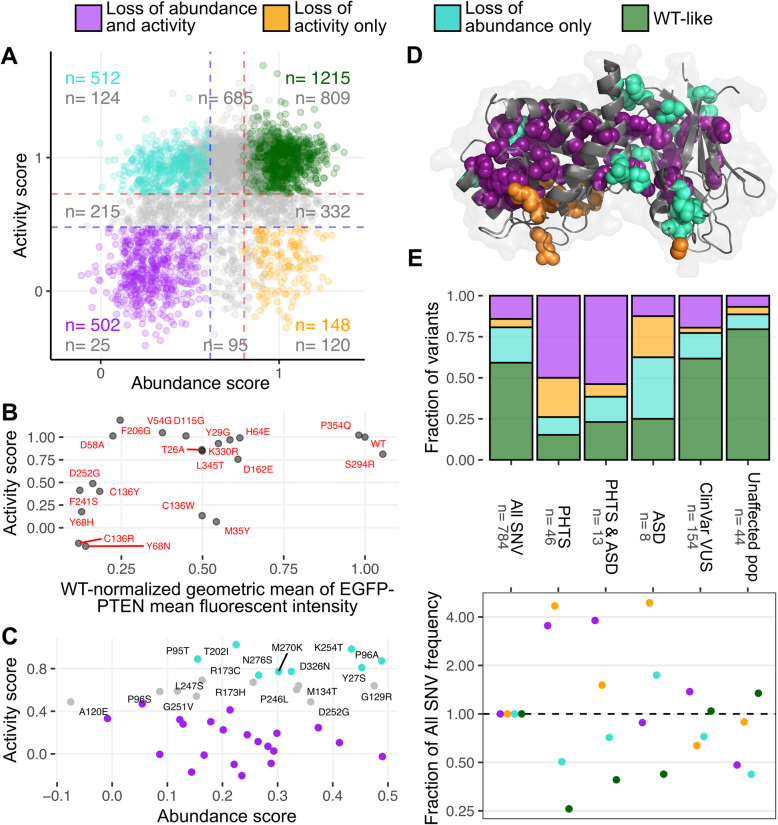
Here, we add to these efforts by measuring the intracellular abundance of 764 new PTEN variants and refining abundance measurements for 3351 previously studied variants. We use this expanded and refined PTEN abundance dataset to explore the mutational patterns governing PTEN intracellular abundance, and then incorporate the phosphatase activity data to subdivide PTEN variants into four functionally distinct groups.
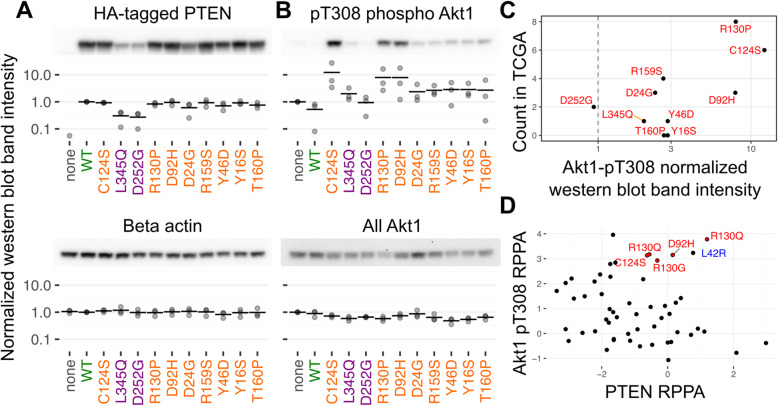
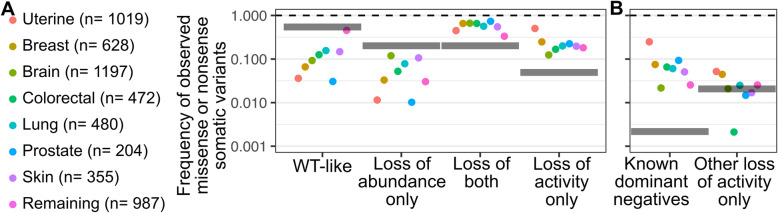
This analysis revealed a set of highly abundant but lipid phosphatase defective variants that could act in a dominant-negative fashion to suppress PTEN activity. Two of these variants were, indeed, capable of dysregulating Akt signaling in cells harboring a WT PTEN allele. Both variants were observed in multiple breast or uterine tumors, demonstrating the disease relevance of these high abundance, inactive variants.
We show that multidimensional, large-scale variant functional data, when paired with public cancer genomics datasets and follow-up assays, can improve understanding of uncharacterized cancer-associated variants, and provide better insights into how they contribute to oncogenesis.
PTEN 是一种多功能肿瘤抑制蛋白,调节细胞生长、免疫信号、神经元功能和基因组稳定性。实验特征可以帮助指导对患者中观察到的数千种种系或体细胞 PTEN 变体的临床解释。最近发表了两个大规模的突变数据集,一个用于包含 4112 个错义变体的 PTEN 变体细胞内丰度,另一个用于包含 7244 个变体的脂质磷酸酶活性。这些数据集的综合信息可以揭示可能是各种临床表现基础的变体特异性表型,但尚未全面研究,特别是对于在癌症中观察到的体细胞 PTEN 变体。
在这里,我们通过测量 764 个新的 PTEN 变体的细胞内丰度并改进对之前研究的 3351 个变体的丰度测量来补充这些努力。我们使用这个扩展和改进的 PTEN 丰度数据集来探索控制 PTEN 细胞内丰度的突变模式,然后将磷酸酶活性数据纳入其中,将 PTEN 变体细分为四个功能不同的组。
这项分析揭示了一组高度丰富但脂质磷酸酶缺陷的变体,它们可能以显性负性方式抑制 PTEN 活性。其中两个变体确实能够在携带 WT PTEN 等位基因的细胞中失调 Akt 信号。这两种变体都在多个乳腺或子宫肿瘤中观察到,证明了这些高丰度、无活性变体的疾病相关性。
我们表明,多维、大规模的变体功能数据,与公共癌症基因组数据集和后续检测相结合,可以提高对未表征的癌症相关变体的理解,并更好地了解它们如何促成肿瘤发生。