Huster Abigail R, Wallace Lyle T, Myers James R
Department of Horticulture, Oregon State University, Corvallis, OR, United States.
USDA-ARS, Plant Germplasm Introduction and Testing Research Unit, Washington State University, Pullman, WA, United States.
Front Plant Sci. 2021 Sep 28;12:697615. doi: 10.3389/fpls.2021.697615. eCollection 2021.
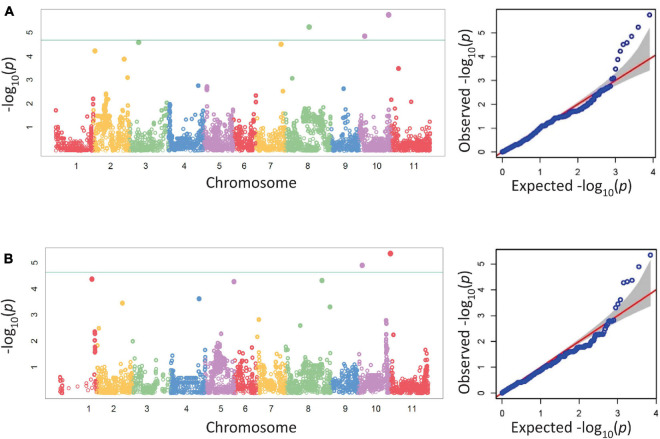
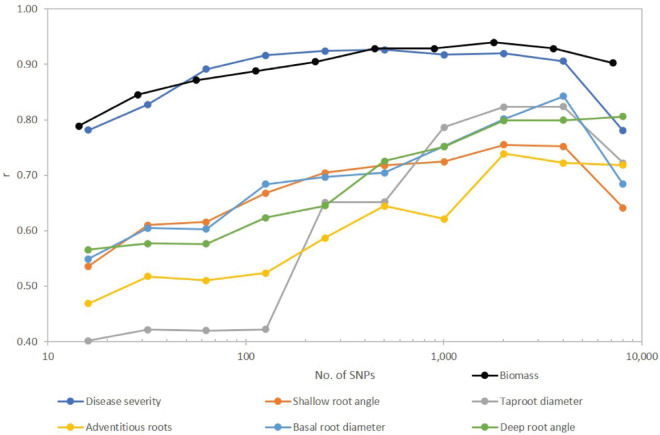
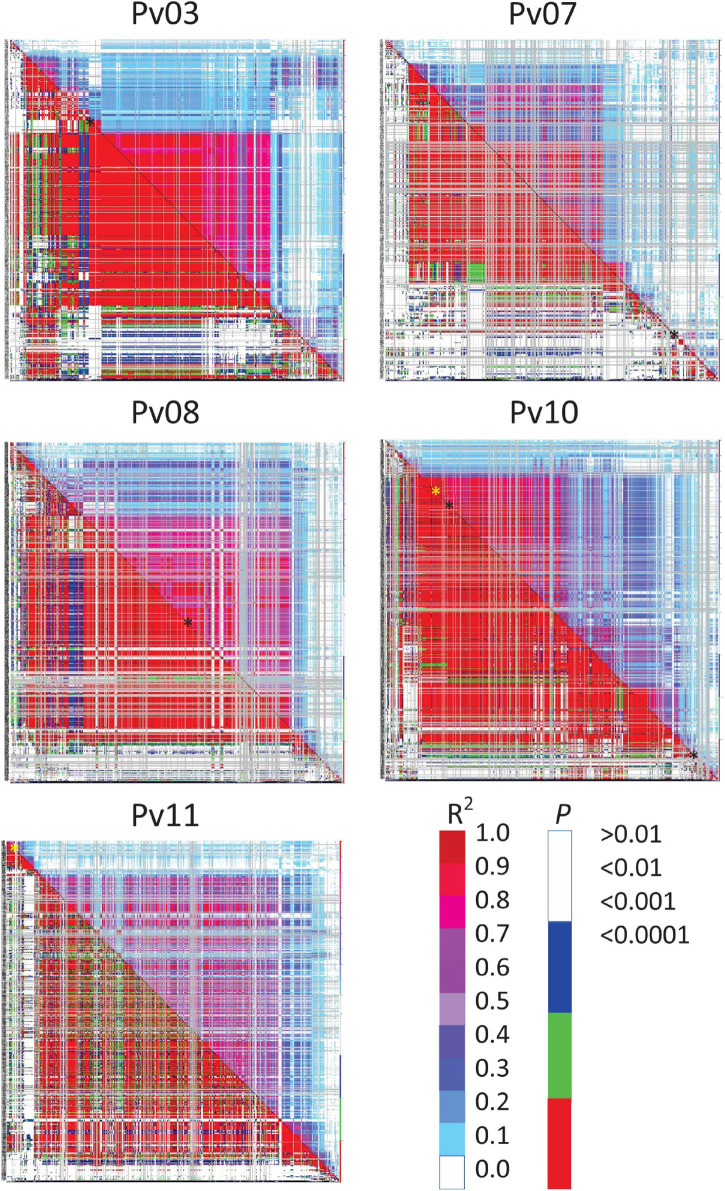
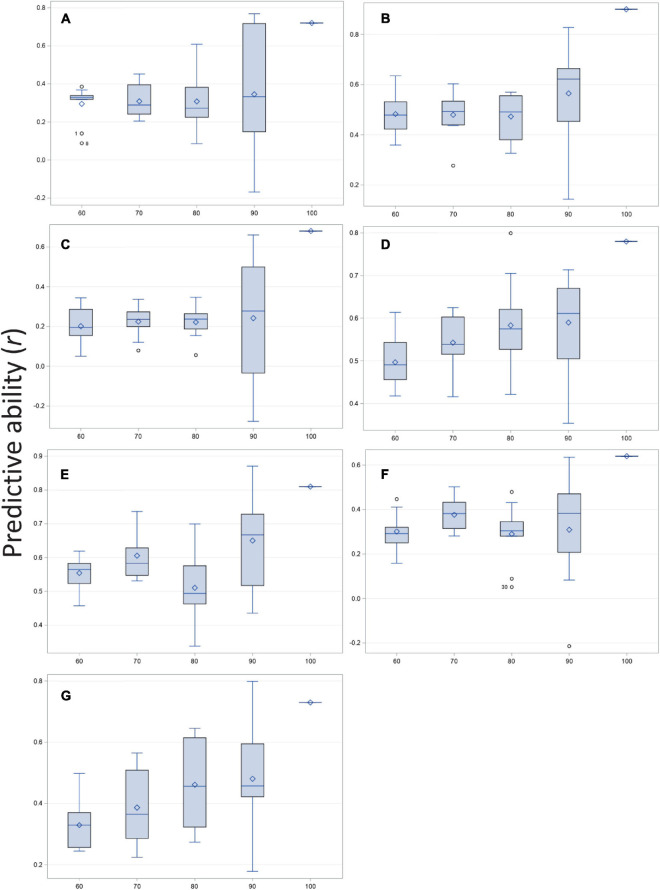
Root rot is a major constraint to snap bean () production in the United States and around the world. Genetic resistance is needed to effectively control root rot disease because cultural control methods are ineffective, and the pathogen will be present at the end of one season of production on previously clean land. A diversity panel of 149 snap bean pure lines was evaluated for resistance to root rot in Oregon. Morphological traits potentially associated with root rot resistance, such as aboveground biomass, adventitious roots, taproot diameter, basal root diameter, deepest root angle, shallowest root angle, root angle average, root angle difference, and root angle geometric mean were evaluated and correlated to disease severity. A genome wide association study (GWAS) using the Fixed and random model Circulating Probability Unification (FarmCPU) statistical method, identified five associated single nucleotide polymorphisms (SNPs) for disease severity and two SNPs for biomass. The SNPs were found on Pv03, Pv07, Pv08, Pv10, and Pv11. One candidate gene for disease reaction near a SNP on Pv03 codes for a peroxidase, and two candidates associated with biomass SNPs were a 2-alkenal reductase gene cluster on Pv10 and a Pentatricopeptide repeat domain on Pv11. Bean lines utilized in the study were ranked by genomic estimated breeding values (GEBV) for disease severity, biomass, and the root architecture traits, and the observed and predicted values had high to moderate correlations. Cross validation of genomic predictions showed slightly lower correlational accuracy. Bean lines with the highest GEBV were among the most resistant, but did not necessarily rank at the very top numerically. This study provides information on the relationship of root architecture traits to root rot disease reaction. Snap bean lines with genetic merit for genomic selection were identified and may be utilized in future breeding efforts.
根腐病是美国乃至全球菜豆()生产的主要限制因素。由于栽培防治方法无效,且病原菌会在一季生产结束时出现在此前的净耕土地上,因此需要通过遗传抗性来有效控制根腐病。对149个菜豆纯系的多样性群体进行了俄勒冈州根腐病抗性评估。对可能与根腐病抗性相关的形态学性状进行了评估,如地上生物量、不定根、主根直径、基部根直径、最深根角、最浅根角、平均根角、根角差异和根角几何平均值,并将其与病情严重程度进行关联。使用固定和随机模型循环概率统一法(FarmCPU)统计方法进行全基因组关联研究(GWAS),确定了5个与病情严重程度相关的单核苷酸多态性(SNP)和2个与生物量相关的SNP。这些SNP位于Pv03、Pv07、Pv08、Pv10和Pv11上。Pv03上一个SNP附近的一个病害反应候选基因编码一种过氧化物酶,与生物量SNP相关的两个候选基因分别是Pv10上的一个2-烯醛还原酶基因簇和Pv11上的一个五肽重复结构域。根据病情严重程度、生物量和根系结构性状的基因组估计育种值(GEBV)对研究中使用的菜豆品系进行排名,观察值和预测值具有高到中等的相关性。基因组预测的交叉验证显示相关准确性略低。GEBV最高的菜豆品系属于抗性最强的品系,但在数值上不一定排名最靠前。本研究提供了根系结构性状与根腐病反应关系的信息。鉴定出了具有基因组选择遗传优势的菜豆品系,可用于未来的育种工作。