School of Psychological Sciences, Macquarie University, North Ryde, New South Wales, Australia.
Department of Gastroenterology and Hepatology, Princess Alexandra Hospital and Translational Research Institute (TRI), Woolloongabba, Queensland, Australia.
United European Gastroenterol J. 2021 Nov;9(9):1074-1080. doi: 10.1002/ueg2.12164. Epub 2021 Oct 15.
While the etiopathogenesis of functional gastrointestinal disorders (FGIDs) is not completely understood, alterations of the intestinal microbiome have been observed. Antibiotics can induce dysbiosis, but whether antibiotics are a risk factor for the onset of FGIDs is uncertain. Antibiotics have been reported as both a risk factor for new onset FGID but also as a therapy for existing FGID. This study aimed to estimate the fraction of cases where antibiotics provoked the onset of FGID.
Electronic medical records were obtained from general practices (primary care) in the United Kingdom. Dates of antibiotic prescription (AP) were compared with first date of FGID diagnosis and contrasted across three prevalent FGIDs and controls without gastrointestinal disorders.
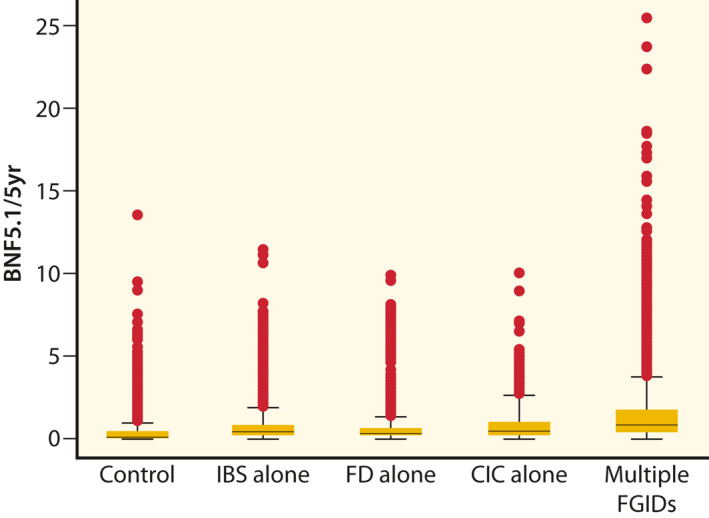
There were 10,926 GI healthy controls, 4326 IBS alone, 3477 FD alone, 340 chronic constipation and 4402 with overlap of multiple conditions. Both the prevalence of AP and rate were higher in FGID patients and increased with diagnosis of multiple FGIDs. 7%-14% of FGID patients were prescribed their first recorded antibiotic in the 12 months prior to their first FGID diagnosis and 20%-33% were prescribed an antibiotic in the same period. Differences between FGID groups were not accounted for by social deprivation and only rate of AP was moderated by social deprivation. In contrast, only 5%-10% of patients ever had a gastrointestinal infection recorded and only 1.5%-3.5% prior to their first FGID diagnosis.
These data indicate that antibiotics are prescribed prior to FGID diagnosis in a significant minority of care-seeking FGID patients, opening the potential for this medication to contribute to the pathophysiology. APs appears to mostly be for non-gastrointestinal conditions.
尽管功能性胃肠病(FGIDs)的发病机制尚不完全清楚,但已经观察到肠道微生物组的改变。抗生素可引起肠道菌群失调,但抗生素是否是 FGIDs 发病的危险因素尚不确定。抗生素既被报道为新发 FGID 的危险因素,也被报道为现有 FGIDs 的治疗方法。本研究旨在估计抗生素引起 FGID 发病的病例比例。
从英国的普通诊所(初级保健)获得电子病历。抗生素处方(AP)的日期与 FGID 诊断的首次日期进行比较,并与三种常见 FGIDs 和无胃肠道疾病的对照组进行对比。
共有 10926 名胃肠道健康对照者、4326 名 IBS 单独患者、3477 名 FD 单独患者、340 名慢性便秘患者和 4402 名多种疾病重叠患者。FGID 患者的 AP 患病率和发生率均较高,且随着多种 FGIDs 的诊断而增加。7%-14%的 FGID 患者在首次 FGID 诊断前的 12 个月内首次接受抗生素治疗,20%-33%的患者在同一时期接受了抗生素治疗。FGID 组之间的差异与社会剥夺无关,只有 AP 的发生率受到社会剥夺的调节。相比之下,只有 5%-10%的患者有记录的胃肠道感染,且只有 1.5%-3.5%的患者在首次 FGID 诊断前有记录。
这些数据表明,在寻求治疗的 FGID 患者中,抗生素在 FGID 诊断前开具的比例相当大,这为这种药物可能有助于发病机制提供了可能性。AP 主要用于非胃肠道疾病。