Klinik für Innere Medizin III-Kardiologie, Angiologie und Internistische Intensivmedizin, Universitätsklinikum des Saarlandes, Kirrberger Strasse 100, Homburg, 66421, Germany.
Department of Cardiology & Berlin Institute of Health Center for Regenerative Therapies (BCRT), German Centre for Cardiovascular Research (DZHK), partner site Berlin, Charité-Universitätsmedizin Berlin (Campus CVK), Berlin, Germany.
ESC Heart Fail. 2021 Dec;8(6):4444-4453. doi: 10.1002/ehf2.13646. Epub 2021 Oct 16.
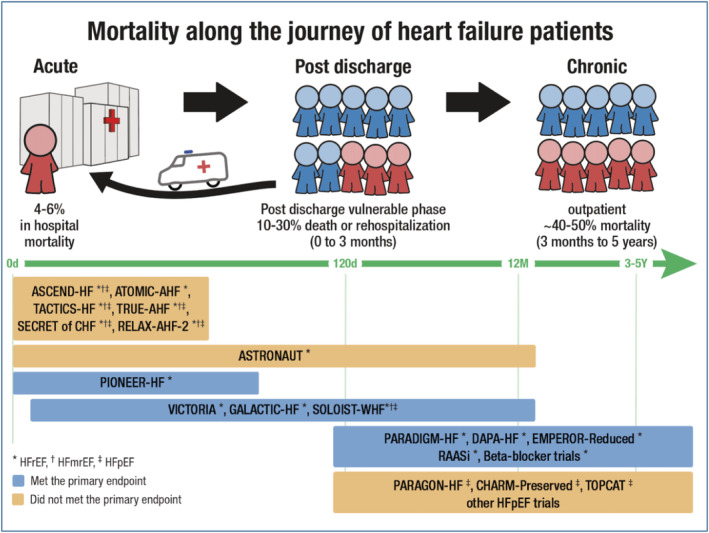
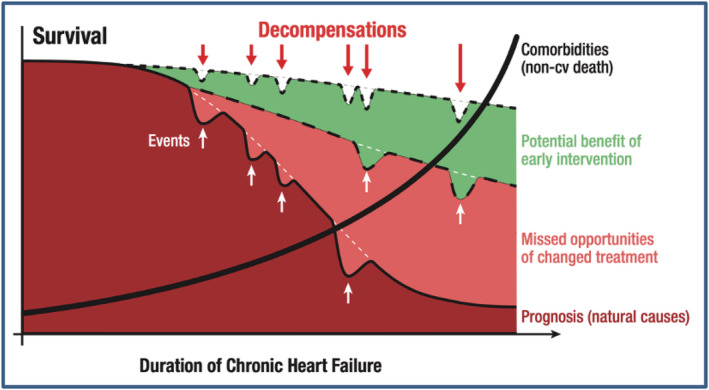
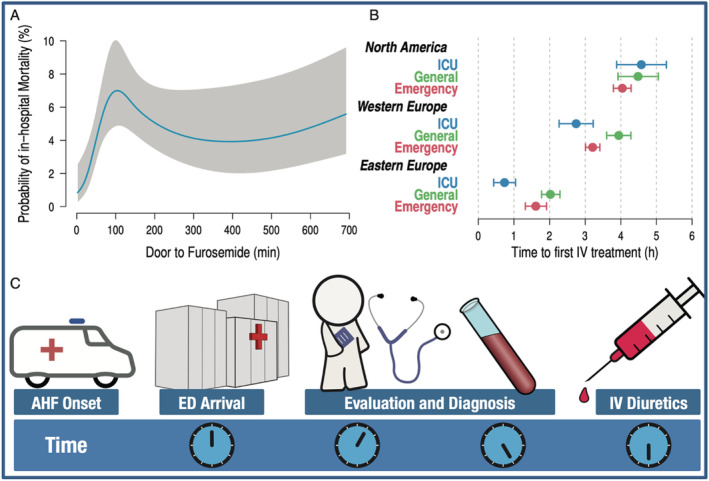
In heart failure (HF), acute decompensation can occur quickly and unexpectedly because of worsening of chronic HF or to new-onset HF diagnosed for the first time ('de novo'). Patients presenting with acute HF (AHF) have a poor prognosis comparable with those with acute myocardial infarction, and any delay of treatment initiation is associated with worse outcomes. Recent HF guidelines and recommendations have highlighted the importance of a timely diagnosis and immediate treatment for patients presenting with AHF to decrease disease progression and improve prognosis. However, based on the available data, there is still uncertainty regarding the optimal 'time-to-treatment' effect in AHF. Furthermore, the immediate post-worsening HF period plays an important role in clinical outcomes in HF patients after hospitalization and is known as the 'vulnerable phase' characterized by high risk of readmission and early death. Early and intensive treatment for HF patients in the 'vulnerable phase' might be associated with lower rates of early readmission and mortality. Additionally, in the chronic stable HF outpatient, treatments are often delayed or not initiated when symptoms are stable, ignoring the risk for adverse outcomes such as sudden death. Consequently, there is a dire need to better identify HF patients during hospitalization and after discharge and treating them adequately to improve their prognosis. HF is an urgent clinical scenario along all its stages and disease conditions. Therefore, time plays a significant role throughout the entire patient's journey. Therapy should be optimized as soon as possible, because this is beneficial regardless of severity or duration of HF. Time lavished before treatment initiation is recognized as important modifiable risk factor in HF.
在心力衰竭(HF)中,由于慢性 HF 的恶化或首次诊断为新发作的 HF(“新发”),急性失代偿可能会迅速且意外地发生。出现急性 HF(AHF)的患者预后较差,与急性心肌梗死患者相当,任何治疗开始的延迟都与更差的结果相关。最近的 HF 指南和建议强调了及时诊断和立即治疗 AHF 患者的重要性,以减少疾病进展并改善预后。然而,根据现有数据,AHF 中最佳“治疗时间”效果仍存在不确定性。此外,HF 恶化后的即刻时期在 HF 患者住院后的临床结局中起着重要作用,被称为“脆弱期”,其特征是再入院和早期死亡的风险较高。在“脆弱期”对 HF 患者进行早期和强化治疗可能与早期再入院和死亡率降低相关。此外,在慢性稳定型 HF 门诊患者中,当症状稳定时,治疗往往会延迟或未开始,忽略了不良结局(如猝死)的风险。因此,迫切需要在住院期间和出院后更好地识别 HF 患者,并对其进行充分治疗,以改善其预后。HF 是一个贯穿其所有阶段和疾病状况的紧急临床情况。因此,时间在整个患者的旅程中起着重要作用。应尽快优化治疗,因为无论 HF 的严重程度或持续时间如何,这都是有益的。在开始治疗之前浪费的时间被认为是 HF 中的一个重要可改变的风险因素。