University of Ottawa Department of Family Medicine, Telfer School of Management, Ottawa, Canada.
University of Ottawa Department of Family Medicine, Institut du Savoir Montfort, Bruyère Research Institute, Ottawa, Canada.
BMC Health Serv Res. 2021 Oct 16;21(1):1107. doi: 10.1186/s12913-021-07131-7.
COVID-19 has caused significant healthcare service disruptions. Surgical backlogs have been estimated but not for other healthcare services. This study aims to estimate the backlog of preventive care services caused by COVID-19.
This observational study assessed preventive care screening rates at three primary care clinics in Ottawa, Ontario from March to November 2020 using data from 22,685 electronic medical records. The change in cervical cancer, colorectal cancer, and type 2 diabetes screening rates were crudely estimated using 2016 census data, estimating the volume of key services delayed by COVID-19 across Ontario and Canada.
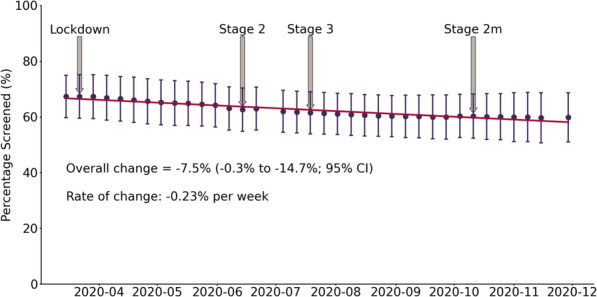
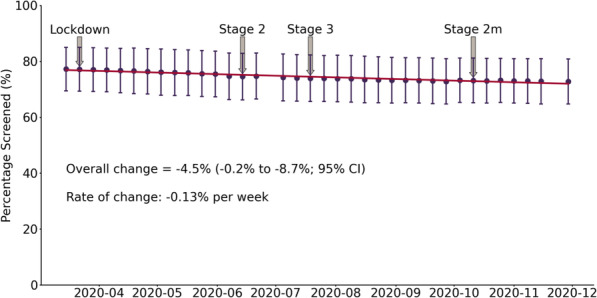
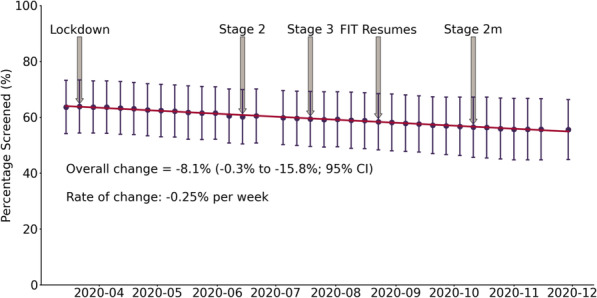
The mean percentage of patients appropriately screened for cervical cancer decreased by 7.5% (- 0.3% to - 14.7%; 95% CI), colorectal cancer decreased by 8.1% (- 0.3% to - 15.8%; 95% CI), and type 2 diabetes decreased by 4.5% (- 0.2% to - 8.7%; 95% CI). Crude estimates imply 288,000 cervical cancer (11,000 to 565,000; 95% CI), 326,000 colorectal cancer (13,000 to 638,000; 95% CI), and 274,000 type 2 diabetes screenings (13,000 to 535,000; 95% CI) may be overdue in Ontario. Nationally the deficits may be tripled these numbers. Re-opening measures have not reversed these trends.
COVID-19 decreased the delivery of preventive care services, which may cause delayed diagnoses, increased mortality, and increased health care costs. Virtual care and reopening measures have not restored the provision of preventive care services. Electronic medical record data could be leveraged to improve screening via panel management. Additional, system-wide primary care and laboratory capacity will be needed to restore pre-COVID-19 screening rates.
COVID-19 导致医疗服务严重中断。据估计,手术积压已经出现,但其他医疗服务的积压情况尚未可知。本研究旨在估计 COVID-19 导致的预防保健服务积压情况。
本观察性研究使用来自安大略省渥太华的三家初级保健诊所的 22685 份电子病历数据,评估了 2020 年 3 月至 11 月期间的预防保健筛查率。利用 2016 年人口普查数据对宫颈癌、结直肠癌和 2 型糖尿病筛查率的变化进行了粗略估计,估算了 COVID-19 对安大略省和加拿大各地关键服务的延迟量。
适当筛查宫颈癌的患者比例平均下降了 7.5%(-0.3%至-14.7%;95%CI),结直肠癌下降了 8.1%(-0.3%至-15.8%;95%CI),2 型糖尿病下降了 4.5%(-0.2%至-8.7%;95%CI)。粗略估计表明,安大略省可能有 288,000 例宫颈癌(11,000 至 565,000;95%CI)、326,000 例结直肠癌(13,000 至 638,000;95%CI)和 274,000 例 2 型糖尿病筛查(13,000 至 535,000;95%CI)可能已逾期。全国范围内,这些数字可能会增加两倍。重新开放措施并未扭转这些趋势。
COVID-19 减少了预防保健服务的提供,这可能导致诊断延迟、死亡率增加和医疗保健成本增加。虚拟护理和重新开放措施并未恢复预防保健服务的提供。可以利用电子病历数据通过面板管理来提高筛查率。此外,还需要增加全系统的初级保健和实验室能力,以恢复 COVID-19 前的筛查率。