Centre for the AIDS Programme of Research in South Africa (CAPRISA), University of KwaZulu-Natal, Durban, South Africa.
Department of Virology, School of Laboratory Medicine and Medical Sciences, University of KwaZulu-Natal and National Health Laboratory Service, Durban, South Africa.
AIDS Res Ther. 2021 Oct 16;18(1):74. doi: 10.1186/s12981-021-00393-5.
Introduction of tenofovir (TDF) plus lamivudine (3TC) and dolutegravir (DTG) in first- and second-line HIV treatment regimens in South Africa warrants characterization of acquired HIV-1 drug resistance (ADR) mutations that could impact DTG-based antiretroviral therapy (ART). In this study, we sought to determine prevalence of ADR mutations and their potential impact on susceptibility to drugs used in combination with DTG among HIV-positive adults (≥ 18 years) accessing routine care at a selected ART facility in KwaZulu-Natal, South Africa.
We enrolled adult participants in a cross-sectional study between May and September 2019. Eligible participants had a most recent documented viral load (VL) ≥ 1000 copies/mL after at least 6 months on ART. We genotyped HIV-1 reverse transcriptase and protease genes by Sanger sequencing and assessed ADR. We characterized the effect of ADR mutations on the predicted susceptibility to drugs used in combination with DTG.
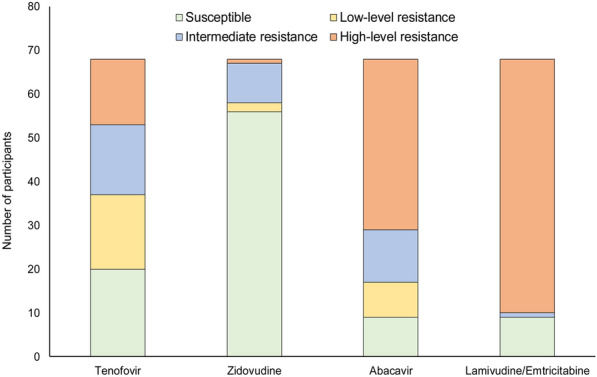
From 143 participants enrolled, we obtained sequence data for 115 (80%), and 92.2% (95% CI 85.7-96.4) had ADR. The proportion with ADR was similar for participants on first-line ART (65/70, 92.9%, 95% CI 84.1-97.6) and those on second-line ART (40/44, 90.9%, 95% CI 78.3-97.5), and was present for the single participant on third-line ART. Approximately 89% (62/70) of those on first-line ART had dual class NRTI and NNRTI resistance and only six (13.6%) of those on second-line ART had major PI mutations. Most participants (82%) with first-line viraemia maintained susceptibility to Zidovudine (AZT), and the majority of them had lost susceptibility to TDF (71%) and 3TC (84%). Approximately two in every five TDF-treated individuals had thymidine analogue mutations (TAMs).
Susceptibility to AZT among most participants with first-line viraemia suggests that a new second-line regimen of AZT + 3TC + DTG could be effective. However, atypical occurrence of TAMs in TDF-treated individuals suggests a less effective AZT + 3TC + DTG regimen in a subpopulation of patients. As most patients with first-line viraemia had at least low-level resistance to TDF and 3TC, identifying viraemia before switch to TDF + 3TC + DTG is important to avoid DTG functional monotherapy. These findings highlight a need for close monitoring of outcomes on new standardized treatment regimens.
在南非,将替诺福韦(TDF)加拉米夫定(3TC)和多替拉韦(DTG)引入一线和二线 HIV 治疗方案中,需要对可能影响基于 DTG 的抗逆转录病毒治疗(ART)的获得性 HIV-1 耐药性(ADR)突变进行特征描述。在这项研究中,我们旨在确定在南非夸祖鲁-纳塔尔省的一个选定的 ART 机构接受常规护理的 HIV 阳性成年人(≥18 岁)中,ADR 突变的流行情况及其对与 DTG 联合使用的药物的敏感性的潜在影响。
我们在 2019 年 5 月至 9 月期间进行了一项横断面研究,招募了成年参与者。合格的参与者在接受 ART 至少 6 个月后,最近的记录病毒载量(VL)≥1000 拷贝/mL。我们通过 Sanger 测序对 HIV-1 逆转录酶和蛋白酶基因进行基因分型,并评估了 ADR。我们描述了 ADR 突变对与 DTG 联合使用的药物的预测敏感性的影响。
在 143 名入组的参与者中,我们获得了 115 名(80%)的序列数据,92.2%(95%CI 85.7-96.4)存在 ADR。一线 ART 组(65/70,92.9%,95%CI 84.1-97.6)和二线 ART 组(40/44,90.9%,95%CI 78.3-97.5)的 ADR 比例相似,且三线 ART 的一名参与者也存在 ADR。大约 89%(62/70)接受一线 ART 的患者存在双重 NRTI 和 NNRTI 耐药性,而仅 6 名(13.6%)接受二线 ART 的患者存在主要 PI 突变。大多数(82%)一线病毒血症患者对齐多夫定(AZT)保持敏感性,他们中的大多数人已经失去了对 TDF(71%)和 3TC(84%)的敏感性。大约五分之二的 TDF 治疗者存在胸苷类似物突变(TAMs)。
大多数一线病毒血症患者对 AZT 的敏感性表明,新的二线 AZT+3TC+DTG 方案可能是有效的。然而,TDF 治疗者中 TAMs 的异常发生表明,在一部分患者中,AZT+3TC+DTG 方案的效果较差。由于大多数一线病毒血症患者对 TDF 和 3TC 至少有低水平的耐药性,因此在转换为 TDF+3TC+DTG 之前识别病毒血症非常重要,以避免 DTG 功能性单药治疗。这些发现强调了需要密切监测新的标准化治疗方案的结果。