Tayal Sachin, Ali Abbas, Kumar Vikrant, Jha Ashish Kumar, Gandhi Arun
Department of Nuclear Medicine, Kailash Cancer Hospital and Research Centre, Muni Seva Ashram, Vadodara, Gujarat, India.
Department of Nuclear Medicine and Molecular Imaging, Tata Memorial Hospital, Gujarat, India.
Indian J Nucl Med. 2021 Jul-Sep;36(3):282-287. doi: 10.4103/ijnm.ijnm_7_21. Epub 2021 Sep 23.
With advent of gallium-labeling somatostatin analogs and its evaluation under positron emission tomography-computed tomography, there has been a tremendous surge in its application. Gallium 68 can be made available either from onsite cyclotron production or in the form of ready-to-use Ge/Ga generators. Wherein setting up and running of cyclotron amounts to huge investment and dedicated team, the Ge/Ga generator has proved to be a better option and viable project. Moreover, due to long half-life of Ge, i.e. 271 days, it enables the usage of generator for several months. The preparation of gallium-labeled peptides is much simpler in comparison to 18F radiochemistry, but the radiation exposure has always been an area of concern owing to high-energy annihilation photon of 511 keV.
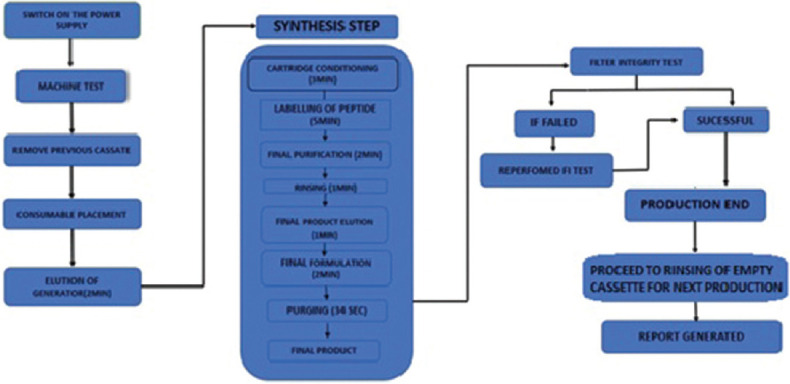
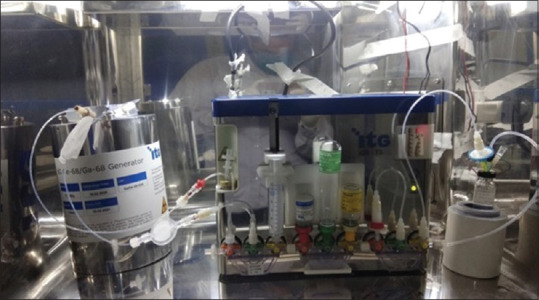
In this study, we share our experience of self-installation of Ge/Ga generator during lockdown and the various steps involved in installation of fully automated peptide-labeling system in customized mini hot cell module, synthesis steps, and quality control steps of gallium-based radiopharmaceutical.
The installation was successfully completed with online assistance during the pandemic situation. The average elution yield met company specification (>80%), and Ga-labeled peptides were prepared with high radiochemical purity (>95%). The overall exposure in single batch of production and quality control never exceeded 3 μSv as shielding was well-taken care of with customized mini hot cell.
With the described experience and validation process, one can easily think of making an installation at his/her center and cater to the needs of society with a new radiopharmaceutical.
随着镓标记生长抑素类似物的出现及其在正电子发射断层扫描-计算机断层扫描下的评估,其应用有了巨大的增长。镓68可以通过现场回旋加速器生产获得,也可以以即用型锗/镓发生器的形式获得。鉴于建立和运行回旋加速器需要巨额投资和专业团队,锗/镓发生器已被证明是一个更好的选择和可行的项目。此外,由于锗的半衰期长,即271天,这使得该发生器可以使用几个月。与18F放射化学相比,镓标记肽的制备要简单得多,但由于511keV的高能湮灭光子,辐射暴露一直是一个令人担忧的领域。
在本研究中,我们分享了在封锁期间自行安装锗/镓发生器的经验,以及在定制的小型热室模块中安装全自动肽标记系统所涉及的各个步骤、合成步骤和镓基放射性药物的质量控制步骤。
在疫情期间通过在线协助成功完成了安装。平均洗脱产率符合公司规格(>80%),并且制备的镓标记肽具有高放射化学纯度(>95%)。由于定制的小型热室对屏蔽进行了妥善处理,单批次生产和质量控制中的总体暴露从未超过3μSv。
通过上述经验和验证过程,人们可以轻松地考虑在自己的中心进行安装,并以一种新的放射性药物满足社会需求。