Ali Ferdausi, Das Sharup, Hossain Tanim Jabid, Chowdhury Sumaiya Islam, Zedny Subrina Akter, Das Tuhin, Ahmed Chowdhury Mohammad Nazmul, Uddin Mohammad Seraj
Department of Microbiology, University of Chittagong, Chattogram 4331, Bangladesh.
Department of Biochemistry and Molecular Biology, University of Chittagong, Chattogram 4331, Bangladesh.
R Soc Open Sci. 2021 Oct 13;8(10):211003. doi: 10.1098/rsos.211003. eCollection 2021 Oct.
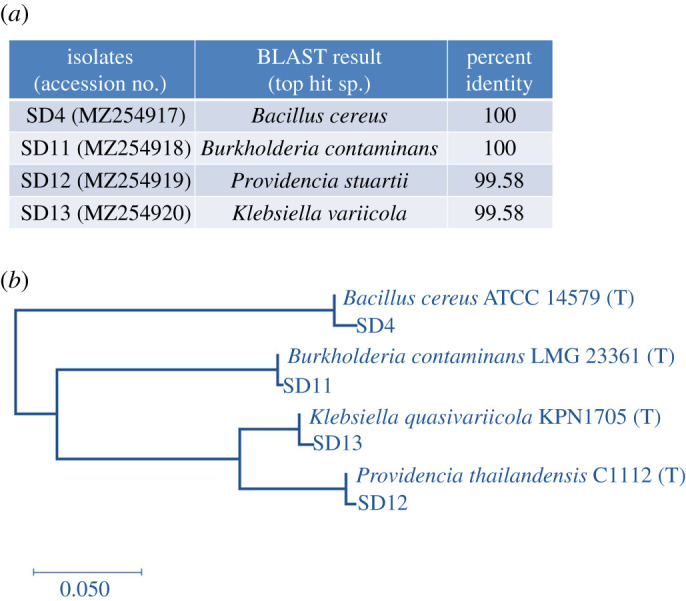
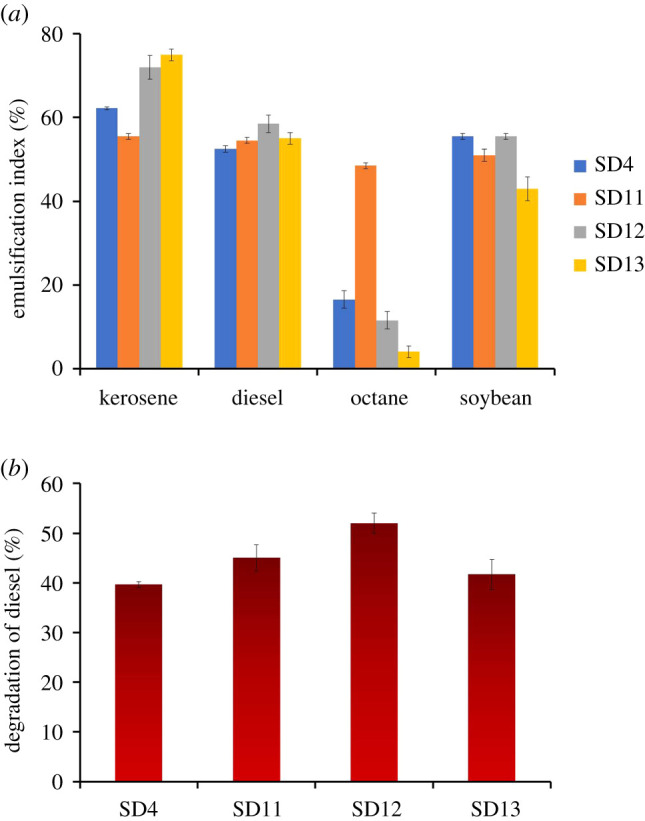
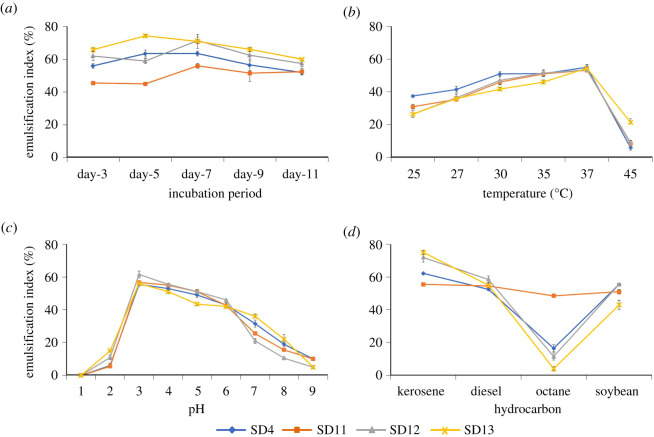
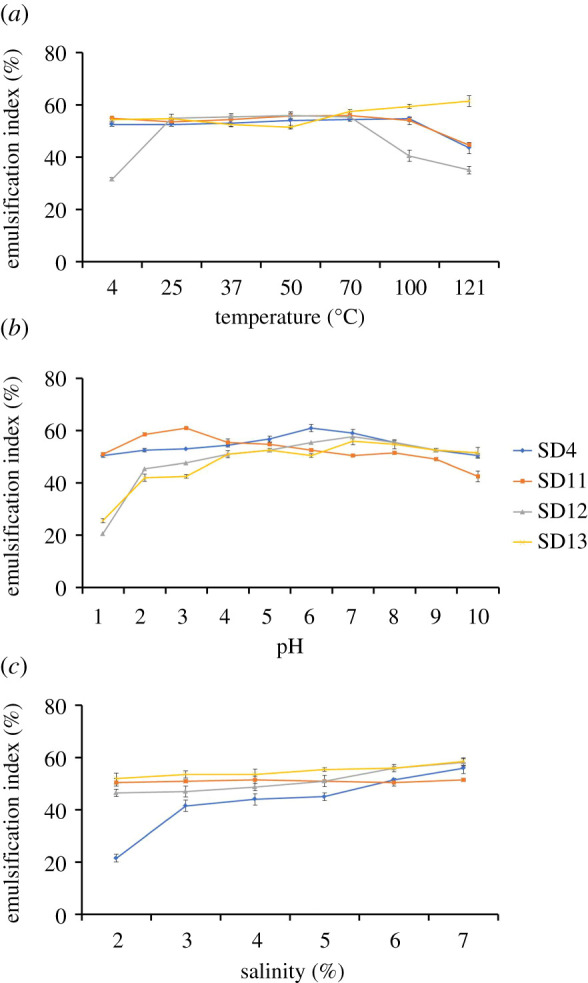
Oil pollution is of increasing concern for environmental safety and the use of microbial surfactants in oil remediation has become inevitable for their efficacy and ecofriendly nature. In this work, biosurfactants of bacteria isolated from oil-contaminated soil have been characterized. Four potent biosurfactant-producing strains (SD4, SD11, SD12 and SD13) were selected from 27 isolates based on drop collapse assay and emulsification index, and identified as species belonging to , , and , revealed from their 16S rRNA gene-based analysis. Detailed morphological and biochemical characteristics of each selected isolate were determined. Their growth conditions for maximum biosurfactant production were optimized and found quite similar among the four isolates with a pH of 3.0 and temperature 37°C after 6 or 7 days of growth on kerosene. The biosurfactants of SD4, SD11 and SD12 appeared to be glycolipids and that of SD13 a lipopeptide. Emulsification activity of most of the biosurfactants was stable at low and high temperatures (4-100°C), a wide range of pH (2-10) and salt concentrations (2-7% NaCl). Each biosurfactant showed antimicrobial activity against two or more pathogenic bacteria. The biosurfactants were well-capable of emulsifying kerosene, diesel and soya bean, and could efficiently degrade diesel.
石油污染对环境安全的影响日益受到关注,由于微生物表面活性剂的有效性和生态友好性,其在石油修复中的应用已成为必然。在这项工作中,对从石油污染土壤中分离出的细菌产生的生物表面活性剂进行了表征。基于液滴坍塌试验和乳化指数,从27株分离物中筛选出4株高效产生物表面活性剂的菌株(SD4、SD11、SD12和SD13),通过基于16S rRNA基因的分析鉴定为属于 、 、 和 的物种。确定了每个选定分离物的详细形态和生化特征。优化了它们产生最大量生物表面活性剂的生长条件,发现在煤油上生长6或7天后,这4株分离物的生长条件非常相似,pH为3.0,温度为37°C。SD4、SD11和SD12产生的生物表面活性剂似乎是糖脂,而SD13产生的是脂肽。大多数生物表面活性剂的乳化活性在低温和高温(4-100°C)、宽pH范围(2-10)和盐浓度(2-7% NaCl)下都很稳定。每种生物表面活性剂对两种或更多种病原菌都表现出抗菌活性。这些生物表面活性剂具有良好的乳化煤油、柴油和大豆油的能力,并且能够有效地降解柴油。