Gillé Vera, Kerkhoff Denise, Heim-Dreger Uwe, Kohlmann Carl-Walter, Lohaus Arnold, Eschenbeck Heike
Department of Psychology, University of Education Schwäbisch Gmünd, Schwäbisch Gmünd, Germany.
Department of Psychology, University of Konstanz, Konstanz, Germany.
Health Psychol Behav Med. 2021 Oct 14;9(1):875-894. doi: 10.1080/21642850.2021.1990062. eCollection 2021.
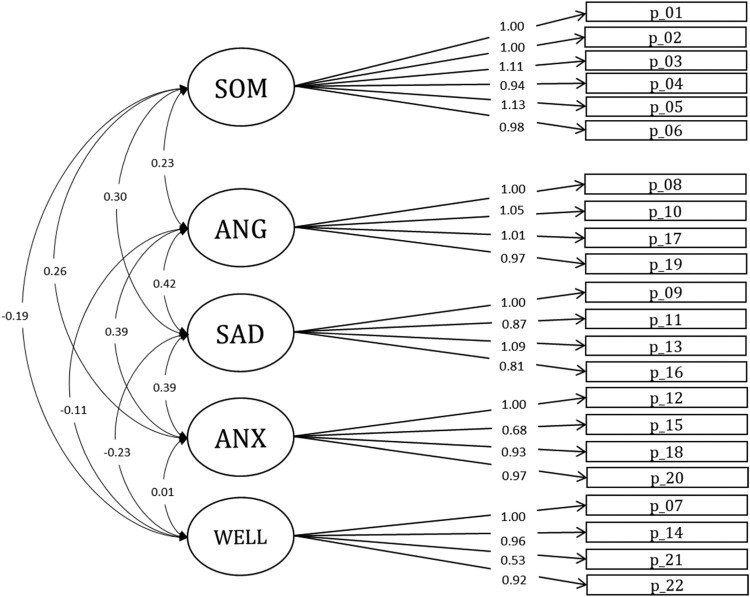
The present cross-cultural study examined the factor structure, measurement invariance, and convergent validity of the Stress-Symptom and Well-Being Scales from the Stress and Coping Questionnaire for Children and Adolescents (SSKJ), originally in German, across gender and for five newly developed language versions: English, French, Russian, Spanish, and Ukrainian.
Children and adolescents ( = 5,227) from Germany, France, Russia, the Dominican Republic, Ukraine, and several English-speaking countries participated in the survey study.
The SSKJ Stress-Symptom and Well-Being Scales capture stress symptomatology and well-being with five subscales: Somatic Symptoms, Anger, Sadness, Anxiety, and Well-Being. The Strengths and Difficulties Questionnaire (SDQ) was used for validation.
The factorial structure (five factors) was confirmed. In multi-group comparisons, confirmatory factor analyses showed partial metric invariance across the different languages. Regarding gender, results showed scalar invariance for all languages, except for Spanish. Gender differences were shown with girls scoring higher on somatic symptoms, sadness, anxiety (German-, French-, Russian-speaking samples), anger (French), and well-being (German, Ukrainian). Correlations with indicators of mental health and behavioral problems demonstrated convergent validity.
The SSKJ Stress-Symptom and Well-Being Scales showed psychometric evidence for equivalence across the different languages and gender. Thus, this instrument is a useful tool for cross-cultural research in children and adolescents.
本跨文化研究考察了最初为德语的《儿童和青少年压力与应对问卷》(SSKJ)中的压力症状与幸福感量表在性别间以及五个新开发语言版本(英语、法语、俄语、西班牙语和乌克兰语)中的因子结构、测量不变性和收敛效度。
来自德国、法国、俄罗斯、多米尼加共和国、乌克兰和几个英语国家的儿童和青少年(n = 5227)参与了这项调查研究。
SSKJ压力症状与幸福感量表通过五个子量表来衡量压力症状和幸福感:躯体症状、愤怒、悲伤、焦虑和幸福感。使用优势与困难问卷(SDQ)进行效度验证。
确认了因子结构(五个因子)。在多组比较中,验证性因子分析表明不同语言间存在部分度量不变性。在性别方面,结果显示除西班牙语外,所有语言均具有标量不变性。女孩在躯体症状、悲伤、焦虑(德语、法语、俄语样本)、愤怒(法语)和幸福感(德语、乌克兰语)方面得分更高,显示出性别差异。与心理健康和行为问题指标的相关性证明了收敛效度。
SSKJ压力症状与幸福感量表显示出不同语言和性别间等效性的心理测量学证据。因此,该工具是儿童和青少年跨文化研究的有用工具。