Mundodan Jesha Mohammedali, K K Lamiya, Haveri Sheela P
Department of Community Medicine, Perinthalmanna, Kerala, India.
J Family Med Prim Care. 2021 Aug;10(8):2845-2852. doi: 10.4103/jfmpc.jfmpc_2313_20. Epub 2021 Aug 27.
Domestic violence has substantial public health consequences. More than one-third of women globally suffer from physical and sexual violence, mostly by an intimate partner with a lifetime prevalence of 10%-69%. In India, 28.8% of the ever-married women in the reproductive age group, reported domestic violence. Although Kerala, in southern India, performs better than other Indian states on a host of human development indicators for women, 15.8% among the women in this group have ever experienced physical or sexual violence in the past 12 months, the most common perpetrator being the husband.
A community-based cross-sectional study was carried out among the ever-married women, residing in a selected area of northern Kerala, who have been married for at least 1 year. One to one structured interview was conducted with a pretested structured questionnaire by the investigator. Spousal violence was defined as proportion of ever-married women with a lifetime experience of violence perpetrated by their spouse, manifested through acts of physical, sexual, and/or emotional violence, even threat.
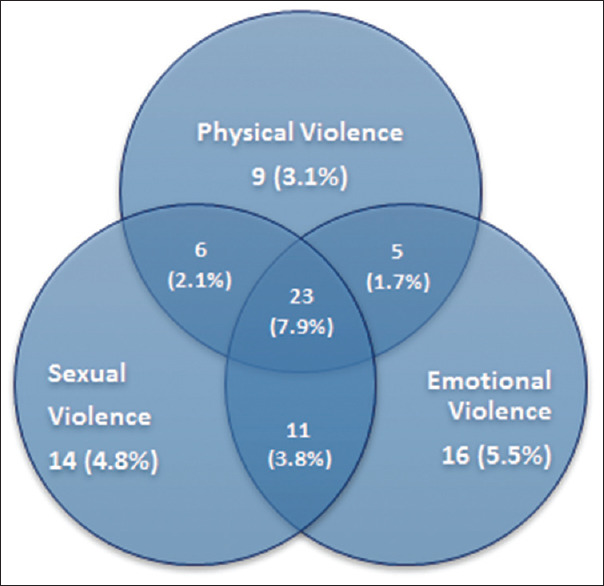
A total of 290 women were interviewed. The age of the participants ranged from 18 years to 64 years; majority were Muslims. Only 16.5% were college-educated and over 90% were homemakers. 29% reported having experienced spousal violence; with the most common being emotional violence (19%) closely followed by sexual violence (18.6%) and physical violence (14.8%). A little over one-third (39.7%) reported controlling behaviour of their husband. Age of the participant ( = 0.019), absence of social support ( = 0.034), employment status of husband ( = 0.026), controlling behaviour of husband ( < 0.001), alcohol abuse by husband ( = 0.004) and extra-marital relationship of spouse ( < 0.001) were found to have significant influence on spousal violence experience.
More than a quarter of the married women in this rural setting have experienced one or the other form of violence.
A multifaceted approach needs to be employed which takes into consideration legal measures, social sciences, women empowerment, mental health systems and educate the men to curb this menace.
家庭暴力对公众健康有重大影响。全球超过三分之一的女性遭受身体和性暴力,大部分是由亲密伴侣实施,终生患病率为10%-69%。在印度,28.8%的育龄已婚女性报告遭受过家庭暴力。尽管印度南部的喀拉拉邦在一系列女性人类发展指标方面表现优于其他印度邦,但该群体中有15.8%的女性在过去12个月内曾遭受身体或性暴力,最常见的施暴者是丈夫。
在喀拉拉邦北部一个选定地区对已婚至少1年的已婚女性进行了一项基于社区的横断面研究。研究者使用预先测试过的结构化问卷进行一对一的结构化访谈。配偶暴力定义为有过配偶实施暴力经历的已婚女性比例,表现为身体、性和/或情感暴力行为,甚至威胁。
共访谈了290名女性。参与者年龄在18岁至64岁之间;大多数是穆斯林。只有16.5%受过大学教育,超过90%是家庭主妇。29%的人报告曾遭受配偶暴力;最常见的是情感暴力(19%),其次是性暴力(18.6%)和身体暴力(14.8%)。略超过三分之一(39.7%)的人报告丈夫有控制行为。发现参与者年龄(=0.019)、缺乏社会支持(=0.034)、丈夫的就业状况(=0.026)、丈夫的控制行为(<0.001)、丈夫酗酒(=0.004)和配偶的婚外情(<0.001)对配偶暴力经历有显著影响。
在这个农村地区,超过四分之一的已婚女性经历过一种或另一种形式的暴力。
需要采用多方面的方法,考虑法律措施、社会科学、妇女赋权、心理健康系统,并教育男性遏制这种威胁。