Samari Goleen, Nagle Amanda, Coleman-Minahan Kate
Heilbrunn Department of Population and Family Health, Mailman School of Public Health, Columbia University, New York, NY, USA.
College of Nursing, University of Colorado Anschutz Medical Campus, Denver, CO, USA.
SSM Popul Health. 2021 Oct 2;16:100938. doi: 10.1016/j.ssmph.2021.100938. eCollection 2021 Dec.
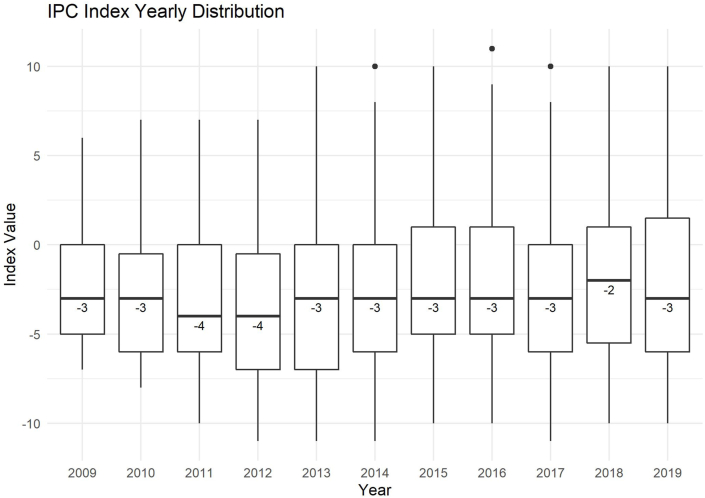
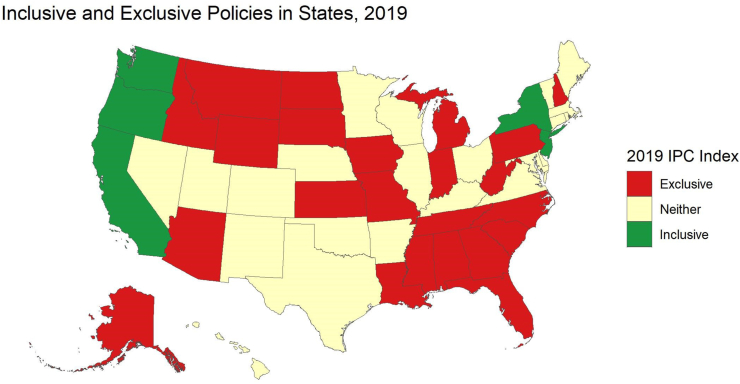
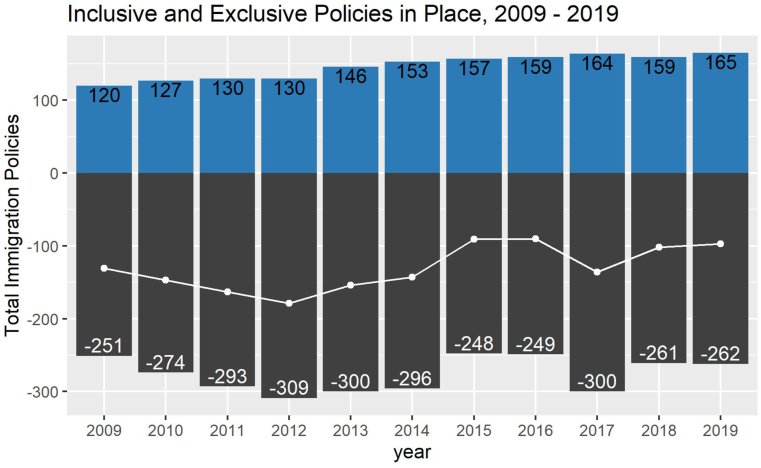
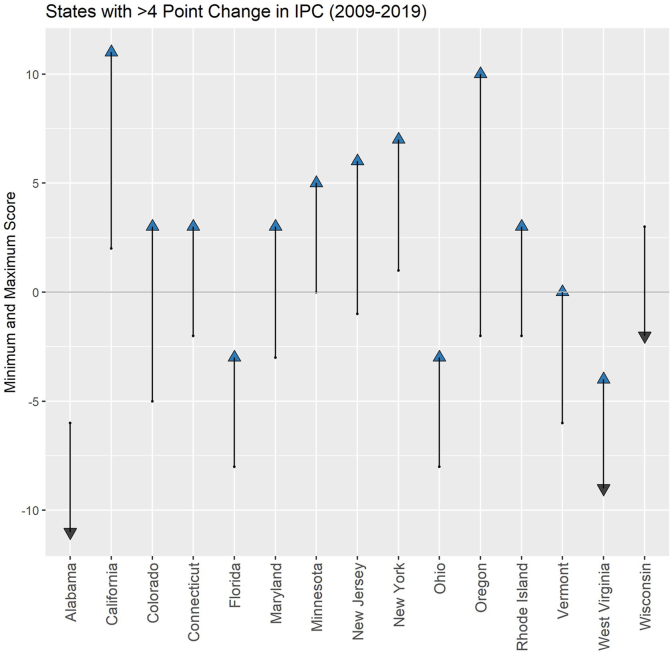
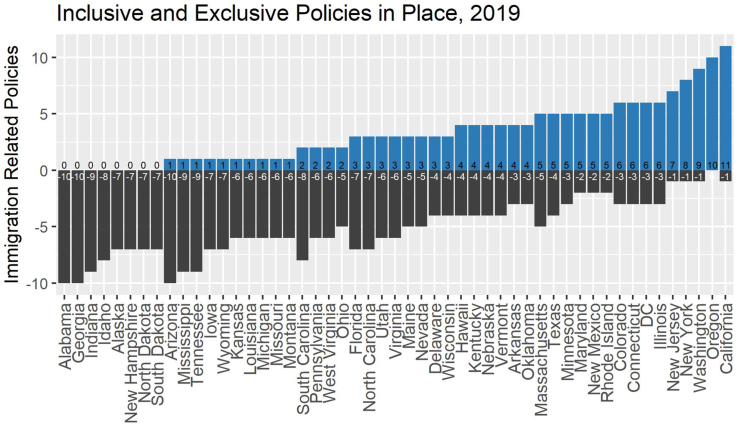
There is an increasing need to understand the structural drivers of immigrant health inequities, including xenophobic and racist policies at the state level in the United States. Databases aggregate state policies related to immigration and research using single year indices examines state policy and immigrant health. Yet none of these sources use a theoretically informed social determinants of immigrant health approach to consider state environments longitudinally, include both exclusionary and inclusionary policies, and are relevant to immigrants from any region of the world or ethnic group. Using an established social determinants of immigrant health framework, a measure of structural xenophobia was created using fourteen policies across five domains: access to public health benefits, higher education, labor and employment, driver's licenses and identification, and immigration enforcement over a ten-year period (2009-2019). To create the Immigration Policy Climate (IPC) index, we used data from state legislatures as well as policy databases from foundations, advocacy organizations, and scholarly articles. We identified and coded 714 US state policies across the 50 US States and the District of Columbia from 2009 to 2019. We calculated annual IPC index scores (range: 12 - 12) as a continuous measure (negative scores: exclusionary; positive scores: inclusionary). Results show that the US has an exclusionary immigration policy climate at the state-level (mean IPC score of -2.5). From 2009 to 2019, two-thirds of state-level immigration policies are exclusionary towards immigrants. About 75% of states experienced a 4-point change or less on the IPC index, and no state changed from largely exclusive to largely inclusive. By aggregating comprehensive, detailed data and a measure of state-level immigration policies over time, the IPC index provides population health researchers with rigorous evidence with which to assess structural xenophobia and an opportunity for longitudinal research on health inequities and immigrant health.
越来越有必要了解移民健康不平等的结构性驱动因素,包括美国州一级的仇外和种族主义政策。数据库汇总了与移民相关的州政策,并且使用单年指数的研究考察了州政策与移民健康。然而,这些来源均未采用从理论上深入理解的移民健康社会决定因素方法来纵向考量州环境,纳入排外和包容政策,也未涉及来自世界任何地区或种族群体的移民。利用既定的移民健康社会决定因素框架,通过五项领域的十四项政策创建了一项结构性仇外心理衡量指标,这五项领域包括获得公共卫生福利、高等教育、劳动与就业、驾照与身份识别以及十年期间(2009 - 2019年)的移民执法。为了创建移民政策气候(IPC)指数,我们使用了来自州立法机构的数据以及基金会、倡导组织和学术文章的政策数据库。我们识别并编码了2009年至2019年美国50个州和哥伦比亚特区的714项州政策。我们将年度IPC指数得分(范围:12 - 12)计算为一项连续指标(负得分:排外;正得分:包容)。结果显示,美国在州一级存在排外的移民政策气候(IPC平均得分为 -2.5)。2009年至2019年,三分之二的州一级移民政策对移民具有排他性。约75%的州在IPC指数上的变化为4分或更小,并且没有一个州从主要排外转变为主要包容。通过汇总全面、详细的数据以及对州一级移民政策的长期衡量,IPC指数为人口健康研究人员提供了用以评估结构性仇外心理的严谨证据,以及对健康不平等和移民健康进行纵向研究的机会。