Alarid-Escudero Fernando, Gracia Valeria, Luviano Andrea, Roa Jorge, Peralta Yadira, Reitsma Marissa B, Claypool Anneke L, Salomon Joshua A, Studdert David M, Andrews Jason R, Goldhaber-Fiebert Jeremy D
Division of Public Administration, Center for Research and Teaching in Economics (CIDE), Aguascalientes, Mexico.
Center for Research and Teaching in Economics (CIDE), Aguascalientes, Mexico.
MDM Policy Pract. 2021 Oct 11;6(2):23814683211049249. doi: 10.1177/23814683211049249. eCollection 2021 Jul-Dec.
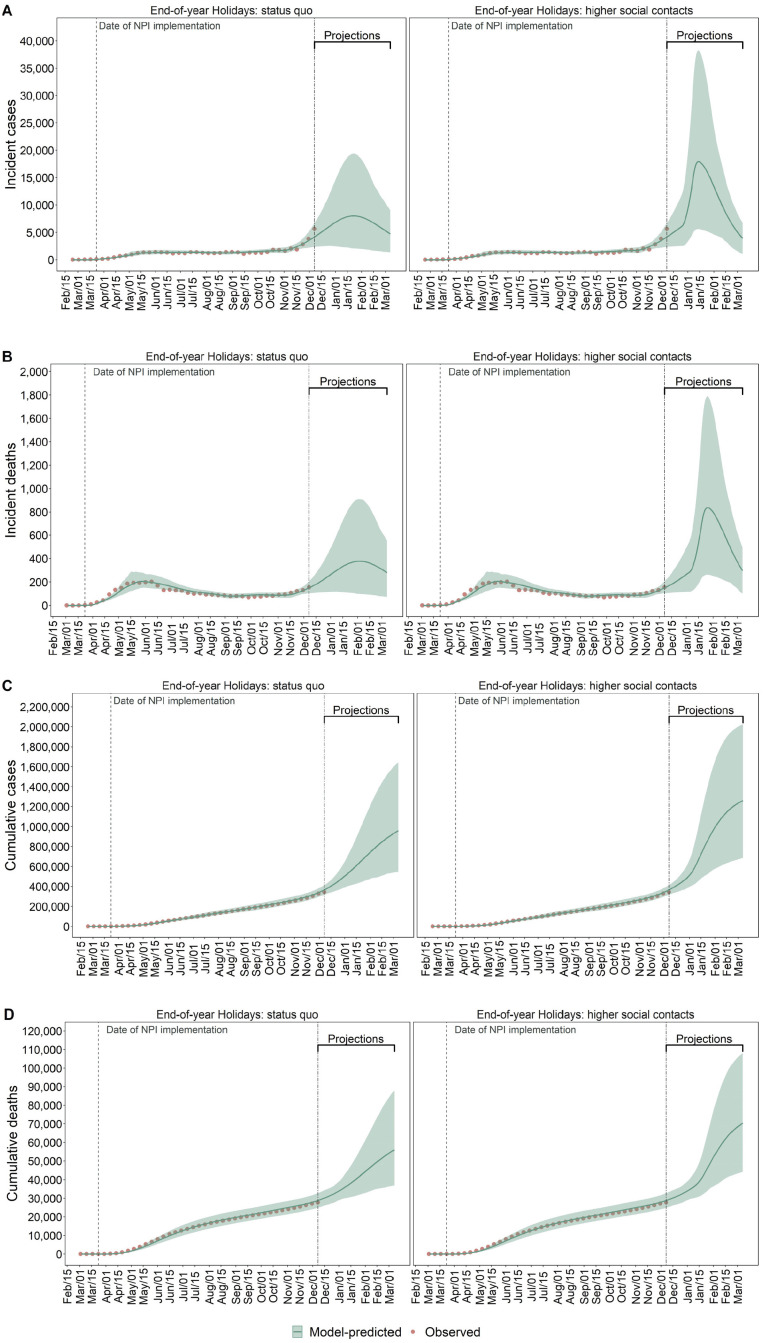
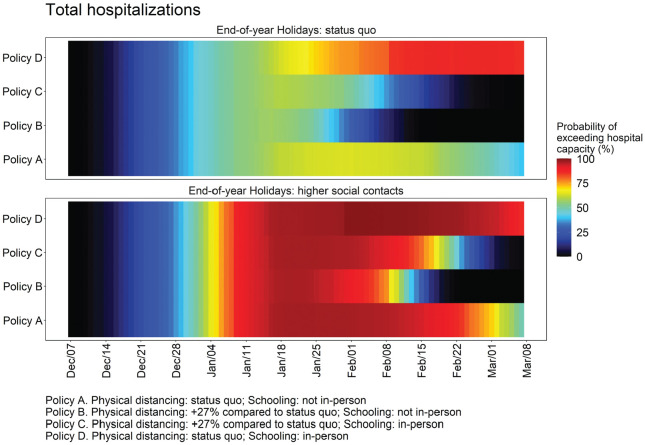
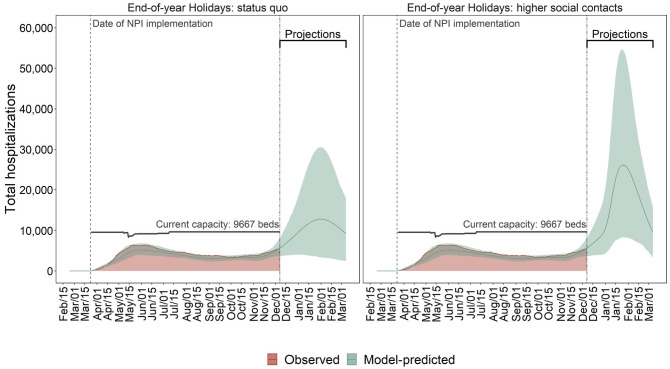
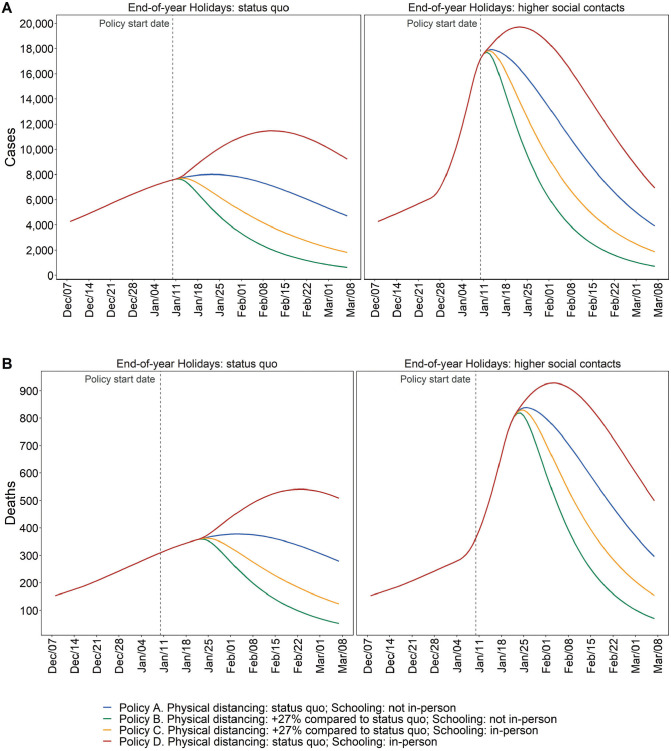
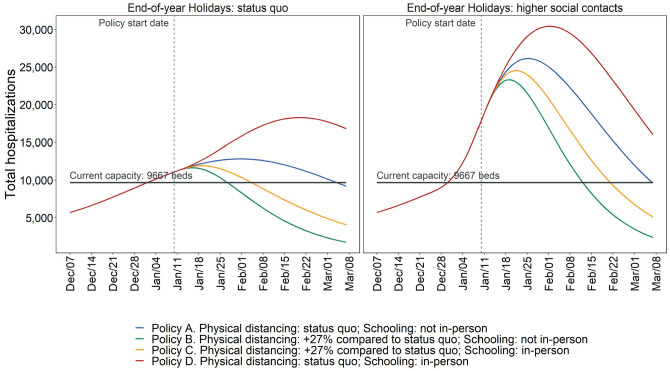
Mexico City Metropolitan Area (MCMA) has the largest number of COVID-19 (coronavirus disease 2019) cases in Mexico and is at risk of exceeding its hospital capacity in early 2021. We used the Stanford-CIDE Coronavirus Simulation Model (SC-COSMO), a dynamic transmission model of COVID-19, to evaluate the effect of policies considering increased contacts during the end-of-year holidays, intensification of physical distancing, and school reopening on projected confirmed cases and deaths, hospital demand, and hospital capacity exceedance. Model parameters were derived from primary data, literature, and calibrated. Following high levels of holiday contacts even with no in-person schooling, MCMA will have 0.9 million (95% prediction interval 0.3-1.6) additional COVID-19 cases between December 7, 2020, and March 7, 2021, and hospitalizations will peak at 26,000 (8,300-54,500) on January 25, 2021, with a 97% chance of exceeding COVID-19-specific capacity (9,667 beds). If MCMA were to control holiday contacts, the city could reopen in-person schools, provided they increase physical distancing with 0.5 million (0.2-0.9) additional cases and hospitalizations peaking at 12,000 (3,700-27,000) on January 19, 2021 (60% chance of exceedance). MCMA must increase COVID-19 hospital capacity under all scenarios considered. MCMA's ability to reopen schools in early 2021 depends on sustaining physical distancing and on controlling contacts during the end-of-year holiday.
墨西哥城大都市区(MCMA)是墨西哥新冠肺炎(2019冠状病毒病)病例最多的地区,有在2021年初超出其医院收治能力的风险。我们使用了斯坦福-国际疾病动态合作中心冠状病毒模拟模型(SC-COSMO),这是一个新冠肺炎的动态传播模型,来评估考虑到年末假期期间接触增加、强化物理距离措施以及学校重新开学等政策对预计确诊病例和死亡人数、医院需求以及医院收治能力超支情况的影响。模型参数来自原始数据、文献并经过校准。即使没有面对面授课,在假期接触水平较高的情况下,2020年12月7日至2021年3月7日期间,墨西哥城大都市区将新增90万例(95%预测区间为30万 - 160万)新冠肺炎病例,住院人数将于2021年1月25日达到峰值26000例(8300 - 54500例),有97%的可能性超出新冠肺炎特定收治能力(9667张床位)。如果墨西哥城大都市区能够控制假期接触,该市可以重新开展面对面授课,前提是增加物理距离措施,这样将新增50万例(20万 - 90万)病例,住院人数于2021年1月19日达到峰值12000例(3700 - 27000例)(超支概率为60%)。在所有考虑的情景下,墨西哥城大都市区都必须增加新冠肺炎医院收治能力。墨西哥城大都市区在2021年初重新开学的能力取决于维持物理距离措施以及控制年末假期期间的接触。