Stein-O'Brien Genevieve L, Ainsile Michaela C, Fertig Elana J
Department of Oncology, Division of Biostatistics and Bioinformatics, Sidney Kimmel Comprehensive Cancer Center, Johns Hopkins School of Medicine, Baltimore, MD.
Department of Neuroscience, Johns Hopkins School of Medicine, Baltimore, MD.
Curr Opin Syst Biol. 2021 Jun;26:24-32. doi: 10.1016/j.coisb.2021.03.008. Epub 2021 Apr 3.
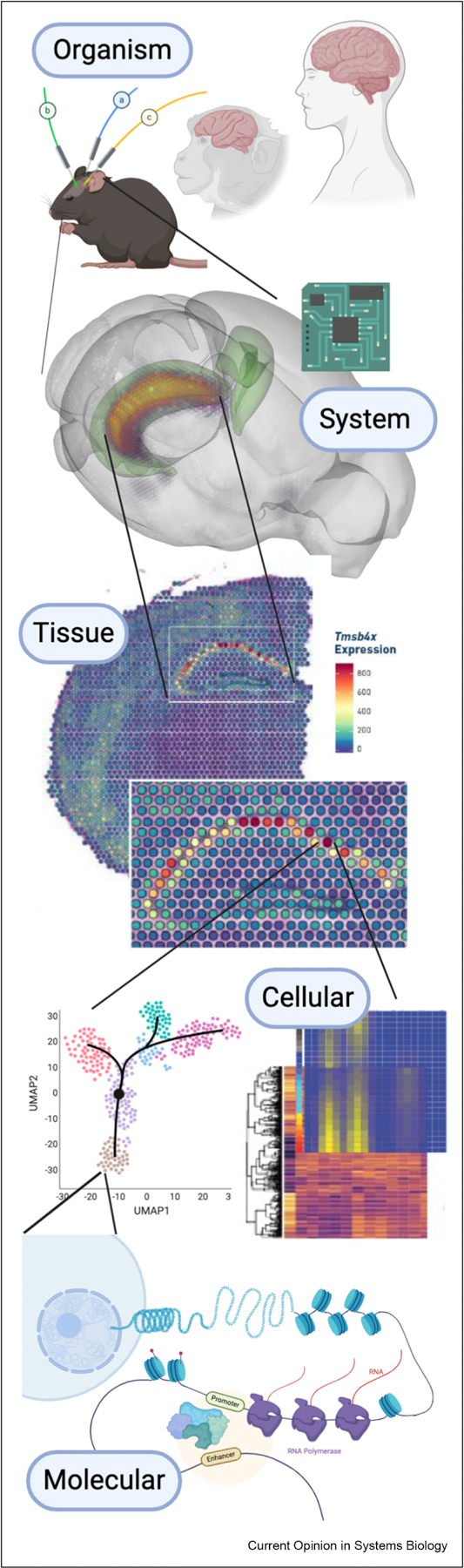
As the single cell field races to characterize each cell type, state, and behavior, the complexity of the computational analysis approaches the complexity of the biological systems. Single cell and imaging technologies now enable unprecedented measurements of state transitions in biological systems, providing high-throughput data that capture tens-of-thousands of measurements on hundreds-of-thousands of samples. Thus, the definition of cell type and state is evolving to encompass the broad range of biological questions now attainable. To answer these questions requires the development of computational tools for integrated multi-omics analysis. Merged with mathematical models, these algorithms will be able to forecast future states of biological systems, going from statistical inferences of phenotypes to time course predictions of the biological systems with dynamic maps analogous to weather systems. Thus, systems biology for forecasting biological system dynamics from multi-omic data represents the future of cell biology empowering a new generation of technology-driven predictive medicine.
随着单细胞领域竞相描述每种细胞类型、状态和行为,计算分析的复杂性已接近生物系统的复杂性。单细胞和成像技术如今能够以前所未有的方式测量生物系统中的状态转变,提供高通量数据,这些数据能对数以十万计的样本进行数以万计的测量。因此,细胞类型和状态的定义正在不断演变,以涵盖目前能够实现的广泛生物学问题。要回答这些问题,需要开发用于综合多组学分析的计算工具。与数学模型相结合,这些算法将能够预测生物系统的未来状态,从表型的统计推断发展到利用类似于气象系统的动态图谱对生物系统进行时程预测。因此,基于多组学数据预测生物系统动态的系统生物学代表了细胞生物学的未来,为新一代技术驱动的精准医学提供支持。