Psychiatry and Psychology Research Center, Roozbeh Hospital, Tehran University of Medical Sciences, Tehran, Iran.
Department of Psychiatry, Roozbeh Hospital, Tehran University of Medical Sciences, Tehran, Iran.
Brain Behav. 2021 Nov;11(11):e2394. doi: 10.1002/brb3.2394. Epub 2021 Oct 17.
Vitamin B6 has been linked to a variety of probable roles, including anti-inflammatory, homocysteine-lowering, serotonin-regulating, and dopamine-lowering. In this study, we investigated the possible effect of vitamin B6 on bipolar disorder in manic episode with psychotic feature in a placebo-controlled double-blind clinical trial in a psychiatric hospital.
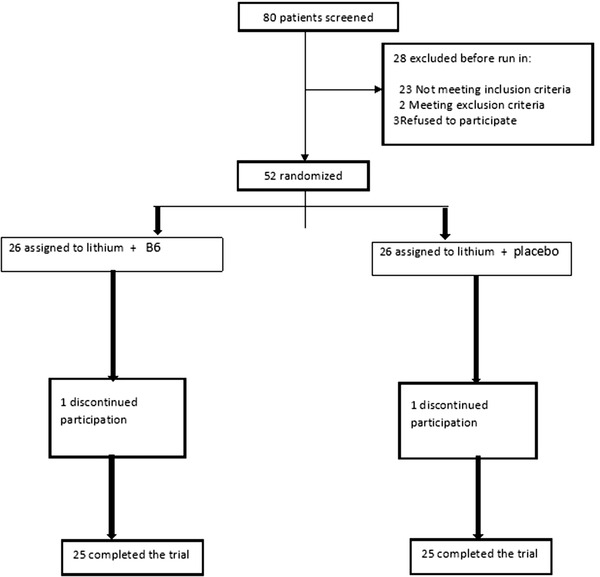
This study was performed on 50 patients who were equally divided into two groups (each group included 25 patients) using 80 mg of vitamin B6 daily or placebo. At the beginning and end of the study, they were evaluated for lab tests, inflammatory biomarkers and level of blood homocysteine. Also, at the baseline and in weeks 2, 4, and 8, they were evaluated based on the anthropometric measurements, score obtained from the Young Mania Questionnaire, Mini-Mental State Examination (MMSE), and the Pittsburgh Sleep Questionnaire.
Accordingly, based on Yang Mania scoring scale, no significant difference was observed between the two groups receiving vitamin B6 and placebo (22.68 ± 5.39 vs. 21.80 ± 5.39 [p-value = .51]). Based on MMSE, significant improvement in cognitive status was obtained in group placebo compared to vitamin B6 group (25.24 ± 1.96 vs. 24.40 ± 3.25, respectively [p-value = .01]). At the Pittsburg scale (total, there was no statistically significant difference between the two groups receiving vitamin B6 and placebo (1.04 ± 0.20 vs. 0.48 ± 0.50 [p-value = .23]). Additionally, no significant difference was observed between the two groups regarding the anthropometric status.
According to this study, the daily dose of 80 mg of vitamin B6 for 8 weeks in patients with bipolar disorder in the manic episode with psychotic feature treated daily with lithium, was not associated with a significant improvement in mood status compared to the control-placebo group. It is recommended to perform similar studies in a multi-center manner with a larger sample size and longer duration.
维生素 B6 与多种可能的作用有关,包括抗炎、降低同型半胱氨酸、调节 5-羟色胺和降低多巴胺。在这项研究中,我们在一家精神病院进行了一项安慰剂对照双盲临床试验,研究了维生素 B6 对伴有精神病特征的躁狂发作双相情感障碍的可能影响。
这项研究共纳入了 50 名患者,将他们平均分为两组(每组 25 名患者),一组每天给予 80mg 维生素 B6,另一组给予安慰剂。在研究开始和结束时,对他们进行实验室检查、炎症生物标志物和血液同型半胱氨酸水平评估。此外,在基线和第 2、4 和 8 周时,根据青年躁狂症问卷评分、简易精神状态检查(MMSE)和匹兹堡睡眠问卷,对他们进行评估。
根据杨氏躁狂评分量表,接受维生素 B6 和安慰剂治疗的两组之间没有显著差异(22.68±5.39 与 21.80±5.39 [p 值=0.51])。根据 MMSE,与维生素 B6 组相比,安慰剂组的认知状态有显著改善(25.24±1.96 与 24.40±3.25,p 值=0.01)。在匹兹堡量表(总分)方面,接受维生素 B6 和安慰剂治疗的两组之间没有统计学上的显著差异(1.04±0.20 与 0.48±0.50,p 值=0.23)。此外,两组在人体测量学状态方面也没有显著差异。
根据这项研究,与安慰剂对照组相比,每日 80mg 剂量的维生素 B6 连续 8 周治疗伴有精神病特征的躁狂发作双相情感障碍患者,每日服用锂盐,与情绪状态的显著改善无关。建议以多中心方式进行类似的研究,样本量更大,持续时间更长。