Kumar Antul, Choudhary Anuj, Kaur Harmanjot, Mehta Sahil, Husen Azamal
Department of Botany, Punjab Agricultural University, Ludhiana, 141004, India.
International Centre for Genetic Engineering and Biotechnology, Aruna Asaf Ali Marg, New Delhi, 110067, India.
Nanoscale Res Lett. 2021 Oct 18;16(1):156. doi: 10.1186/s11671-021-03612-0.
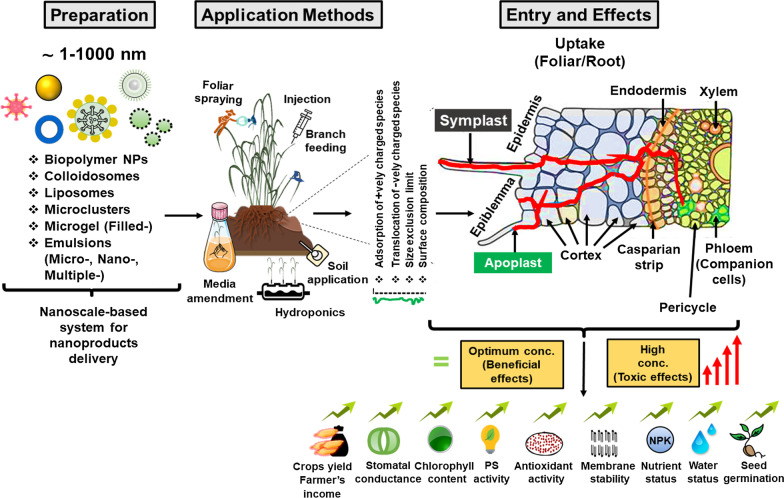
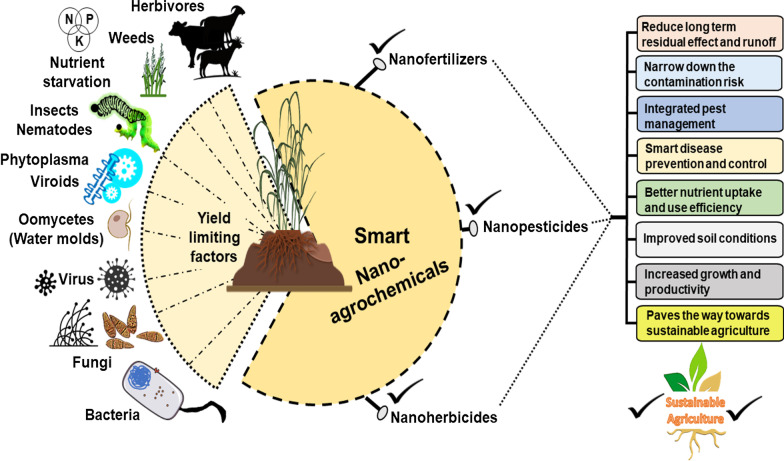
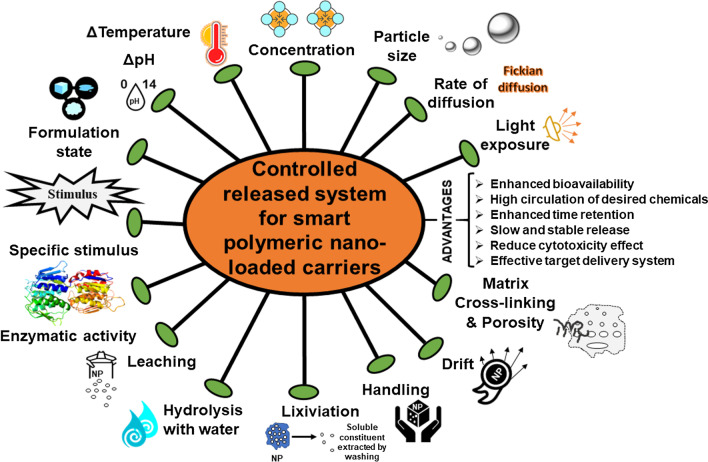
Conventional agriculture solely depends upon highly chemical compounds that have negatively ill-affected the health of every living being and the entire ecosystem. Thus, the smart delivery of desired components in a sustainable manner to crop plants is the primary need to maintain soil health in the upcoming years. The premature loss of growth-promoting ingredients and their extended degradation in the soil increases the demand for reliable novel techniques. In this regard, nanotechnology has offered to revolutionize the agrotechnological area that has the imminent potential over conventional agriculture and helps to reform resilient cropping systems withholding prominent food security for the ever-growing world population. Further, in-depth investigation on plant-nanoparticles interactions creates new avenues toward crop improvement via enhanced crop yield, disease resistance, and efficient nutrient utilization. The incorporation of nanomaterial with smart agrochemical activities and establishing a new framework relevant to enhance efficacy ultimately help to address the social acceptance, potential hazards, and management issues in the future. Here, we highlight the role of nanomaterial or nanocomposite as a sustainable as well stable alternative in crop protection and production. Additionally, the information on the controlled released system, role in interaction with soil and microbiome, the promising role of nanocomposite as nanopesticide, nanoherbicide, nanofertilizer, and their limitations in agrochemical activities are discussed in the present review.
传统农业完全依赖于高化学化合物,这些化合物对每一个生物的健康和整个生态系统都产生了负面影响。因此,以可持续的方式向作物智能输送所需成分是未来几年维持土壤健康的首要需求。促进生长成分的过早流失及其在土壤中的长期降解增加了对可靠新技术的需求。在这方面,纳米技术有望彻底改变农业技术领域,其潜力超过传统农业,并有助于改革有弹性的种植系统,为不断增长的世界人口提供突出的粮食安全保障。此外,对植物与纳米颗粒相互作用的深入研究为通过提高作物产量、抗病性和有效养分利用来改良作物开辟了新途径。将具有智能农用化学活性的纳米材料纳入并建立一个与提高功效相关的新框架,最终有助于解决未来的社会接受度、潜在危害和管理问题。在此,我们强调纳米材料或纳米复合材料在作物保护和生产中作为一种可持续且稳定的替代品的作用。此外,本综述还讨论了控释系统的信息、其在与土壤和微生物群落相互作用中的作用、纳米复合材料作为纳米农药、纳米除草剂、纳米肥料的前景作用及其在农用化学活性方面的局限性。