Centre for Heart Muscle Disease, Institute of Cardiovascular Science, University College London, London, United Kingdom; Molecular and Clinical Sciences Research Institute, St George's University of London, London, United Kingdom.
Regional Molecular Genetics Laboratory, Great Ormond Street Hospital for Children, London, United Kingdom.
J Lipid Res. 2021;62:100139. doi: 10.1016/j.jlr.2021.100139. Epub 2021 Oct 16.
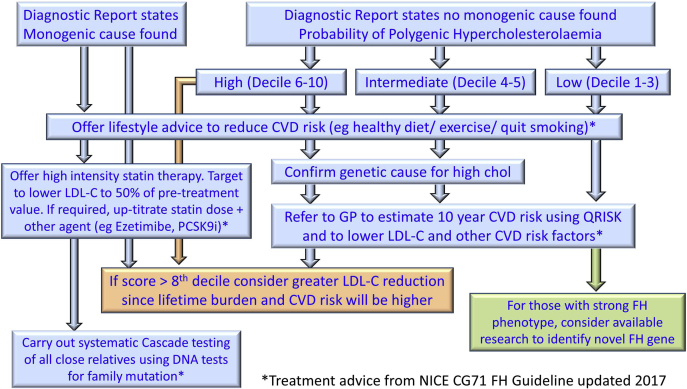
In the early 1980s, the Nobel Prize winning cellular and molecular work of Mike Brown and Joe Goldstein led to the identification of the LDL receptor gene as the first gene where mutations cause the familial hypercholesterolemia (FH) phenotype. We now know that autosomal dominant monogenic FH can be caused by pathogenic variants of three additional genes (APOB/PCSK9/APOE) and that the plasma LDL-C concentration and risk of premature coronary heart disease differs according to the specific locus and associated molecular cause. It is now possible to use next-generation sequencing to sequence all exons of all four genes, processing 96 patient samples in one sequencing run, increasing the speed of test results, and reducing costs. This has resulted in the identification of not only many novel FH-causing variants but also some variants of unknown significance, which require further evidence to classify as pathogenic or benign. The identification of the FH-causing variant in an index case can be used as an unambiguous and rapid test for other family members. An FH-causing variant can be found in 20-40% of patients with the FH phenotype, and we now appreciate that in the majority of patients without a monogenic cause, a polygenic etiology for their phenotype is highly likely. Compared with those with a monogenic cause, these patients have significantly lower risk of future coronary heart disease. The use of these molecular genetic diagnostic methods in the characterization of FH is a prime example of the utility of precision or personalized medicine.
20 世纪 80 年代初,迈克·布朗(Mike Brown)和乔·戈尔茨坦(Joe Goldstein)因细胞和分子方面的诺贝尔奖工作,发现 LDL 受体基因是第一个导致家族性高胆固醇血症(FH)表型的基因突变的基因。我们现在知道,常染色体显性单基因 FH 可由另外三个基因(APOB/PCSK9/APOE)的致病性变体引起,血浆 LDL-C 浓度和早发性冠心病的风险因特定基因座和相关分子病因而异。现在可以使用下一代测序对所有四个基因的所有外显子进行测序,一次测序运行可处理 96 个患者样本,从而提高测试结果的速度并降低成本。这不仅导致了许多新的 FH 致病变体的鉴定,还导致了一些意义不明的变体的鉴定,这些变体需要进一步的证据来归类为致病性或良性。在索引病例中鉴定出 FH 致病变体可作为其他家族成员的明确快速测试。在具有 FH 表型的患者中,有 20-40%可以发现 FH 致病变体,我们现在意识到,在大多数没有单基因病因的患者中,其表型极有可能是多基因病因。与具有单基因病因的患者相比,这些患者未来发生冠心病的风险显著降低。这些分子遗传学诊断方法在 FH 特征描述中的应用是精准或个性化医学实用性的一个主要例子。