State Key Laboratory for Biology of Plant Diseases and Insect Pests, Institute of Plant Protection, Chinese Academy of Agricultural Sciences, Beijing, PR China.
Institute of Plant Protection, Muhammad Nawaz Shareef University of Agriculture, Multan, Pakistan.
PLoS One. 2021 Oct 20;16(10):e0258201. doi: 10.1371/journal.pone.0258201. eCollection 2021.
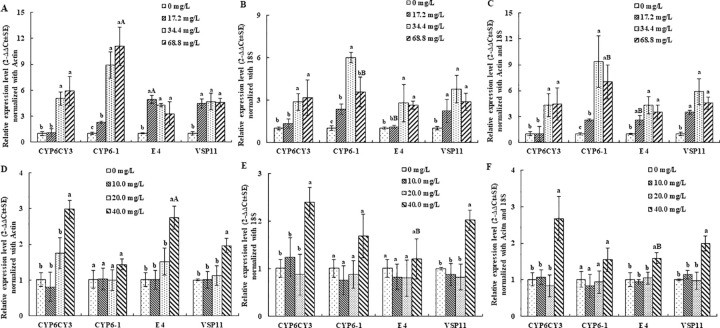
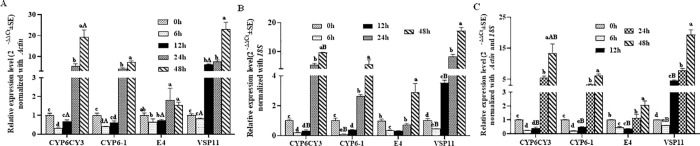
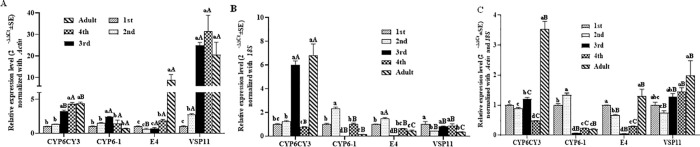
Myzus persicae is a globally important pest with the ability to adjust to a wide range of environmental situations, and many molecular technologies have been developed and applied to understand the biology and/or control this pest insect directly. Reverse-transcription quantitative real-time PCR (RT-qPCR) is a primary molecular technology that is used to quantify gene expression. Choosing a stable reference gene is significantly important for precisely clarifying the expression level of the target gene. Actin and 18S have been recommended as stable compounds for real-time RT-qPCR in M. persicae under the tested biotic and abiotic conditions. In this study, we checked the stability of Actin and 18S by analyzing the relative expression levels of the cytochrome 450 monooxygenase family member genes CYP6CY3 and CYP6-1, carboxylesterase gene E4 and vacuolar protein sorting gene VPS11 via RT-qPCR under various conditions. The expression levels of these four target genes were normalized using both Actin and 18S individually and the combination of these two genes. Our results confirmed that Actin and 18S can be used as reference genes to normalize the expression of target genes under insecticide treatment and starvation in M. persicae. However, at the developmental stages of M. persicae, the expression of the four tested target genes was normalized stably by Actin but not 18S, with the latter presenting a problematic change with the developmental stages. Thus, the stability of reference genes in response to diverse biotic and abiotic factors should be evaluated before each RT-qPCR experiment.
桃蚜是一种全球性重要害虫,具有适应广泛环境情况的能力,许多分子技术已被开发并应用于直接了解这种害虫的生物学和/或控制它。逆转录实时定量 PCR(RT-qPCR)是一种主要的分子技术,用于定量基因表达。选择稳定的参考基因对于准确阐明目标基因的表达水平非常重要。在测试的生物和非生物条件下,肌动蛋白和 18S 已被推荐为桃蚜实时 RT-qPCR 的稳定化合物。在本研究中,我们通过分析在各种条件下通过 RT-qPCR 检测细胞色素 450 单加氧酶家族成员基因 CYP6CY3 和 CYP6-1、羧酸酯酶基因 E4 和液泡蛋白分选基因 VPS11 的相对表达水平,检查肌动蛋白和 18S 的稳定性。使用肌动蛋白和 18S 单独以及这两种基因的组合来归一化这四个目标基因的表达水平。我们的结果证实,肌动蛋白和 18S 可用于在桃蚜受到杀虫剂处理和饥饿时归一化目标基因的表达。然而,在桃蚜的发育阶段,四个测试目标基因的表达通过肌动蛋白而不是 18S 稳定归一化,后者随发育阶段呈现出有问题的变化。因此,在每个 RT-qPCR 实验之前,都应评估参考基因对不同生物和非生物因素的稳定性。