Social, Genetic & Developmental Psychiatry Centre, Institute of Psychiatry, Psychology & Neuroscience, 4616King's College London, London, UK.
ESRC Centre for Society and Mental Health, 4616King's College London, London, UK.
Trauma Violence Abuse. 2023 Apr;24(2):946-965. doi: 10.1177/15248380211048452. Epub 2021 Oct 20.
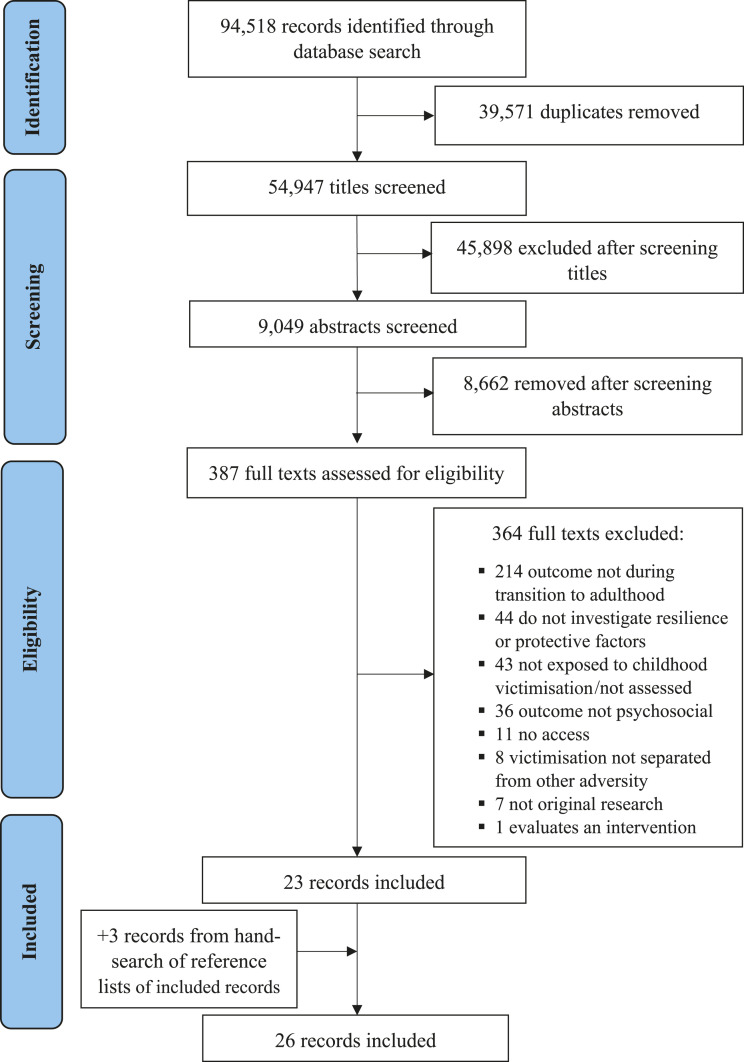
Exposure to childhood victimisation (i.e. abuse, neglect, domestic violence or bullying) can detrimentally impact later psychosocial adjustment. However, this is not the case for all victimised children; some do well despite their experiences and are considered to be resilient. Understanding the factors associated with such resilience is important to inform interventions to support better psychosocial outcomes among victimised children. This review provides an overview of the extant research examining resilience factors for psychosocial outcomes during the transition to adulthood following exposure to childhood victimisation. Studies were identified through a systematic literature search of Embase, PsychINFO and Ovid MEDLINE databases. The 26 included studies spanned a range of psychosocial outcomes between ages 18-25, including education and work, housing and independent living, criminal behaviour, victimisation, and social and psychological adjustment. For each outcome, a variety of putative resilience factors had been investigated including those related to the individual, their family and the wider community within which they lived. However, because few studies had comparable resilience factors and psychosocial outcomes, it is difficult to draw conclusions about which factors are consistently associated with resilience to a particular psychosocial outcome. Additionally, this review revealed that the included studies were of variable methodological quality - many were limited by cross-sectional designs with retrospective self-reports of childhood victimisation, and convenience or unrepresentative samples. In this review, we also highlight gaps in knowledge about the co-occurring impact of multiple resilience factors in combination and the need for studies conducted in non-Western and low- and middle-income countries.
童年期受虐(即虐待、忽视、家庭暴力或欺凌)会对以后的社会心理适应产生不利影响。然而,并非所有受虐儿童都是如此;有些儿童尽管经历了这些,但表现良好,被认为是有韧性的。了解与这种韧性相关的因素对于告知干预措施以支持受虐儿童获得更好的社会心理结果非常重要。
本综述概述了研究童年期受虐后向成年过渡期间与心理社会结果相关的韧性因素的现有研究。通过对 Embase、PsychINFO 和 Ovid MEDLINE 数据库进行系统文献检索,确定了这些研究。
纳入的 26 项研究涵盖了 18-25 岁之间的一系列心理社会结果,包括教育和工作、住房和独立生活、犯罪行为、受虐和社会心理适应。对于每个结果,都研究了各种潜在的韧性因素,包括与个体、家庭以及他们所生活的更广泛社区有关的因素。然而,由于很少有研究具有可比的韧性因素和心理社会结果,因此很难得出关于哪些因素与特定心理社会结果的韧性相关的结论。
此外,本综述还表明,纳入的研究在方法学质量上存在差异——许多研究受到横断面设计的限制,这些设计采用回顾性自我报告的童年期受虐情况,以及便利性或代表性不足的样本。在本综述中,我们还强调了关于多个韧性因素组合的共同影响以及在非西方和低收入及中等收入国家进行研究的知识差距。