Global Pediatric Medicine, Saint Jude Children's Research Hospital, Memphis, Tennessee, USA
Critical Care Medicine, St. Jude Children's Research Hospital, Memphis, TN, USA.
BMJ Open. 2021 Oct 20;11(10):e053116. doi: 10.1136/bmjopen-2021-053116.
Paediatric Early Warning Systems (PEWSs) improve identification of deterioration, however, their sustainability has not been studied. Sustainability is critical to maximise impact of interventions like PEWS, particularly in low-resource settings. This study establishes the reliability and validity of a Spanish-language Clinical Sustainability Assessment Tool (CSAT) to assess clinical capacity to sustain interventions in resource-limited hospitals.
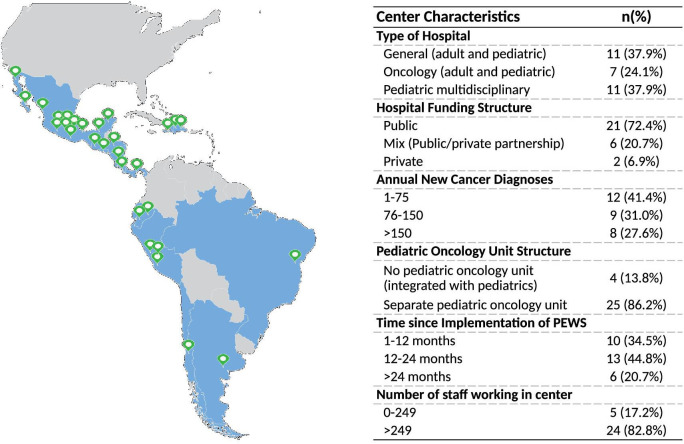
Participants included PEWS implementation leadership teams of 29 paediatric cancer centres in Latin America involved in a collaborative to implement PEWS. The CSAT, a sustainability assessment tool validated in high-resource settings, was translated into Spanish and distributed to participants as an anonymous electronic survey. Psychometric, confirmatory factor analysis (CFA), and multivariate analyses were preformed to assess reliability, structure and initial validity. Focus groups were conducted after participants reviewed CSAT reports to assess their interpretation and utility.
The CSAT survey achieved an 80% response rate (n=169) with a mean score of 4.4 (of 5; 3.8-4.8 among centres). The CSAT had good reliability with an average internal consistency of 0.77 (95% CI 0.71 to 0.81); and CFAs supported the seven-domain structure. CSAT results were associated with respondents' perceptions of the evidence for PEWS, its implementation and use in their centre, and their assessment of the hospital culture and implementation climate. The mean CSAT score was higher among respondents at centres with longer time using PEWS (p<0.001). Focus group participants noted the CSAT report helped assess their centre's clinical capacity to sustain PEWS and provided constructive feedback for improvement.
We present information supporting the reliability and validity of the CSAT tool, the first Spanish-language instrument to assess clinical capacity to sustain evidence-based interventions in hospitals of variable resource levels. This assessment demonstrates a high capacity to sustain PEWS in these resource-limited centres with improvement over time from PEWS implementation.
儿科早期预警系统(PEWSs)可提高对病情恶化的识别能力,但尚未研究其可持续性。可持续性对于最大限度地发挥干预措施(如 PEWS)的影响至关重要,尤其是在资源有限的环境中。本研究建立了西班牙语临床可持续性评估工具(CSAT)的可靠性和有效性,以评估资源有限的医院维持干预措施的临床能力。
参与者包括参与协作实施 PEWS 的 29 家拉丁美洲儿科癌症中心的 PEWS 实施领导团队。CSAT 是一种在高资源环境中验证的可持续性评估工具,已被翻译成西班牙语,并作为匿名电子调查分发给参与者。进行了心理测量学、验证性因素分析(CFA)和多变量分析,以评估可靠性、结构和初步有效性。在参与者审查 CSAT 报告后,进行焦点小组讨论,以评估他们的解释和实用性。
CSAT 调查的回复率达到 80%(n=169),平均得分为 4.4(中心得分为 3.8-4.8)。CSAT 具有良好的可靠性,平均内部一致性为 0.77(95%CI 0.71 至 0.81);并且 CFA 支持七域结构。CSAT 结果与受访者对 PEWS 的证据、其在中心的实施和使用的看法以及他们对医院文化和实施氛围的评估相关。在使用 PEWS 时间较长的中心,CSAT 得分较高(p<0.001)。焦点小组参与者指出,CSAT 报告有助于评估中心维持 PEWS 的临床能力,并提供了改进的建设性反馈。
我们提供了支持 CSAT 工具可靠性和有效性的信息,这是第一个评估不同资源水平医院维持基于证据的干预措施的临床能力的西班牙语工具。该评估表明,这些资源有限的中心具有高度维持 PEWS 的能力,并随着时间的推移从 PEWS 的实施中不断提高。