Department of Clinical Laboratory and Department of Sleep-Wake Disorders, National Center of Neurology and Psychiatry, Kodaira, Tokyo, Japan
Department of Psychiatry, Tokyo Women's Medical University, Shinjuku-ku, Tokyo, Japan.
BMJ Open. 2021 Oct 20;11(10):e053737. doi: 10.1136/bmjopen-2021-053737.
There are numerous reports on the psychological burden of medical workers after the COVID-19 outbreak; however, no study has examined the influence of developmental characteristics on the mental health of medical workers. The objective of this study was to examine whether the developmental characteristics of medical workers are associated with anxiety and depression after the COVID-19 outbreak.
We conducted an online cross-sectional questionnaire survey in October 2020.
The data of 640 medical workers were analysed. The questionnaire included items on sociodemographic data, changes in their life after the COVID-19 outbreak and symptoms of depression, anxiety, attention-deficit/hyperactivity disorder (ADHD) traits and autism spectrum disorder traits.
Depression symptoms were assessed by the Patient Health Questionnaire-9 and anxiety symptoms were assessed by the Generalised Anxiety Disorder-7. A series of hierarchical multiple regression analyses were performed to test the effects of developmental characteristics on depression and anxiety symptoms after controlling for sociodemographic factors and changes in participants' lives after the COVID-19 outbreak.
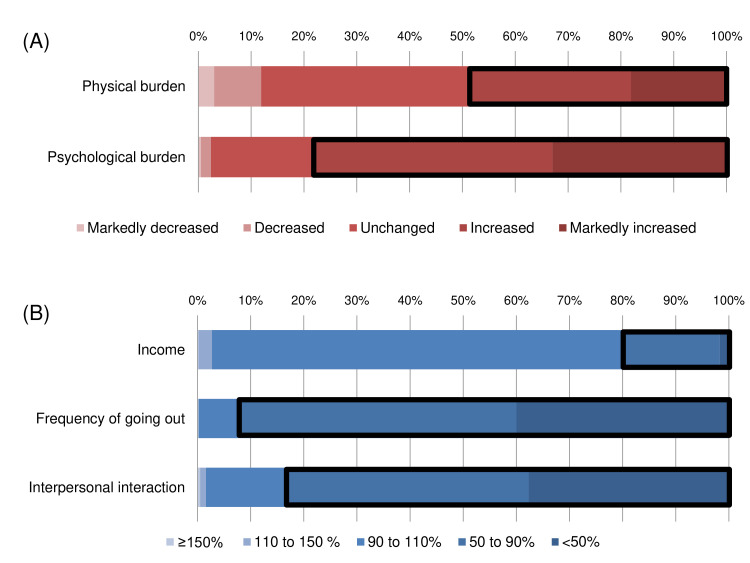
Increases in physical and psychological burden were observed in 49.1% and 78.3% of the subjects, respectively. The results of a multiple regression analysis showed that ADHD traits were significantly associated with both depression (β=0.390, p<0.001) and anxiety (β=0.426, p<0.001). Autistic traits were significantly associated with depression (β=0.069, p<0.05) but not anxiety. Increased physical and psychological burden, being female, medical workers other than physicians and nurses, fear of COVID-19 and experience of discrimination were also significantly associated with both depression and anxiety.
Globally, the burden on medical workers increased. This study suggested that medical workers with higher ADHD traits may need special attention during the COVID-19 pandemic.
有大量关于 COVID-19 爆发后医务人员心理负担的报告;然而,尚无研究探讨发展特征对医务人员心理健康的影响。本研究旨在探讨医务人员的发展特征是否与 COVID-19 爆发后的焦虑和抑郁有关。
我们于 2020 年 10 月进行了一项在线横断面问卷调查。
分析了 640 名医务人员的数据。问卷包括社会人口统计学数据、COVID-19 爆发后生活变化以及抑郁、焦虑、注意缺陷多动障碍(ADHD)特征和自闭症谱系障碍特征的症状。
使用患者健康问卷-9 评估抑郁症状,使用广泛性焦虑症-7 评估焦虑症状。进行了一系列层次多重回归分析,以测试发展特征对 COVID-19 爆发后抑郁和焦虑症状的影响,同时控制社会人口统计学因素和参与者生活变化。
分别有 49.1%和 78.3%的受试者观察到身体和心理负担增加。多元回归分析的结果表明,ADHD 特征与抑郁(β=0.390,p<0.001)和焦虑(β=0.426,p<0.001)均显著相关。自闭症特征与抑郁显著相关(β=0.069,p<0.05),但与焦虑无关。身体和心理负担增加、女性、非医生和护士的医务人员、对 COVID-19 的恐惧和经历歧视也与抑郁和焦虑显著相关。
全球范围内,医务人员的负担增加。本研究表明,COVID-19 大流行期间,ADHD 特征较高的医务人员可能需要特别关注。