Kitasato University School of Allied Health Sciences, Kitazato 1-15-1, Minami-ku, Sagamihara, Kanagawa, 252-0373, Japan.
BMC Psychiatry. 2021 Jan 12;21(1):33. doi: 10.1186/s12888-021-03047-y.
Social dislocations resulting from coronavirus disease 2019 (COVID-19) pandemic have been prolonged, which has led to general population social suppression. The present study aimed to reveal risk factors associated with mental health problems and suggest concrete coping strategies in the context of COVID-19.
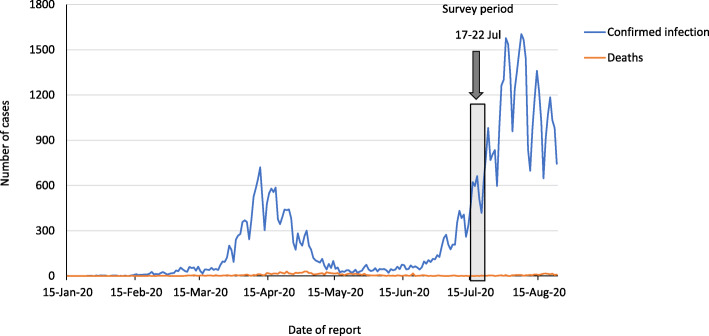
A web-based survey was conducted in July when Japan was experiencing a second wave of COVID-19. Demographics, Patient Health Questionnaire-9 (PHQ-9), state anger, anger control, and the Brief Coping Orientation to Problems Experienced were measured. Multivariate logistic regression analysis on PHQ-9 scores by set variables was conducted.
The participants were 2708 individuals, and 18.35% of them were depressed. Logistic regression analysis showed that in the order of odds ratios (ORs), underlying disease (OR = 1.96, 95% confidence interval (CI) = 1.32-2.92), not working (OR = 1.85, CI = 1.22-2.80), negative economic impact (OR = 1.33, CI = 1.01-1.77), state anger (OR = 1.17, CI = 1.14-1.21), anger control (OR = 1.08, CI = 1.04-1.13), age (OR = 0.97, CI = 0.96-0.98), high income (OR = 0.45, CI = 0.25-0.80), and being married (OR = 0.53, CI = 0.38-0.74) were predictors of depressive symptoms. Regarding coping strategies, planning (OR = 0.84, CI = 0.74-0.94), use of instrumental support (OR = 0.85, CI = 0.76-0.95), denial (OR = 0.88, CI = 0.77-0.99), behavioural disengagement (OR = 1.28, CI = 1.13-1.44), and self-blame (OR = 1.47, CI = 1.31-1.65) were associated with probable depression.
During prolonged psychological distress caused by COVID-19 pandemic, the prevalence of depressive symptoms in Japan was two to nine times as high as before the COVID-19 pandemic, even though Japan was not a lockdown country. Although some coping strategies were useful for maintaining mental health, such as developing ways, alone or with others, to address or avoid social dislocations, the influence of demographics was more powerful than these coping strategies, and medical treatments are needed for high-risk individuals.
由 2019 年冠状病毒病(COVID-19)大流行导致的社会动荡已经持续了很长时间,这导致了民众的社会压抑。本研究旨在揭示与心理健康问题相关的风险因素,并在 COVID-19 背景下提出具体的应对策略。
在日本经历第二波 COVID-19 时,于 7 月进行了一项基于网络的调查。测量了人口统计学、患者健康问卷-9(PHQ-9)、状态愤怒、愤怒控制和经历的简要应对方式。对设定变量的 PHQ-9 评分进行了多元逻辑回归分析。
参与者为 2708 人,其中 18.35%的人抑郁。逻辑回归分析表明,按优势比(OR)的顺序,基础疾病(OR=1.96,95%置信区间(CI)=1.32-2.92)、不工作(OR=1.85,CI=1.22-2.80)、负面经济影响(OR=1.33,CI=1.01-1.77)、状态愤怒(OR=1.17,CI=1.14-1.21)、愤怒控制(OR=1.08,CI=1.04-1.13)、年龄(OR=0.97,CI=0.96-0.98)、高收入(OR=0.45,CI=0.25-0.80)和已婚(OR=0.53,CI=0.38-0.74)是抑郁症状的预测因素。关于应对策略,计划(OR=0.84,CI=0.74-0.94)、使用工具性支持(OR=0.85,CI=0.76-0.95)、否认(OR=0.88,CI=0.77-0.99)、行为脱离(OR=1.28,CI=1.13-1.44)和自责(OR=1.47,CI=1.31-1.65)与可能的抑郁有关。
在 COVID-19 大流行导致的长期心理困扰期间,日本的抑郁症状患病率是 COVID-19 大流行前的两到九倍,尽管日本不是一个封锁国家。尽管一些应对策略对维护心理健康很有用,例如单独或与他人一起制定解决或避免社会动荡的方法,但人口统计学的影响比这些应对策略更强大,高危人群需要医疗治疗。