Kyung Hee University Hospital at Gangdong, Seoul, Republic of Korea.
Jaseng Medical Foundation, Seoul, Republic of Korea.
Integr Cancer Ther. 2021 Jan-Dec;20:15347354211040830. doi: 10.1177/15347354211040830.
Sipjeondaebo-tang (SDT) is a widely used traditional herbal medicine for relieving fatigue. This randomized, placebo-controlled, preliminary study evaluated SDT for cancer-related fatigue, which is the most common symptom experienced by patients with cancer.
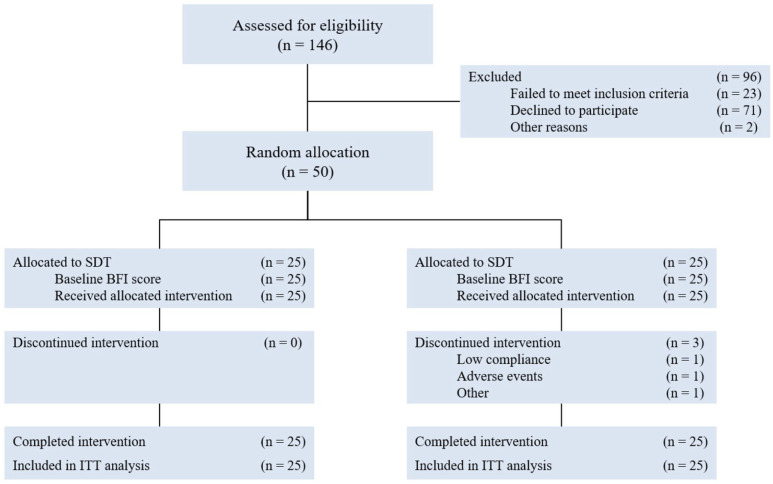
Patients with a Brief Fatigue Inventory (BFI) score of at least 4 were randomly assigned in a double-blinded manner to receive SDT (3 g 3 times daily) or placebo orally for 3 weeks. The BFI was the primary outcome measure and secondary outcome measures included the Hospital Anxiety and Depression Scale (HADS), the European Organization for Research and Treatment of Cancer-Quality of Life Questionnaire (EORTC QLQ-C30), immunoregulatory tests, and safety.
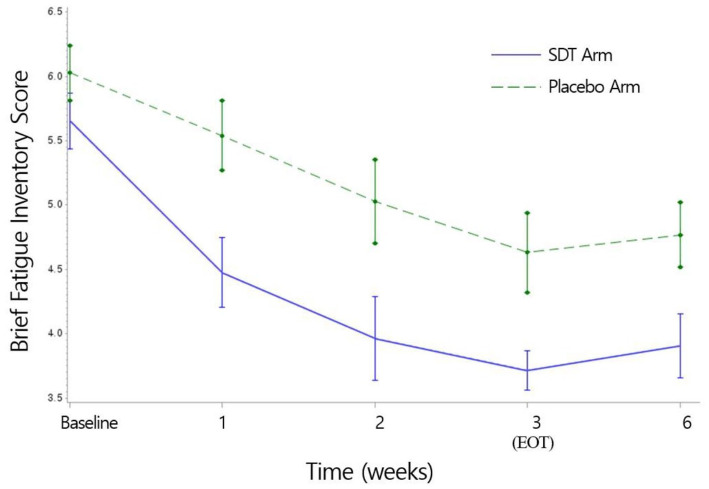
A total of 50 participants were randomly assigned and 48 patients completed the trial. Based on intention-to-treat analysis, fatigue, which was the primary outcome, was improved in both arms compared with the baseline, and was significantly better in the SDT group than in the placebo group at week 3 (3.56 ± 1.18 vs 4.63 ± 1.83, = .019). Secondary outcomes, including anxiety, depression, and immunoregulatory tests, did not improve significantly in either group. However, quality of life measured using the EORTC QLQ-C30 improved in both arms compared with the baseline, and the global health subscale was significantly better in the SDT group than in the placebo group ( = .02). No significant toxicities were observed.
SDT may improve cancer-related fatigue and quality of life in patients with cancer. A further randomized clinical trial with large sample size is warranted.
实脾饮(SDT)是一种广泛用于缓解疲劳的传统草药。这项随机、安慰剂对照、初步研究评估了 SDT 对癌症相关疲劳的作用,这是癌症患者最常见的症状。
具有至少 4 分的简短疲劳量表(BFI)评分的患者被随机分为双盲组,分别接受 SDT(3 克,每日 3 次)或安慰剂口服治疗 3 周。BFI 是主要结局测量指标,次要结局测量指标包括医院焦虑和抑郁量表(HADS)、欧洲癌症研究与治疗组织生活质量问卷(EORTC QLQ-C30)、免疫调节测试和安全性。
共有 50 名参与者被随机分配,48 名患者完成了试验。根据意向治疗分析,疲劳是主要结局,与基线相比,两组的疲劳均有所改善,SDT 组在第 3 周的改善明显优于安慰剂组(3.56±1.18 与 4.63±1.83, = .019)。次要结局,包括焦虑、抑郁和免疫调节测试,在两组中均无显著改善。然而,使用 EORTC QLQ-C30 测量的生活质量与基线相比均有所改善,SDT 组的全球健康亚量表明显优于安慰剂组( = .02)。未观察到明显的毒性。
SDT 可能改善癌症患者的癌症相关疲劳和生活质量。需要进一步进行更大样本量的随机临床试验。