
健脾化痰活血安神方改善H22肝癌移植化疗小鼠的胃肠道炎症和微生态失衡。
Jianpi-Huatan-Huoxue-Anshen formula ameliorates gastrointestinal inflammation and microecological imbalance in chemotherapy-treated mice transplanted with H22 hepatocellular carcinoma.
作者信息
Wang Ya-Nan, Zhai Xiang-Yang, Wang Zheng, Gao Chun-Ling, Mi Sui-Cai, Tang Wen-Li, Fu Xue-Min, Li Huai-Bang, Yue Li-Feng, Li Peng-Fei, Xi Sheng-Yan
机构信息
Department of TCM, Xiang'an Hospital, School of Medicine, Xiamen University, Xiamen 361102, Fujian Province, China.
Faculty of Chinese Medicine and State Key Laboratory of Quality Research in Chinese Medicine, Macau University of Science and Technology, Macau 999078, China.
出版信息
World J Gastrointest Oncol. 2024 Oct 15;16(10):4209-4231. doi: 10.4251/wjgo.v16.i10.4209.
BACKGROUND
Jianpi-Huatan-Huoxue-Anshen formula [Tzu-Chi cancer-antagonizing & life-protecting II decoction (TCCL)] is a Chinese medical formula that has been clinically shown to reduce the gastrointestinal side effects of chemotherapy in cancer patients and improve their quality of life. However, its effect and mechanism on the intestinal microecology after chemotherapy are not yet clear.
AIM
To discover the potential mechanisms of TCCL on gastrointestinal inflammation and microecological imbalance in chemotherapy-treated mice transplanted with hepatocellular carcinoma (HCC).
METHODS
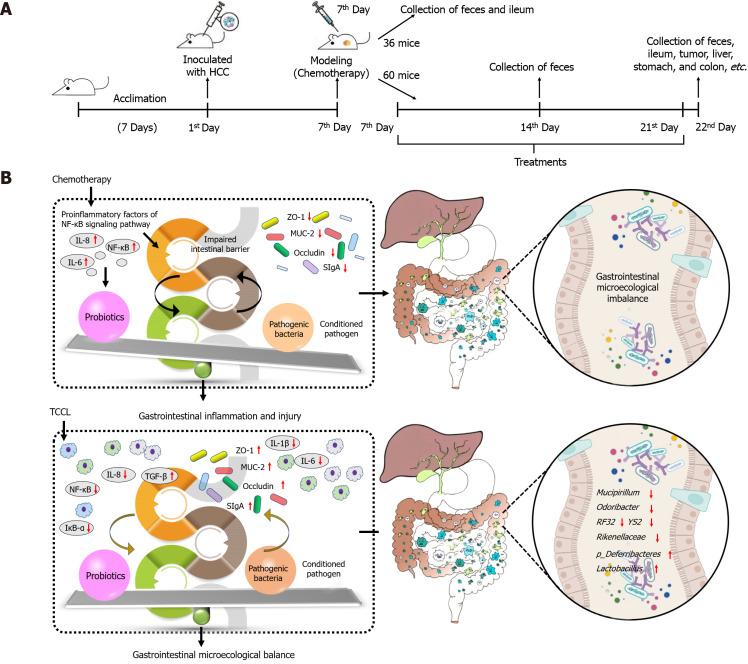
Ninety-six mice were inoculated subcutaneously with HCC cells. One week later, the mice received a large dose of 5-fluorouracil by intraperitoneal injection to establish a HCC chemotherapy model. Thirty-six mice were randomly selected before administration, and feces, ileal tissue, and ileal contents were collected from each mouse. The remaining mice were randomized into normal saline, continuous chemotherapy, Yangzheng Xiaoji capsules-treated, and three TCCL-treated groups. After treatment, feces, tumors, liver, spleen, thymus, stomach, jejunum, ileum, and colon tissues, and ileal contents were collected. Morphological changes, serum levels of IL-1β, IL-6, IL-8, IL-10, IL-22, TNF-α, and TGF-β, intestinal SIgA, and protein and mRNA expression of ZO-1, NF-κB, Occludin, MUC-2, Claudin-1, and IκB-α in colon tissues were documented. The effect of TCCL on the abundance and diversity of intestinal flora was analyzed using 16S rDNA sequencing.
RESULTS
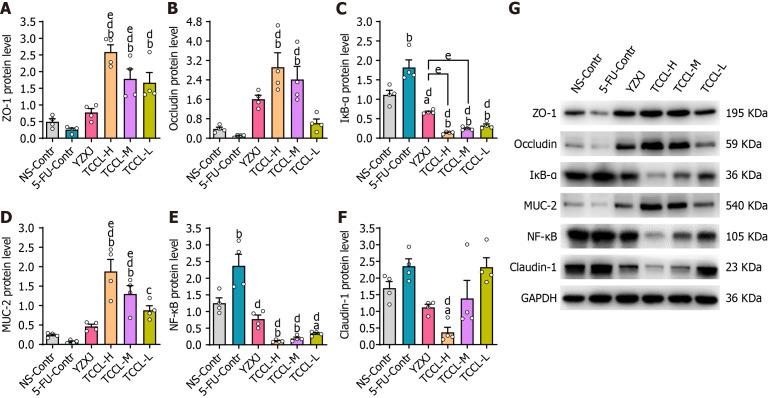
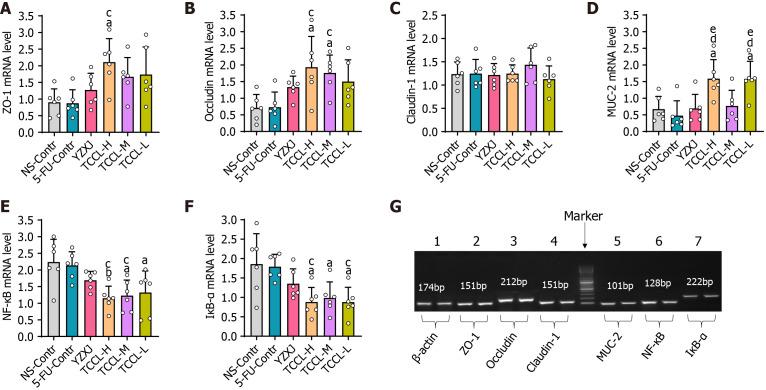
TCCL treatment improved thymus and spleen weight, thymus and spleen indexes, and body weight, decreased tumor volumes and tumor tissue cell density, and alleviated injury to gastric, ileal, and colonic mucosal tissues. Among proteins and genes associated with inflammation, IL-10, TGF-β, SIgA, ZO-1, MUC-2, and Occludin were upregulated, whereas NF-κB, IL-1β, IL-6, TNF-α, IL-22, IL-8, and IκB-α were downregulated. Additionally, TCCL increased the proportions of fecal , , , , , and in the intermediate stage of treatment, decreased the proportions of , , , , and but increased the proportions of and at the end of treatment. Studies on ileal mucosal microbiota showed similar findings. Moreover, TCCL improved community richness, evenness, and the diversity of fecal and ileal mucosal flora.
CONCLUSION
TCCL relieves pathological changes in tumor tissue and chemotherapy-induced gastrointestinal injury, potentially by reducing the release of pro-inflammatory factors to repair the gastrointestinal mucosa, enhancing intestinal barrier function, and maintaining gastrointestinal microecological balance. Hence, TCCL is a very effective adjuvant to chemotherapy.
背景
健脾化痰活血安神方[慈济抗癌保生Ⅱ号方(TCCL)]是一种中药方剂,临床已证实其可减轻癌症患者化疗的胃肠道副作用并改善其生活质量。然而,其对化疗后肠道微生态的作用及机制尚不清楚。
目的
探讨TCCL对肝癌移植化疗小鼠胃肠道炎症及微生态失衡的潜在作用机制。
方法
96只小鼠皮下接种肝癌细胞。1周后,小鼠腹腔注射大剂量5-氟尿嘧啶以建立肝癌化疗模型。给药前随机选取36只小鼠,收集每只小鼠的粪便、回肠组织及回肠内容物。其余小鼠随机分为生理盐水组、持续化疗组、养正消积胶囊治疗组和3个TCCL治疗组。治疗后,收集粪便、肿瘤、肝脏、脾脏、胸腺、胃、空肠、回肠、结肠组织及回肠内容物。记录形态学变化、血清白细胞介素-1β(IL-1β)、IL-6、IL-8、IL-10、IL-22、肿瘤坏死因子-α(TNF-α)、转化生长因子-β(TGF-β)水平、肠道分泌型免疫球蛋白A(SIgA)以及结肠组织中紧密连接蛋白1(ZO-1)、核因子-κB(NF-κB)、闭合蛋白(Occludin)、黏蛋白-2(MUC-2)、紧密连接蛋白1(Claudin-1)和核因子κB抑制蛋白α(IκB-α)的蛋白及mRNA表达。采用16S核糖体DNA(rDNA)测序分析TCCL对肠道菌群丰度和多样性的影响。
结果
TCCL治疗可改善胸腺和脾脏重量、胸腺和脾脏指数以及体重,减小肿瘤体积和肿瘤组织细胞密度,减轻胃、回肠和结肠黏膜组织损伤。在与炎症相关的蛋白质和基因中,IL-10、TGF-β、SIgA、ZO-1、MUC-2和Occludin上调,而NF-κB、IL-1β、IL-6、TNF-α、IL-22、IL-8和IκB-α下调。此外,TCCL在治疗中期增加了粪便中双歧杆菌属、乳酸杆菌属、阿克曼菌属、罗氏菌属、粪杆菌属和瘤胃球菌属的比例,在治疗末期降低了拟杆菌属、普雷沃菌属、脱硫弧菌属、嗜胆菌属和肠杆菌属的比例,但增加了双歧杆菌属和瘤胃球菌属的比例。回肠黏膜微生物群研究显示了类似结果。此外,TCCL改善了粪便和回肠黏膜菌群的群落丰富度、均匀度和多样性。
结论
TCCL可缓解肿瘤组织的病理变化及化疗引起的胃肠道损伤,可能是通过减少促炎因子释放以修复胃肠道黏膜、增强肠道屏障功能并维持胃肠道微生态平衡。因此,TCCL是一种非常有效的化疗辅助药物。





 Zotero 插件