Aspetar, Orthopaedic and Sports Medicine Hospital, FIFA Medical Centre of Excellence, 29222, Doha, Qatar.
Physical Activity for Health Group, School of Psychological Sciences & Health, University of Strathclyde, Glasgow, UK.
BMC Public Health. 2021 Oct 21;21(1):1912. doi: 10.1186/s12889-021-11961-9.
Muslims around the world practice intermittent fasting during the month of Ramadan each year. We hypothesized that daily physical activity could be reduced among Muslims due to the inability to refuel and rehydrate in the fasting state.
A cohort study design among adults registered with national physical activity community program. Data from a pedometer-based community program was used to extract 3 months of daily step counts before, during, and after Ramadan for the past years (2013-2019). A survey was conducted among participants to determine fasting practice and other health and environmental factors.
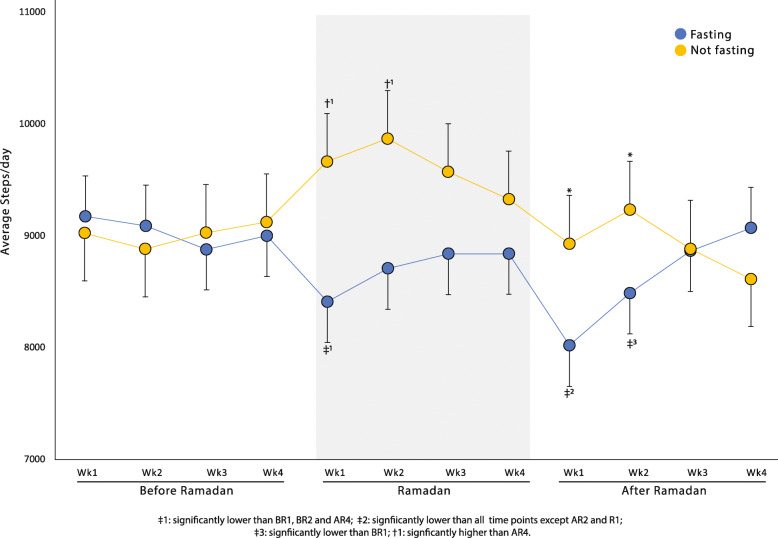
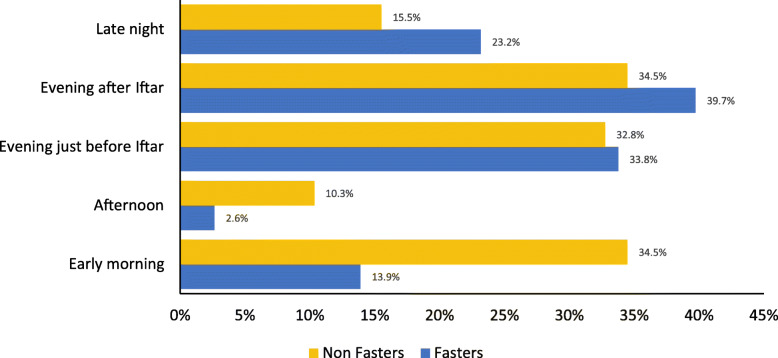
A total of 209 participants completed the survey and provided valid data on physical activity. During Ramadan, the average steps per day decreased significantly (- 385 ± SE 158) among participants who fasted (n = 151) p = 0.046 and increased (+ 731 ± SE 247) for the non- fasting participants (n = 58) p = 0.010. Fasting participants preferred before sunset (33.8%) or evening (39.7%) for physical activity. Whereas, non-fasting participants preferred early morning (34.5%).
Fasting during Ramadan impacts the daily physical activity behavior among Muslims. Interventions should focus on creating awareness of the importance of maintenance of adequate physical activity for adults fasting during Ramadan.
全世界的穆斯林每年在斋月期间都要进行间歇性禁食。我们假设由于禁食状态下无法补充营养和水分,穆斯林的日常体力活动可能会减少。
这是一项在参加全国体力活动社区计划的成年人中进行的队列研究设计。利用基于计步器的社区计划的数据,提取过去几年(2013-2019 年)斋月前后三个月的每日步数。对参与者进行了一项调查,以确定他们的斋戒实践以及其他健康和环境因素。
共有 209 名参与者完成了调查并提供了关于体力活动的有效数据。在斋月期间,禁食的参与者(n=151)的平均每日步数明显减少(-385±SE 158),p=0.046,而非禁食的参与者(n=58)的平均每日步数增加(+731±SE 247),p=0.010。禁食的参与者更喜欢在日落前(33.8%)或傍晚(39.7%)进行体力活动。而非禁食的参与者则更喜欢在清晨(34.5%)。
斋月期间的禁食会影响穆斯林的日常体力活动行为。干预措施应侧重于提高对维持斋月期间禁食的成年人进行足够体力活动的重要性的认识。