Unidad de Investigación UNAM-INC, Instituto Nacional de Cardiología Ignacio Chávez, Mexico City, Mexico.
Sección de Estudios de Posgrado e Investigación, Escuela Superior de Medicina, Instituto Politécnico Nacional, Mexico City, Mexico.
Epidemiol Infect. 2021 Oct 22;149:e230. doi: 10.1017/S095026882100234X.
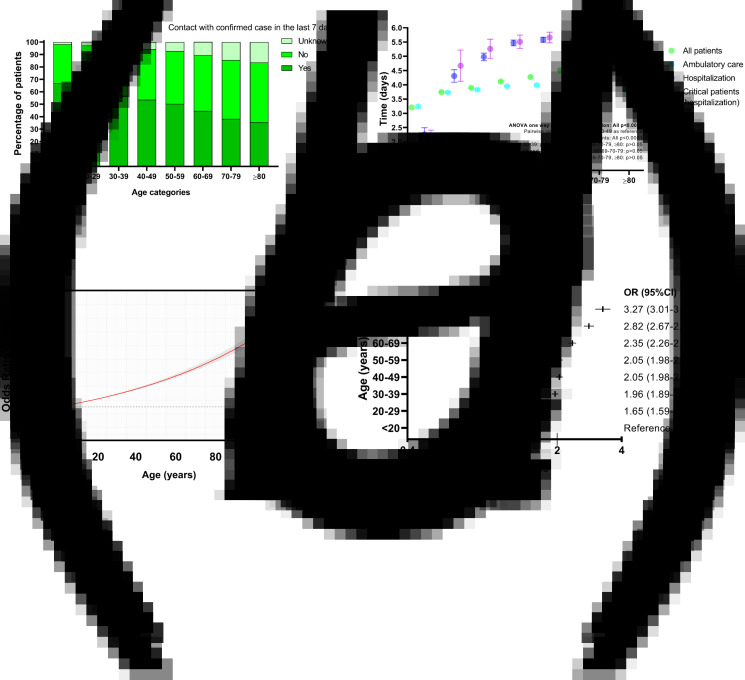
We conducted a retrospective observational study in patients with laboratory-confirmed coronavirus disease (COVID-19) who received medical care in 688 COVID-19 ambulatory units and hospitals in Mexico City between 24 February 2020 and 24 December 2020, to study if the elderly seek medical care later than younger patients and their severity of symptoms at initial medical evaluation. Patients were categorised into eight groups (<20, 20-29, 30-39, 40-49, 50-59, 60-69, 70-79 and ≥80 years). Symptoms at initial evaluation were classified according to a previously validated classification into respiratory and non-respiratory symptoms. Comparisons between time from symptom onset to medical care for every age category were performed through variance analyses. Logistic regression models were applied to determine the risk of presenting symptoms of severity according to age, and mortality risk according to delays in medical care. In total, 286 020 patients were included (mean age: 42.8, s.d.: 16.8 years; 50.4% were women). Mean time from symptom onset to medical care was 4.04 (s.d.: 3.6) days and increased with older age categories (P < 0.0001). Mortality risk increased by 6.4% for each day of delay in medical care from symptom onset. The risk of presenting with the symptoms of severity was greater with increasing age categories. In conclusion, COVID-19 patients with increasing ages tend to seek medical care later, with higher rates of symptoms of severity at initial presentation in both ambulatory units and hospitals.
我们对 2020 年 2 月 24 日至 2020 年 12 月 24 日期间在墨西哥城的 688 个 COVID-19 门诊单位和医院接受治疗的实验室确诊的冠状病毒疾病 (COVID-19) 患者进行了回顾性观察研究,以研究老年人是否比年轻患者就诊晚,以及他们在初次医疗评估时的症状严重程度。患者分为 8 组(<20 岁、20-29 岁、30-39 岁、40-49 岁、50-59 岁、60-69 岁、70-79 岁和≥80 岁)。根据先前验证的分类,将初始评估时的症状分为呼吸道和非呼吸道症状。通过方差分析比较每个年龄组从症状出现到医疗的时间。应用逻辑回归模型确定根据年龄出现严重症状的风险,以及根据医疗延迟出现死亡风险。共纳入 286020 例患者(平均年龄:42.8,标准差:16.8 岁;50.4%为女性)。从症状出现到医疗的平均时间为 4.04(标准差:3.6)天,随着年龄组的增加而增加(P<0.0001)。从症状出现到医疗每延迟一天,死亡风险增加 6.4%。随着年龄组的增加,出现严重症状的风险也随之增加。总之,COVID-19 患者年龄越大,就诊时间越晚,在门诊和医院就诊时初始表现出的严重症状发生率也越高。