Department of Mathematics, The University of Manchester, Manchester, UK.
Joint UNIversities Pandemic and Epidemiological Research, UK.
Philos Trans R Soc Lond B Biol Sci. 2021 Jul 19;376(1829):20200264. doi: 10.1098/rstb.2020.0264. Epub 2021 May 31.
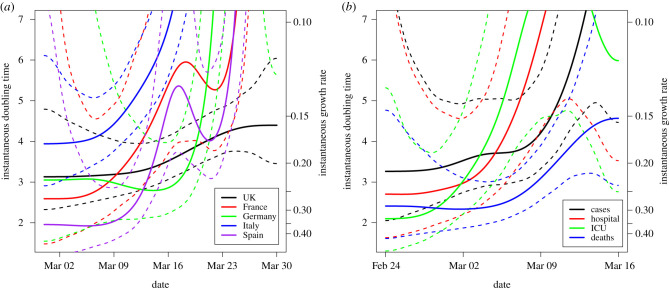
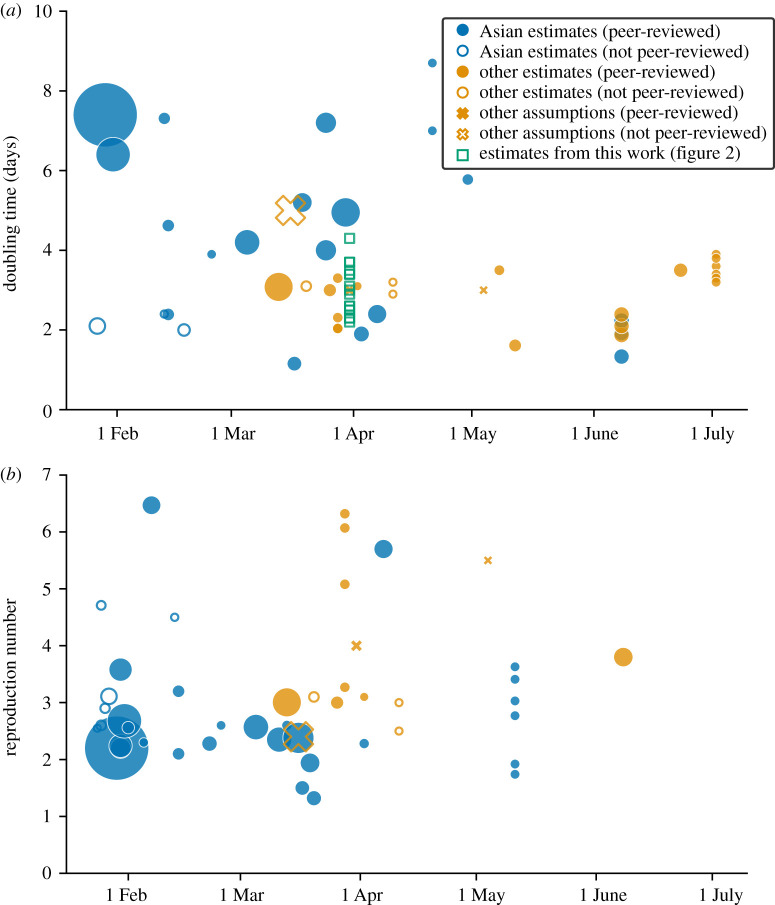
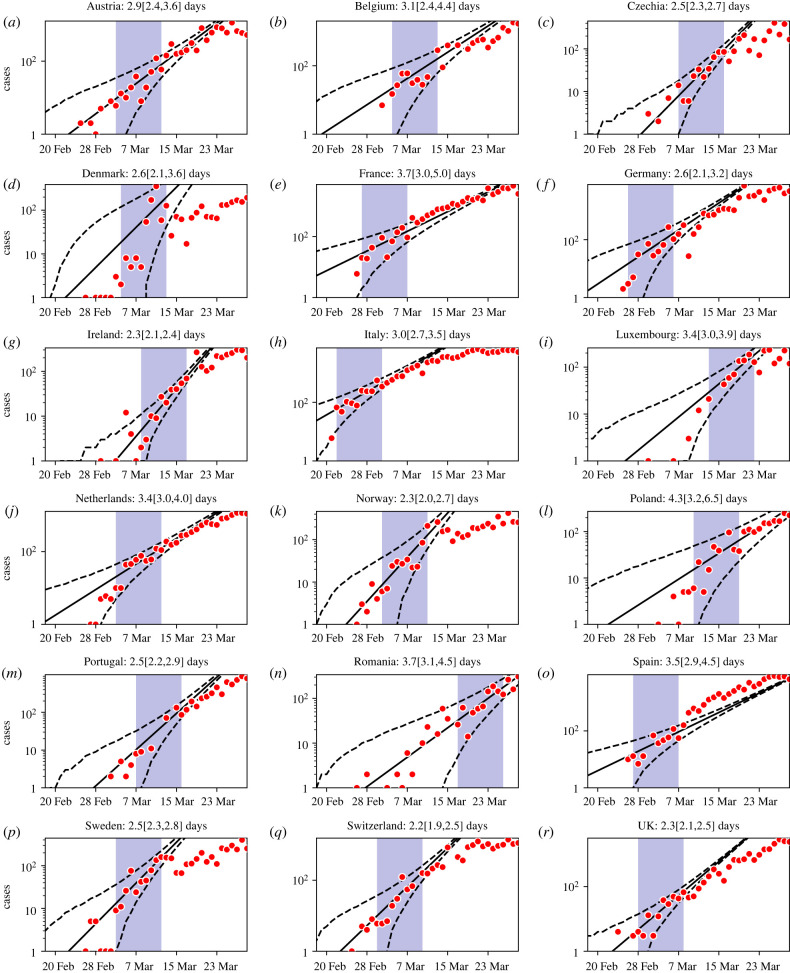
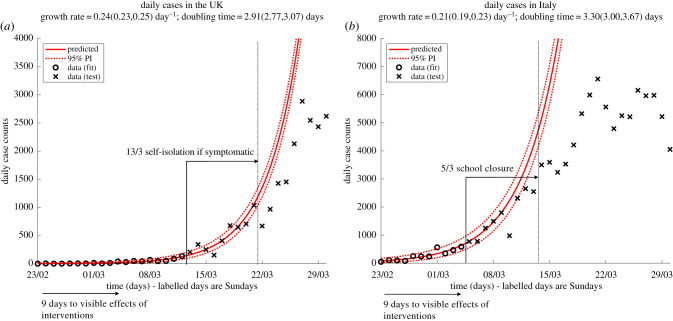
Early assessments of the growth rate of COVID-19 were subject to significant uncertainty, as expected with limited data and difficulties in case ascertainment, but as cases were recorded in multiple countries, more robust inferences could be made. Using multiple countries, data streams and methods, we estimated that, when unconstrained, European COVID-19 confirmed cases doubled on average every 3 days (range 2.2-4.3 days) and Italian hospital and intensive care unit admissions every 2-3 days; values that are significantly lower than the 5-7 days dominating the early published literature. Furthermore, we showed that the impact of physical distancing interventions was typically not seen until at least 9 days after implementation, during which time confirmed cases could grow eightfold. We argue that such temporal patterns are more critical than precise estimates of the time-insensitive basic reproduction number for initiating interventions, and that the combination of fast growth and long detection delays explains the struggle in countries' outbreak response better than large values of alone. One year on from first reporting these results, reproduction numbers continue to dominate the media and public discourse, but robust estimates of unconstrained growth remain essential for planning worst-case scenarios, and detection delays are still key in informing the relaxation and re-implementation of interventions. This article is part of the theme issue 'Modelling that shaped the early COVID-19 pandemic response in the UK'.
早期对 COVID-19 增长率的评估受到很大的不确定性的影响,这是预料之中的,因为数据有限,病例确诊也有困难,但随着多个国家记录了病例,可以做出更可靠的推断。我们使用多个国家、数据流和方法进行了估计,结果表明,在不受限制的情况下,欧洲 COVID-19 确诊病例平均每 3 天(范围为 2.2-4.3 天)就会翻一番,意大利的医院和重症监护病房的入院人数每 2-3 天就会翻一番;这些数据明显低于早期文献中占主导地位的 5-7 天。此外,我们还表明,物理距离干预措施的影响通常要在实施后至少 9 天才能显现出来,在此期间,确诊病例可能会增加 8 倍。我们认为,与启动干预措施的时间敏感基本繁殖数的精确估计相比,这种时间模式更为关键,快速增长和长时间的检测延迟结合起来,比单独的大值更能解释各国在疫情应对方面的困难。从首次报告这些结果一年后,繁殖数继续主导着媒体和公众的讨论,但对无限制增长的可靠估计仍然是规划最坏情况的必要条件,检测延迟仍然是告知干预措施放松和重新实施的关键。本文是“塑造英国早期 COVID-19 大流行应对的模型”主题特刊的一部分。