Ma Lili, Shao Hui, Chen Huazhong, Deng Qilong
Hepatology and Infectious Diseases Center, Taizhou Hospital of Zhejiang Province Affiliated to Wenzhou Medical University, Linhai 317000, Zhejiang, China.
Rehabilitation Medical Center, Taizhou Hospital of Zhejiang Province Affiliated to Wenzhou Medical University, Linhai 317000, Zhejiang, China.
J Oncol. 2021 Oct 12;2021:5425491. doi: 10.1155/2021/5425491. eCollection 2021.
In recent years, it has been reported that miRNA can be used as one of the markers of tumor diagnosis, treatment, and prognosis (including liver cancer), and it plays an important role in tumorigenesis. However, there are still very few studies on the mechanism and role of miR-141 in liver cancer.
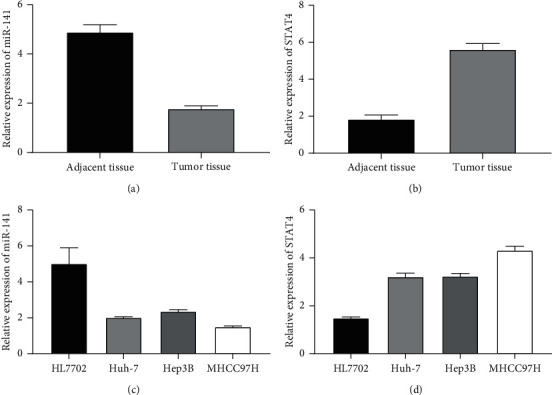
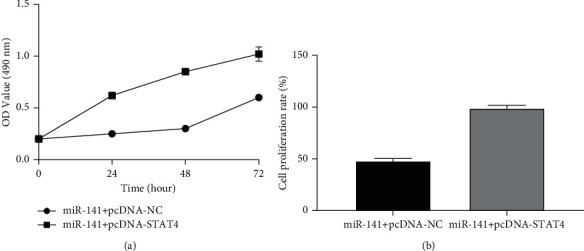
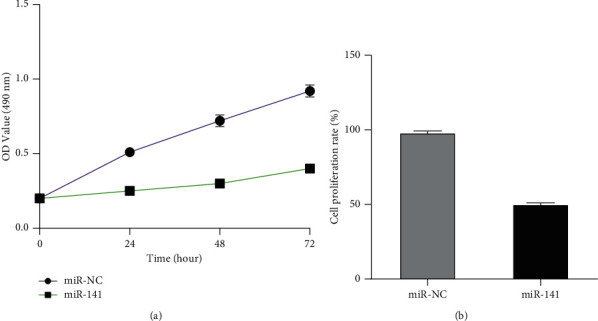
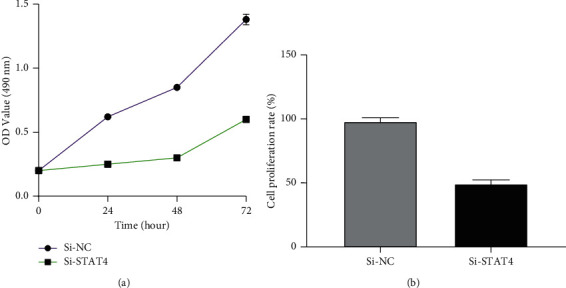
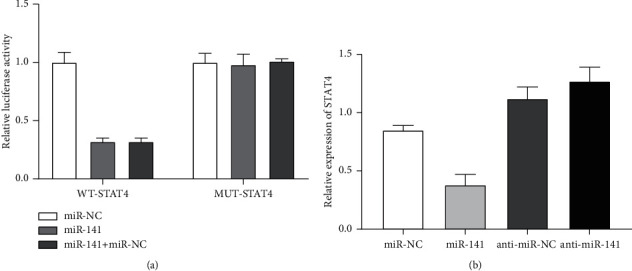
qRT-PCR was used to test the expressions of miR-141 and STAT4 in collected liver cancer tissues and adjacent tissues, cultured liver cancer cell lines MHCC97H, Hep3B, and Huh7, and normal human liver cells HL7702. After processing the results of the qRT-PCR experiment, liver cancer cell MHCC97H which has the lowest expression level was decided to be taken as the research object. miR-NC, miR-141 mimics, si-NC, si-STAT4, miR-141 mimics and pcDNA-NC, and miR-141 mimics and pcDNA-STAT4 were transfected into MHCC97H cells, respectively. The MTT assay was used to detect the proliferation of each group of cells, and the Transwell test was used to detect the effect of miR-141 on cell proliferation, migration, and invasion. The interaction between miR-141 and STAT4 was verified by the dual-luciferase reporter experiment, and the expression level of Cyclin D1 and MMP2 was detected by the western blot.
Compared with normal cell HL7702, the expression level of miR-141 in liver cancer cell lines was relatively low ( < 0.05) and the expression level of STAT4 in liver cancer cell lines was relatively high ( < 0.05) after testing the expression level of STAT4; transfecting miR-141 mimics or Si-SLBP can inhibit cell proliferation, migration, and invasion; dual-luciferase reporter experiments confirmed that miR-141 can specifically bind to the 3'UTR of STAT4; cotransfection of miR-141 mimics and pcDNA-STAT4 can antagonize the effects of miR-141 mimics on cell proliferation, migration, and invasion.
miR-141 can target the STAT4 gene expression to inhibit the proliferation, migration, and invasion of liver cancer cells.
近年来,有报道称微小RNA(miRNA)可作为肿瘤诊断、治疗及预后(包括肝癌)的标志物之一,且在肿瘤发生过程中发挥重要作用。然而,关于miR-141在肝癌中的作用机制及作用的研究仍非常少。
采用qRT-PCR检测收集的肝癌组织及癌旁组织、培养的肝癌细胞系MHCC97H、Hep3B和Huh7以及正常人肝细胞HL7702中miR-141和信号转导子和转录激活子4(STAT4)的表达。对qRT-PCR实验结果进行处理后,决定选取表达水平最低的肝癌细胞MHCC97H作为研究对象。分别将miR-NC、miR-141模拟物、si-NC、si-STAT4、miR-141模拟物与pcDNA-NC以及miR-141模拟物与pcDNA-STAT4转染至MHCC97H细胞中。采用MTT法检测各组细胞的增殖情况,采用Transwell实验检测miR-141对细胞增殖、迁移及侵袭的影响。通过双荧光素酶报告实验验证miR-141与STAT4之间的相互作用,并采用蛋白质免疫印迹法检测细胞周期蛋白D1(Cyclin D1)和基质金属蛋白酶2(MMP2)的表达水平。
检测STAT4表达水平后发现,与正常细胞HL7702相比,肝癌细胞系中miR-141的表达水平相对较低(<0.05),而STAT4的表达水平相对较高(<0.05);转染miR-141模拟物或Si-SLBP可抑制细胞增殖、迁移及侵袭;双荧光素酶报告实验证实miR-141可特异性结合STAT4的3'非翻译区(3'UTR);共转染miR-141模拟物与pcDNA-STAT4可拮抗miR-141模拟物对细胞增殖、迁移及侵袭的影响。
miR-141可靶向STAT4基因表达,抑制肝癌细胞的增殖、迁移及侵袭。