Bente Britt E, Wentzel Jobke, Groeneveld Rik Gh, IJzerman Renée Vh, de Buisonjé David R, Breeman Linda D, Janssen Veronica R, Kraaijenhagen Roderik, Pieterse Marcel E, Evers Andrea Wm, van Gemert-Pijnen Julia Ewc
Department of Psychology, Health and Technology, Centre for eHealth and Wellbeing Research, University of Twente, Enschede, Netherlands.
Research Group IT Innovations in Health Care, Windesheim University of Applied Sciences, Zwolle, Netherlands.
JMIR Cardio. 2021 Oct 22;5(2):e33252. doi: 10.2196/33252.
eHealth interventions are developed to support and facilitate patients with lifestyle changes and self-care tasks after being diagnosed with a cardiovascular disease (CVD). Creating long-lasting effects on lifestyle change and health outcomes with eHealth interventions is challenging and requires good understanding of patient values.
The aim of the study was to identify values of importance to patients with CVD to aid in designing a technological lifestyle platform.
A mixed method design was applied, combining data from usability testing with an additional online survey study, to validate the outcomes of the usability tests.
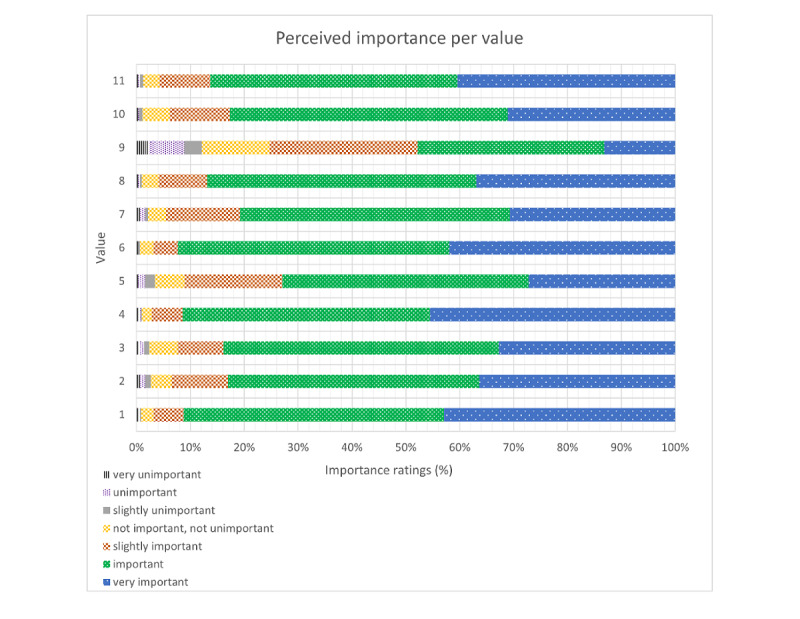
A total of 11 relevant patient values were identified, including the need for security, support, not wanting to feel anxious, tailoring of treatment, and personalized, accessible care. The validation survey shows that all values but one (value 9: To have extrinsic motivation to accomplish goals or activities [related to health/lifestyle]) were regarded as important/very important. A rating of very unimportant or unimportant was given by less than 2% of the respondents (value 1: 4/641, 0.6%; value 2: 10/641, 1.6%; value 3: 9/641, 1.4%; value 4: 5/641, 0.8%; value 5: 10/641, 1.6%; value 6: 4/641, 0.6%; value 7: 10/639, 1.6%; value 8: 4/639, 0.6%; value 10: 3/636, 0.5%; value 11: 4/636, 0.6%) to all values except but one (value 9: 56/636, 8.8%).
There is a high consensus among patients regarding the identified values reflecting goals and themes central to their lives, while living with or managing their CVD. The identified values can serve as a foundation for future research to translate and integrate these values into the design of the eHealth technology. This may call for prioritization of values, as not all values can be met equally.
电子健康干预措施旨在帮助和促进心血管疾病(CVD)患者在被诊断后改变生活方式并完成自我护理任务。通过电子健康干预措施对生活方式改变和健康结果产生持久影响具有挑战性,需要充分了解患者的价值观。
本研究的目的是确定对CVD患者重要的价值观,以帮助设计一个技术生活方式平台。
采用混合方法设计,将可用性测试的数据与另一项在线调查研究相结合,以验证可用性测试的结果。
共确定了11个相关的患者价值观,包括对安全性、支持的需求,不想感到焦虑,治疗的个性化,以及个性化、可获得的护理。验证性调查显示,除了一个价值观(价值观9:有外在动力来完成目标或活动[与健康/生活方式相关])外,所有价值观都被认为是重要/非常重要。不到2%的受访者对所有价值观给出了非常不重要或不重要的评价(价值观1:4/641,0.6%;价值观2:10/641,1.6%;价值观3:9/641,1.4%;价值观4:5/641,0.8%;价值观5:10/641,1.6%;价值观6:4/641,0.6%;价值观7:10/639,1.6%;价值观8:4/639,0.6%;价值观10:3/636,0.5%;价值观11:4/636,0.6%),但对一个价值观(价值观9:56/636,8.8%)除外。
患者对于所确定的反映其在患有或管理CVD期间生活核心目标和主题的价值观高度一致。所确定的价值观可为未来研究提供基础,以便将这些价值观转化并整合到电子健康技术的设计中。这可能需要对价值观进行优先级排序,因为并非所有价值观都能得到同等满足。