Institute for Biology and Environmental Sciences, Carl von Ossietzky University Oldenburg, Oldenburg, Germany.
Helmholtz Zentrum München, German Research Center for Environmental Health, Institute for Diabetes and Obesity, Monoclonal Antibody Core Facility, Neuherberg, Germany.
J Comp Physiol A Neuroethol Sens Neural Behav Physiol. 2022 Jan;208(1):69-81. doi: 10.1007/s00359-021-01506-1. Epub 2021 Oct 22.
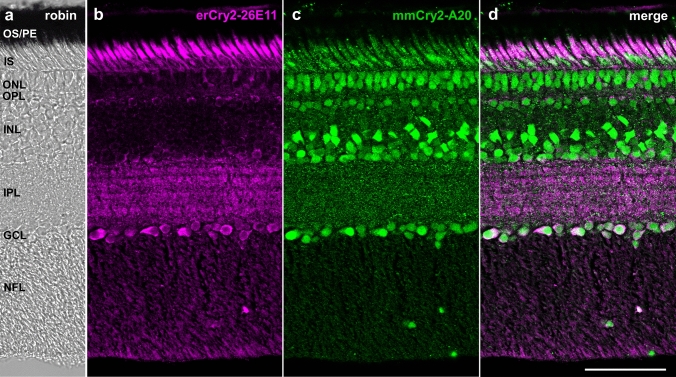
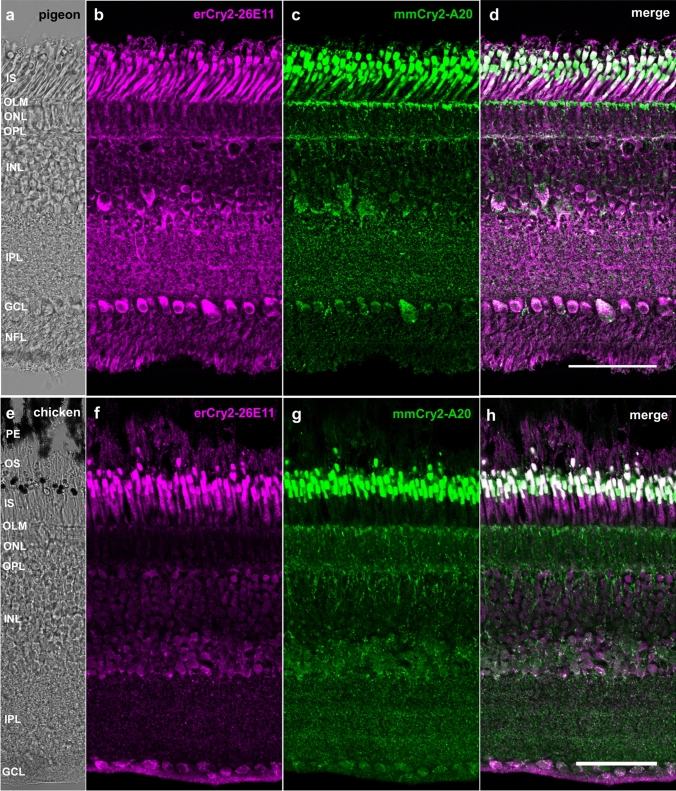
Cryptochromes are photolyase-related blue-light receptors acting as core components of the mammalian circadian clock in the cell nuclei. One or more members of the cryptochrome protein family are also assumed to play a role in avian magnetoreception, but the primary sensory molecule in the retina of migratory birds that mediates light-dependent magnetic compass orientation has still not been identified. The mRNA of cryptochrome 2 (Cry2) has been reported to be located in the cell nuclei of the retina, but Cry2 localisation has not yet been demonstrated at the protein level. Here, we provide evidence that Cry2 protein is located in the photoreceptor inner segments, the outer nuclear layer, the inner nuclear layer and the ganglion cell layer in the retina of night-migratory European robins, homing pigeons and domestic chickens. At the subcellular level, we find Cry2 both in the cytoplasm and the nucleus of cells residing in these layers. This broad nucleic expression rather points to a role for avian Cry2 in the circadian clock and is consistent with a function as a transcription factor, analogous to mammalian Cry2, and speaks against an involvement in magnetoreception.
隐花色素是光解酶相关的蓝光受体,作为细胞核中哺乳动物生物钟的核心组成部分。一个或多个隐花色素蛋白家族的成员也被认为在鸟类的磁感受中发挥作用,但介导依赖于光的磁罗盘定向的迁徙鸟类视网膜中的主要感觉分子仍未被确定。已经报道隐花色素 2 (Cry2) 的 mRNA 位于视网膜的细胞核中,但 Cry2 的蛋白定位尚未在蛋白水平上得到证明。在这里,我们提供的证据表明,Cry2 蛋白位于夜迁欧洲知更鸟、家鸽和家鸡视网膜中的光感受器内节、外核层、内核层和神经节细胞层。在亚细胞水平上,我们发现 Cry2 存在于这些层中细胞的细胞质和细胞核中。这种广泛的核表达表明鸟类 Cry2 可能在生物钟中发挥作用,并且类似于哺乳动物 Cry2 作为转录因子的功能,这表明其与磁感受无关。