Turner Dennis C
Institute for Applied Ethology and Animal Psychology, I.E.A.P./I.E.T., 8810 Horgen, ZH, Switzerland.
Animals (Basel). 2021 Sep 27;11(10):2823. doi: 10.3390/ani11102823.
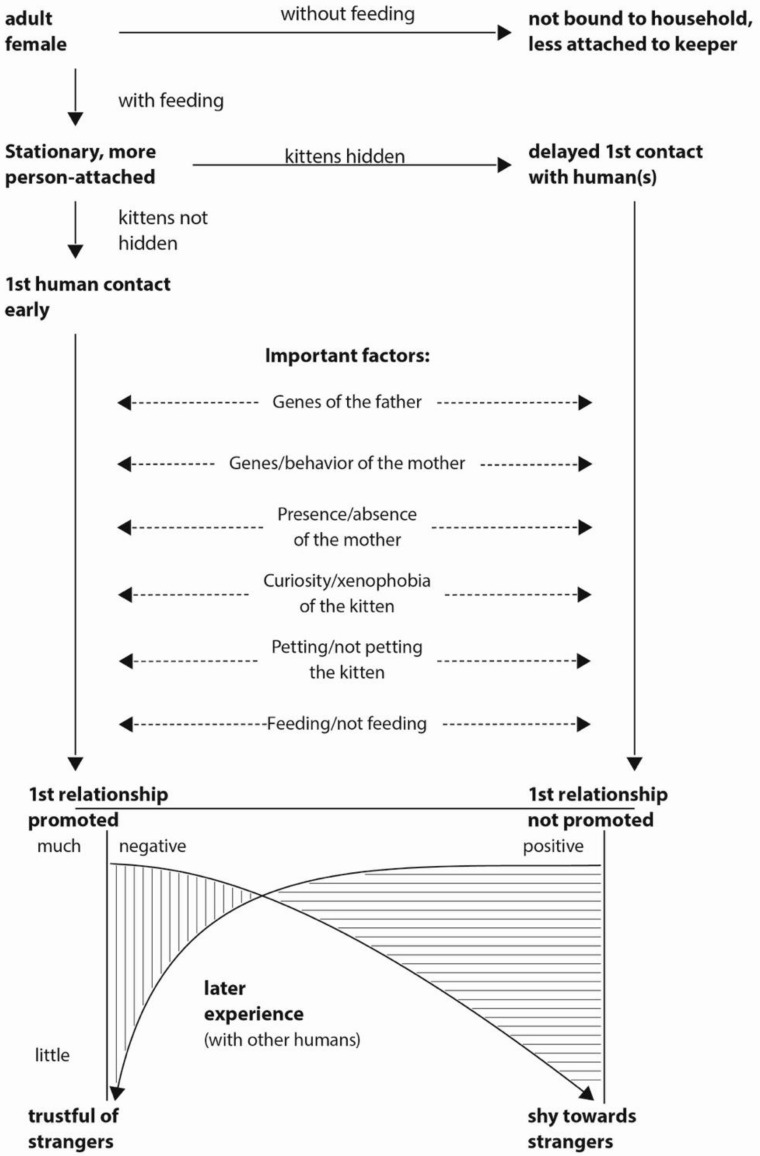
After recent publication of several reviews covering research results from the last 35 years of domestic cat studies, a number of important unanswered questions and hypotheses have arisen that could interest active researchers, especially those beginning their academic careers. Some sections of this paper concern methodologies that have yielded new insights and could provide more in the future; other sections concern findings and interpretations of those that need further testing. First, hypotheses arise from combining subjective (or psychological) assessments of cat and human personality traits and observational (ethological) studies of cat-human interactions: e.g., do owners with high attachment to their cats interact differently with them than owners with low attachment levels? New analytical methods of dyadic interaction observations open the door for testing further hypotheses. In particular, the Theme (Noldus bv, NL) program could be used to determine if there are differences between cat breeds in interaction patterns with people, which is not only of interest to owners but also therapists employing cats in their practices. Cat breed differences have been found using subjective ratings, but these need to be corroborated by direct observational data from the home setting and/or non-invasive colony observations, since ratings based on anthropomorphic projections might not be reliable. This should be done before searching for the genetic basis of such differences. Reliable information on breed differences is also needed before prescribing certain breeds for animal-assisted interventions. A model has predicted that the degree of socialization as a kitten affects cats' responses to positive and negative experiences with unfamiliar humans and their formation of feline-human relationships later on. This needs to be tested in an ethically approved manner on cats of known socialization status and has enormous consequences for cat adoptions from animal shelters. Observations of human-cat interactions have yielded many correlations, which can be tested by non-invasive manipulations of human behavior in the home setting. Examples of these will be given and are of general interest to the cat-owning public. A review of first findings on social cognition in cats has resulted in further unanswered questions and hypotheses. Finally, two aspects of domestic cat ecology will be considered (effects on wildlife and space utilization), which are of great interest to the public and conservationists alike.
在最近发表了几篇涵盖过去35年家猫研究成果的综述之后,出现了一些重要的未解决问题和假设,这可能会引起活跃的研究人员的兴趣,尤其是那些刚开始学术生涯的研究人员。本文的一些章节涉及已经产生新见解并可能在未来提供更多见解的方法;其他章节则涉及那些需要进一步检验的研究结果和解释。首先,假设源于对猫和人类性格特征的主观(或心理)评估与对猫-人互动的观察(行为学)研究的结合:例如,对猫高度依恋的主人与猫的互动方式是否与低依恋水平的主人不同?二元互动观察的新分析方法为检验进一步的假设打开了大门。特别是,主题(Noldus bv,荷兰)程序可用于确定不同猫品种与人互动模式之间是否存在差异,这不仅是猫主人感兴趣的,也是在实践中使用猫的治疗师感兴趣的。已经通过主观评分发现了猫品种之间的差异,但这些需要通过来自家庭环境的直接观察数据和/或非侵入性群体观察来证实,因为基于拟人化投射的评分可能不可靠。这应该在寻找这种差异的遗传基础之前完成。在为动物辅助干预规定某些品种之前,也需要有关品种差异的可靠信息。一个模型预测,小猫时期的社会化程度会影响猫对与陌生人类的积极和消极经历的反应以及它们后来形成猫-人关系的情况。这需要以符合伦理的方式在已知社会化状态的猫身上进行测试,并且对从动物收容所收养猫有巨大影响。对人-猫互动的观察产生了许多相关性,这些相关性可以通过在家庭环境中对人类行为进行非侵入性操纵来检验。将给出这些例子,它们对养猫公众普遍感兴趣。对猫社会认知的初步研究结果进行的综述产生了更多未解决的问题和假设。最后,将考虑家猫生态学的两个方面(对野生动物的影响和空间利用),这对公众和保护主义者都非常有吸引力。