BASIS Independent Silicon Valley, San Jose, CA 95126, USA.
School of Systems Biology, George Mason University, Fairfax, VA 22030, USA.
Biomolecules. 2021 Oct 19;11(10):1541. doi: 10.3390/biom11101541.
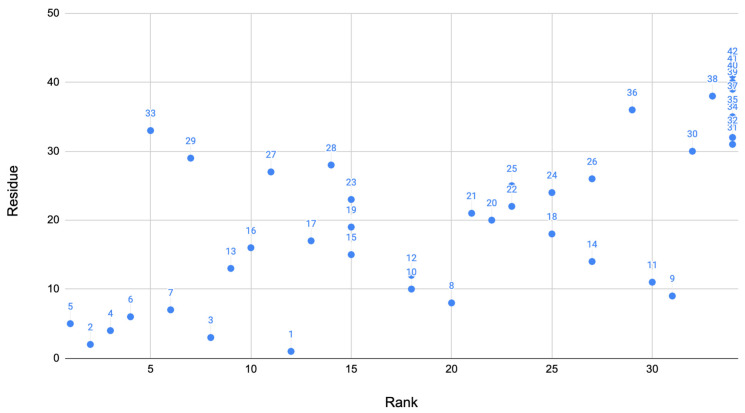
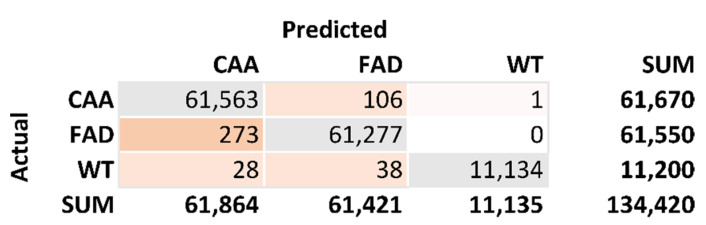
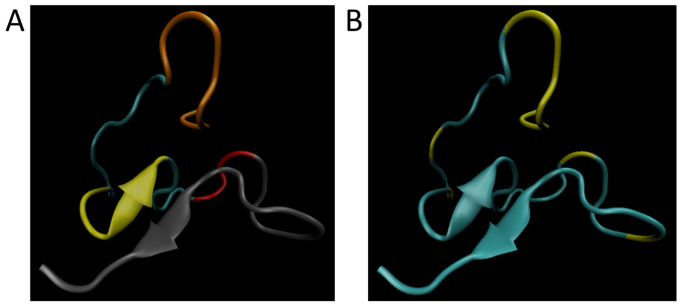
Alzheimer's disease, the most common form of dementia, currently has no cure. There are only temporary treatments that reduce symptoms and the progression of the disease. Alzheimer's disease is characterized by the prevalence of plaques of aggregated amyloid β (Aβ) peptide. Recent treatments to prevent plaque formation have provided little to relieve disease symptoms. Although there have been numerous molecular simulation studies on the mechanisms of Aβ aggregation, the signaling role has been less studied. In this study, a total of over 38,000 simulated structures, generated from molecular dynamics (MD) simulations, exploring different conformations of the Aβ42 mutants and wild-type peptides were used to examine the relationship between Aβ torsion angles and disease measures. Unique methods characterized the data set and pinpointed residues that were associated in aggregation and others associated with signaling. Machine learning techniques were applied to characterize the molecular simulation data and classify how much each residue influenced the predicted variant of Alzheimer's Disease. Orange3 data mining software provided the ability to use these techniques to generate tables and rank the data. The test and score module coupled with the confusion matrix module analyzed data with calculations of specificity and sensitivity. These methods evaluating frequency and rank allowed us to analyze and predict important residues associated with different phenotypic measures. This research has the potential to help understand which specific residues of Aβ should be targeted for drug development.
阿尔茨海默病是最常见的痴呆症形式,目前尚无治愈方法。只有一些暂时的治疗方法可以减轻症状和疾病的进展。阿尔茨海默病的特征是淀粉样 β (Aβ) 肽聚集斑块的流行。最近预防斑块形成的治疗方法对缓解疾病症状几乎没有作用。尽管已经有许多关于 Aβ 聚集机制的分子模拟研究,但信号作用研究较少。在这项研究中,使用了总共超过 38000 个来自分子动力学 (MD) 模拟的模拟结构,探索了 Aβ42 突变体和野生型肽的不同构象,以研究 Aβ 扭转角与疾病测量之间的关系。独特的方法对数据集进行了特征化,并确定了与聚集相关的残基以及与信号相关的残基。机器学习技术被应用于表征分子模拟数据,并对每个残基对预测的阿尔茨海默病变异的影响程度进行分类。Orange3 数据挖掘软件提供了使用这些技术生成表格和对数据进行排序的能力。测试和评分模块与混淆矩阵模块相结合,通过特异性和敏感性的计算来分析数据。这些评估频率和等级的方法使我们能够分析和预测与不同表型测量相关的重要残基。这项研究有可能帮助理解应该针对 Aβ 的哪些特定残基进行药物开发。