Subbalakshmi Ayalur Raghu, Sahoo Sarthak, McMullen Isabelle, Saxena Aaditya Narayan, Venugopal Sudhanva Kalasapura, Somarelli Jason A, Jolly Mohit Kumar
Centre for BioSystems Science and Engineering, Indian Institute of Science, Bangalore 560012, India.
Department of Medicine, Duke University, Durham, NC 27708, USA.
Cancers (Basel). 2021 Oct 13;13(20):5135. doi: 10.3390/cancers13205135.
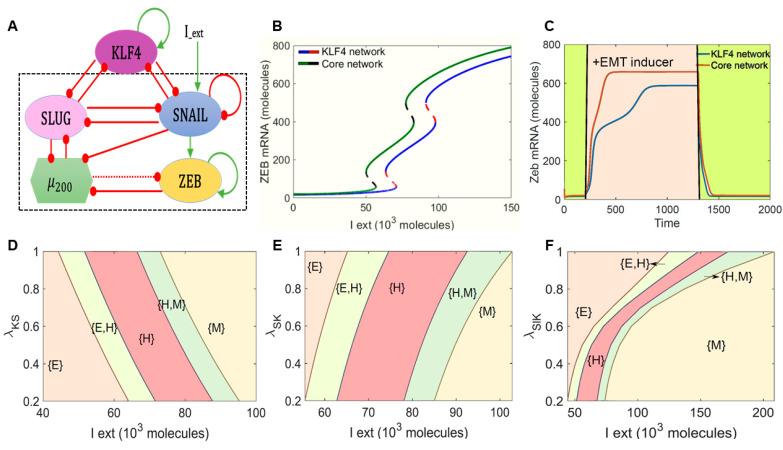
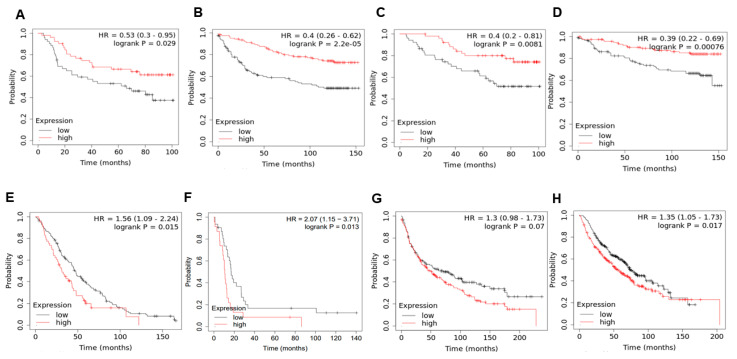
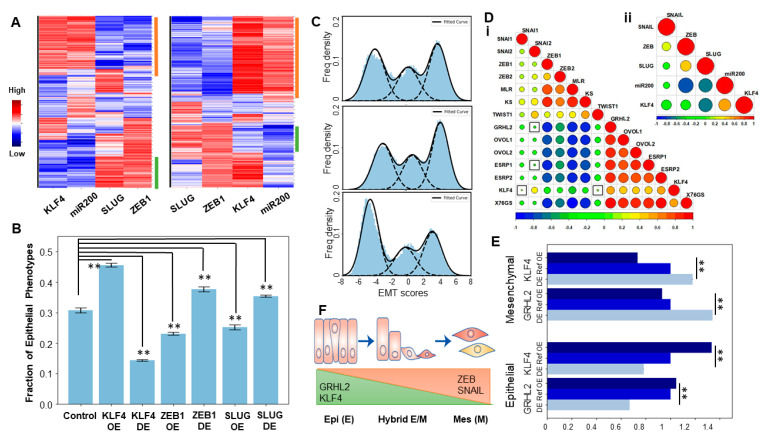
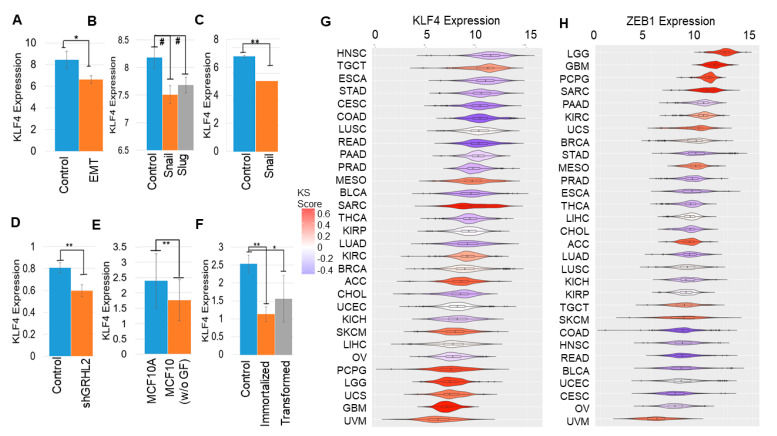
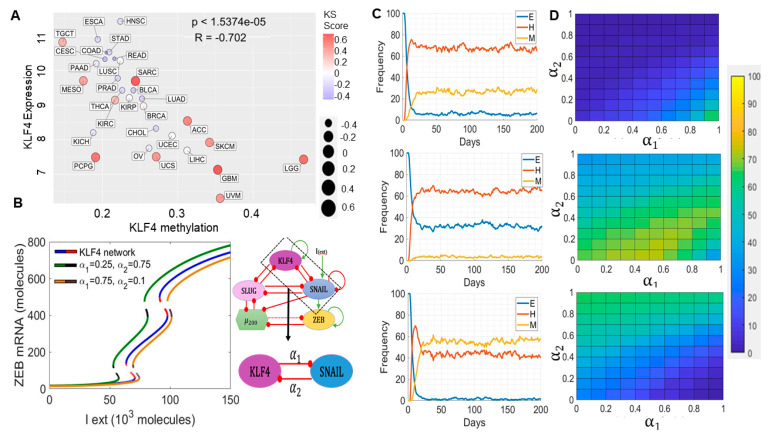
Epithelial-Mesenchymal Plasticity (EMP) refers to reversible dynamic processes where cells can transition from epithelial to mesenchymal (EMT) or from mesenchymal to epithelial (MET) phenotypes. Both these processes are modulated by multiple transcription factors acting in concert. While EMT-inducing transcription factors (TFs)-TWIST1/2, ZEB1/2, SNAIL1/2/3, GSC, and FOXC2-are well-characterized, the MET-inducing TFs are relatively poorly understood (OVOL1/2 and GRHL1/2). Here, using mechanism-based mathematical modeling, we show that transcription factor KLF4 can delay the onset of EMT by suppressing multiple EMT-TFs. Our simulations suggest that KLF4 overexpression can promote a phenotypic shift toward a more epithelial state, an observation suggested by the negative correlation of KLF4 with EMT-TFs and with transcriptomic-based EMT scoring metrics in cancer cell lines. We also show that the influence of KLF4 in modulating the EMT dynamics can be strengthened by its ability to inhibit cell-state transitions at the epigenetic level. Thus, KLF4 can inhibit EMT through multiple parallel paths and can act as a putative MET-TF. KLF4 associates with the patient survival metrics across multiple cancers in a context-specific manner, highlighting the complex association of EMP with patient survival.
上皮-间质可塑性(EMP)指的是细胞能够从上皮表型转变为间质表型(上皮-间质转化,EMT)或从间质表型转变为上皮表型(间质-上皮转化,MET)的可逆动态过程。这两个过程均受到多种协同作用的转录因子的调控。虽然诱导EMT的转录因子(TFs)——TWIST1/2、ZEB1/2、SNAIL1/2/3、GSC和FOXC2——已得到充分研究,但诱导MET的转录因子(OVOL1/2和GRHL1/2)相对了解较少。在此,我们使用基于机制的数学模型表明,转录因子KLF4可通过抑制多种EMT转录因子来延迟EMT的发生。我们的模拟结果表明,KLF4的过表达可促进向更上皮状态的表型转变,这一观察结果由KLF4与癌细胞系中EMT转录因子以及基于转录组的EMT评分指标的负相关性所提示。我们还表明,KLF4在调节EMT动态过程中的影响可因其在表观遗传水平抑制细胞状态转变的能力而得到增强。因此,KLF4可通过多条平行途径抑制EMT,并可作为一种假定的MET转录因子。KLF4以一种特定背景的方式与多种癌症患者的生存指标相关联,突显了EMP与患者生存之间的复杂关联。