Division of Colon and Rectal Surgery, Department of Surgery, Tri-Service General Hospital, National Defense Medical Center, Taipei 11490, Taiwan.
Department of Computer Science and Information Engineering, National Taipei University of Technology, Taipei 10608, Taiwan.
Genes (Basel). 2021 Sep 28;12(10):1539. doi: 10.3390/genes12101539.
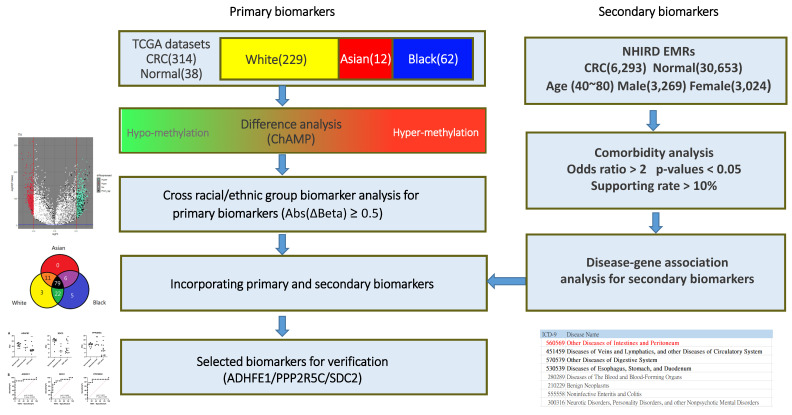
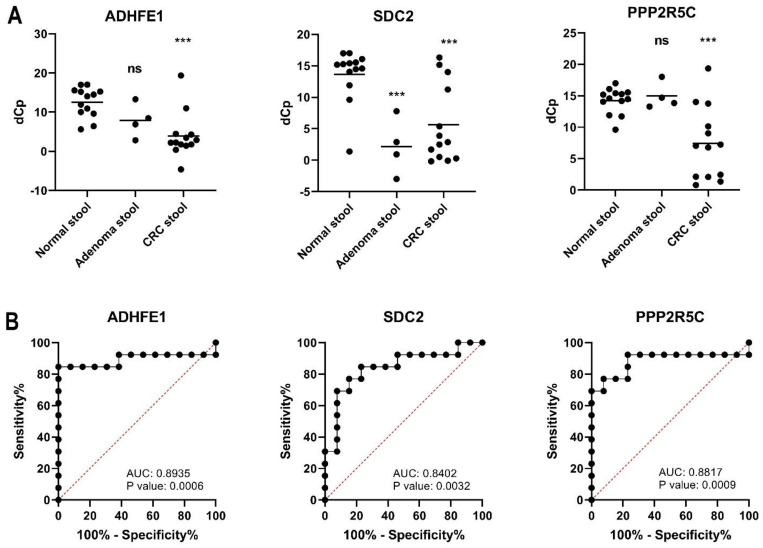
Colorectal cancer (CRC) is the third most commonly diagnosed cancer worldwide in 2020. Colonoscopy and the fecal immunochemical test (FIT) are commonly used as CRC screening tests, but both types of tests possess different limitations. Recently, liquid biopsy-based DNA methylation test has become a powerful tool for cancer screening, and the detection of abnormal DNA methylation in stool specimens is considered as an effective approach for CRC screening. The aim of this study was to develop a novel approach in biomarker selection based on integrating primary biomarkers from genome-wide methylation profiles and secondary biomarkers from CRC comorbidity analytics. A total of 125 differential methylated probes (DMPs) were identified as primary biomarkers from 352 genome-wide methylation profiles. Among them, 51 biomarkers, including 48 hypermethylated DMPs and 3 hypomethylated DMPs, were considered as suitable DMP candidates for CRC screening tests. After comparing with commercial kits, three genes (, , and ) were selected as candidate epigenetic biomarkers for CRC screening tests. Methylation levels of these three biomarkers were significantly higher for patients with CRC than normal subjects. The sensitivity and specificity of integrating methylated , , and for CRC detection achieved 84.6% and 92.3%, respectively. Through an integrated approach using genome-wide DNA methylation profiles and electronic medical records, we could design a biomarker panel that allows for early and accurate noninvasive detection of CRC using stool samples.
结直肠癌(CRC)是 2020 年全球第三大常见癌症。结肠镜检查和粪便免疫化学试验(FIT)常用于 CRC 筛查,但这两种检查方法都存在不同的局限性。最近,基于液体活检的 DNA 甲基化检测已成为癌症筛查的有力工具,粪便标本中异常 DNA 甲基化的检测被认为是 CRC 筛查的有效方法。本研究旨在开发一种新方法,通过整合全基因组甲基化图谱的主要生物标志物和 CRC 合并症分析的次要生物标志物来选择生物标志物。从 352 个全基因组甲基化图谱中鉴定出 125 个差异甲基化探针(DMP)作为主要生物标志物。其中,51 个生物标志物,包括 48 个高甲基化 DMP 和 3 个低甲基化 DMP,被认为是 CRC 筛查试验的合适 DMP 候选物。与商业试剂盒比较后,选择了三个基因(、和)作为 CRC 筛查试验的候选表观遗传生物标志物。CRC 患者粪便中这三个标志物的甲基化水平明显高于正常对照。整合甲基化、、和进行 CRC 检测的敏感性和特异性分别达到 84.6%和 92.3%。通过使用全基因组 DNA 甲基化图谱和电子病历的综合方法,我们可以设计一个生物标志物面板,使用粪便样本进行早期、准确的非侵入性 CRC 检测。