Ciudin Andreea, Fidilio Enzamaría, Gutiérrez-Carrasquilla Liliana, Caixàs Assumpta, Vilarrasa Núria, Pellitero Silvia, Simó-Servat Andreu, Vilallonga Ramon, Ruiz Amador, de la Fuente Maricruz, Luna Alexis, Sánchez Enric, Rigla Mercedes, Hernández Cristina, Salas Eduardo, Simó Rafael, Lecube Albert
Endocrinology and Nutrition Department, Hospital Universitari Vall d'Hebron, 08035 Barcelona, Spain.
Diabetes and Metabolism Research Unit, Vall d'Hebron Institut de Recerca (VHIR), Universitat Autònoma de Barcelona, 08025 Barcelona, Spain.
J Pers Med. 2021 Oct 17;11(10):1040. doi: 10.3390/jpm11101040.
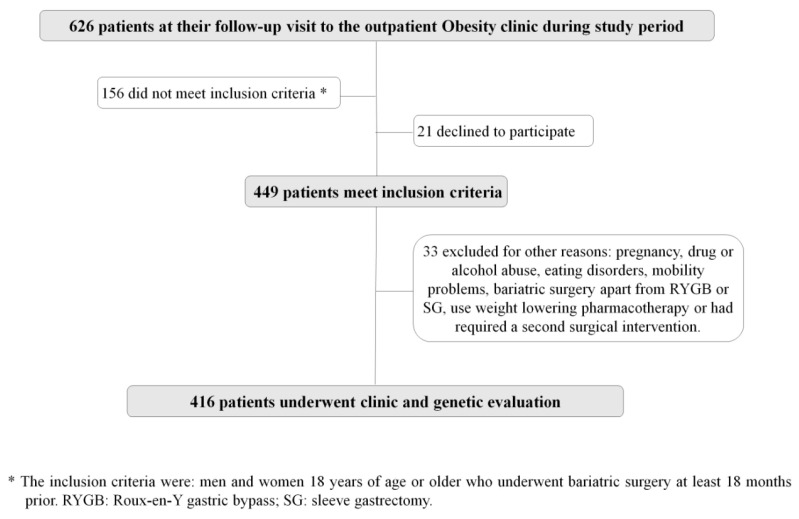
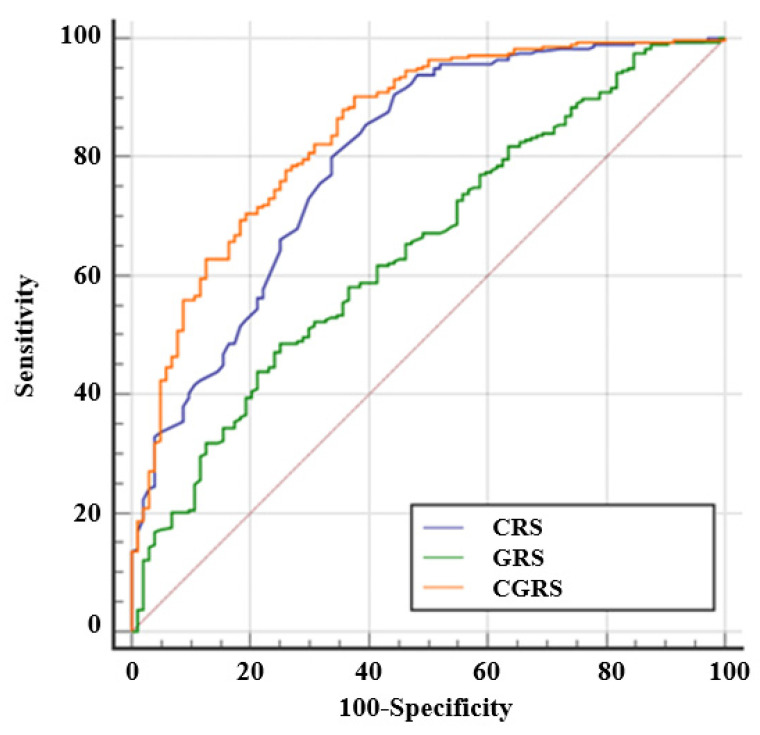
Around 30% of the patients that undergo bariatric surgery (BS) do not reach an appropriate weight loss. The OBEGEN study aimed to assess the added value of genetic testing to clinical variables in predicting weight loss after BS. A multicenter, retrospective, longitudinal, and observational study including 416 patients who underwent BS was conducted (Clinical.Trials.gov- NCT02405949). 50 single nucleotide polymorphisms (SNPs) from 39 genes were examined. Receiver Operating Characteristic (ROC) curve analysis were used to calculate sensitivity and specificity. Satisfactory response to BS was defined as at nadir excess weight loss >50%. A good predictive model of response [area under ROC of 0.845 (95% CI 0.805-0.880), < 0.001; sensitivity 90.1%, specificity 65.5%] was obtained by combining three clinical variables (age, type of surgery, presence diabetes) and nine SNPs located in ADIPOQ, MC4R, IL6, PPARG, INSIG2, CNR1, ELOVL6, PLIN1 and BDNF genes. This predictive model showed a significant higher area under ROC than the clinical score ( = 0.0186). The OBEGEN study shows the key role of combining clinical variables with genetic testing to increase the predictability of the weight loss response after BS. This finding will permit us to implement a personalized medicine which will be associated with a more cost-effective clinical practice.
接受减肥手术(BS)的患者中约有30%未能实现适当的体重减轻。OBEGEN研究旨在评估基因检测对临床变量在预测BS术后体重减轻方面的附加价值。开展了一项多中心、回顾性、纵向观察性研究,纳入416例接受BS的患者(Clinical.Trials.gov - NCT02405949)。检测了39个基因的50个单核苷酸多态性(SNP)。采用受试者工作特征(ROC)曲线分析来计算敏感性和特异性。对BS的满意反应定义为最低点时超重减轻>50%。通过结合三个临床变量(年龄、手术类型、是否存在糖尿病)和位于ADIPOQ、MC4R、IL6、PPARG、INSIG2、CNR1、ELOVL6、PLIN1和BDNF基因中的九个SNP,获得了一个良好的反应预测模型[ROC曲线下面积为0.845(95%CI 0.805 - 0.880),P<0.001;敏感性90.1%,特异性65.5%]。该预测模型的ROC曲线下面积显著高于临床评分(P = 0.0186)。OBEGEN研究表明,将临床变量与基因检测相结合在提高BS术后体重减轻反应的可预测性方面具有关键作用。这一发现将使我们能够实施个性化医疗,这将与更具成本效益的临床实践相关联。