Fansiri Thanyalak, Buddhari Darunee, Pathawong Nattaphol, Pongsiri Arissara, Klungthong Chonticha, Iamsirithaworn Sopon, Jones Anthony R, Fernandez Stefan, Srikiatkhachorn Anon, Rothman Alan L, Anderson Kathryn B, Thomas Stephen J, Endy Timothy P, Ponlawat Alongkot
Department of Entomology, Armed Forces Research Institute of Medical Sciences (AFRIMS), Bangkok 10400, Thailand.
Department of Virology, Armed Forces Research Institute of Medical Sciences (AFRIMS), Bangkok 10400, Thailand.
Pathogens. 2021 Sep 24;10(10):1234. doi: 10.3390/pathogens10101234.
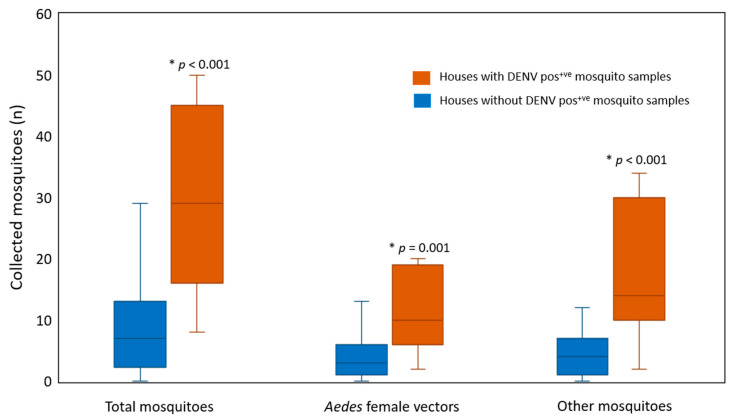
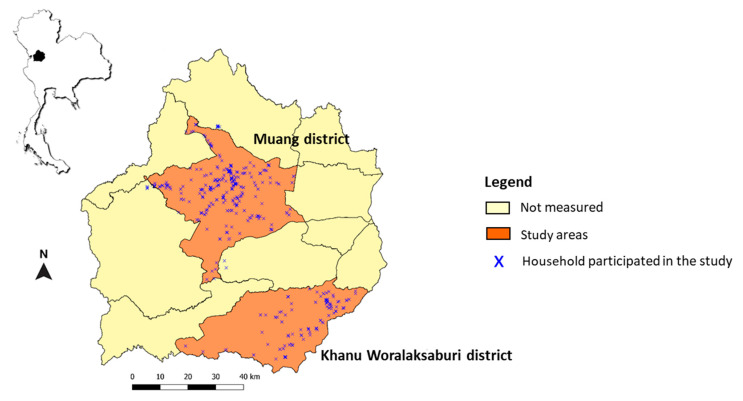
Individual houses with high risks of dengue virus (DENV) transmission might be a source of virus transmission within the neighborhood. We conducted an entomological risk assessment for DENV transmission at the household level, comprising family cohort members residing in the same location, to assess the risk for dengue virus transmitted by mosquito vectors. The studies were conducted in Kamphaeng Phet Province, Thailand, during 2016-2020. Entomological investigations were performed in 35 cohort families on day 1 and day 14 after receiving dengue case reports. DENV was found in 22 samples (4.9%) out of 451 tested samples. A significantly higher DENV infection rate was detected in vectors collected on day 1 (6.64%) compared to those collected on day 14 (1.82%). Annual vector surveillance was carried out in 732 houses, with 1002 traps catching 3653 females. The majority of the 13,228 water containers examined were made from plastic and clay, with used tires serving as a primary container, with 59.55% larval abundance. Larval indices, as indicators of dengue epidemics and to evaluate disease and vector control approaches, were calculated. As a result, high values of larval indices indicated the considerably high risk of dengue transmission in these communities.
登革热病毒(DENV)传播风险高的独栋房屋可能是社区内病毒传播的源头。我们针对家庭层面的登革热病毒传播进行了昆虫学风险评估,评估对象包括居住在同一地点的家庭成员,以评估蚊媒传播登革热病毒的风险。这些研究于2016年至2020年期间在泰国甘烹碧府进行。在收到登革热病例报告后的第1天和第14天,对35个队列家庭进行了昆虫学调查。在451个检测样本中,有22个样本(4.9%)检测出登革热病毒。与第14天采集的病媒(1.82%)相比,第1天采集的病媒中检测到的登革热病毒感染率显著更高(6.64%)。在732所房屋中进行了年度病媒监测,1002个诱捕器捕获了3653只雌蚊。在检查的13228个水容器中,大多数由塑料和粘土制成,废旧轮胎是主要容器类型,幼虫滋生率为59.55%。计算了幼虫指数,作为登革热流行的指标以及评估疾病和病媒控制方法的指标。结果显示,幼虫指数值高表明这些社区登革热传播风险相当高。