Hoang Tung, Lee Jeonghee, Kim Jeongseon
Department of Cancer Biomedical Science, National Cancer Center Graduate School of Cancer Science and Policy, Goyang 10408, Korea.
Nutrients. 2021 Oct 12;13(10):3563. doi: 10.3390/nu13103563.
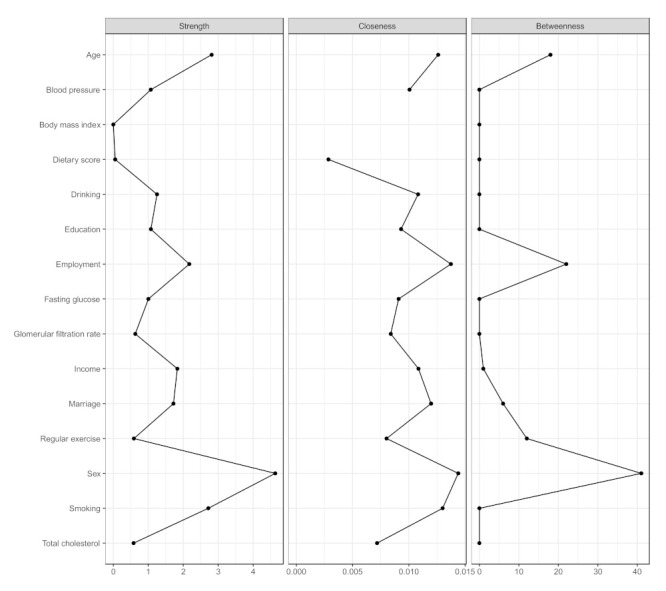
The aim of this study was to elucidate the complex interrelationships among dietary intake, demographics, and the risk of comorbidities. We applied a Gaussian graphical model to calculate the dietary scores of the participants. The network structure of dietary intake, demographics, and comorbidities was estimated in a mixed graphical model. The centrality indices of the nodes (strength (S), closeness (C), and betweenness (B)) were measured to identify the central node. Multinomial logistic regression was used to examine the association between the factors and comorbidities. Among 7423 participants, the strongest pairwise interactions were found between sex and smoking (1.56), sex and employment (0.66), sex and marital status (0.58), marital status and income (0.65), and age and employment (0.58). Among the factors in the network, sex played a central role (S = 4.63, C = 0.014, B = 41), followed by age (S = 2.81, C = 0.013, B = 18), smoking (S = 2.72, C = 0.013, B = 0), and employment (S = 2.17, C = 0.014, B = 22). While the odds of hypertension and diabetes were significantly higher among females than males, an inverse association was observed between high cholesterol and moderate chronic kidney disease. Among these factors, dietary intake was not a strongly interacting factor in the network, whereas age was consistently associated with the comorbidities of hypertension, high cholesterol, diabetes, and chronic kidney disease.
本研究的目的是阐明饮食摄入、人口统计学特征与合并症风险之间复杂的相互关系。我们应用高斯图形模型来计算参与者的饮食得分。在混合图形模型中估计饮食摄入、人口统计学特征和合并症的网络结构。测量节点的中心性指标(强度(S)、接近度(C)和中介中心性(B))以识别中心节点。使用多项逻辑回归来检验这些因素与合并症之间的关联。在7423名参与者中,发现性别与吸烟(1.56)、性别与就业(0.66)、性别与婚姻状况(0.58)、婚姻状况与收入(0.65)以及年龄与就业(0.58)之间存在最强的成对相互作用。在网络中的因素中,性别起核心作用(S = 4.63,C = 0.014,B = 41),其次是年龄(S = 2.81,C = 0.013,B = 18)、吸烟(S = 2.72,C = 0.013,B = 0)和就业(S = 2.17,C = 0.014,B = 22)。虽然女性患高血压和糖尿病的几率显著高于男性,但高胆固醇与中度慢性肾脏病之间存在负相关。在这些因素中,饮食摄入在网络中不是一个强相互作用因素,而年龄始终与高血压、高胆固醇、糖尿病和慢性肾脏病的合并症相关。