Institute of Molecular Medicine, Feinstein Institutes for Medical Research, Manhasset, New York, USA
Institute of Molecular Medicine, Feinstein Institutes for Medical Research, Manhasset, New York, USA.
Lupus Sci Med. 2021 Oct;8(1). doi: 10.1136/lupus-2021-000559.
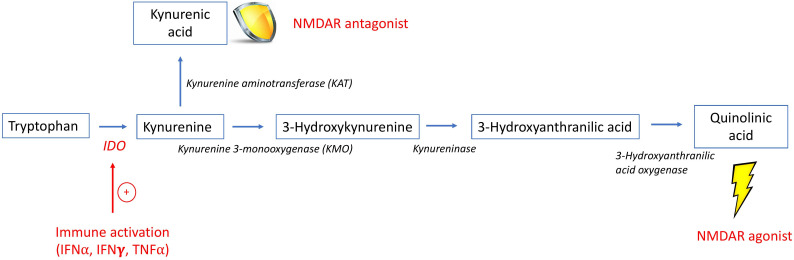
Interferon-alpha, an important contributor to SLE pathogenesis, induces the enzyme indoleamine 2,3-dioxygenase in the kynurenine/tryptophan (KYN/TRP) pathway. This leads to a potentially neurotoxic imbalance in the KYN/TRP pathway metabolites, quinolinic acid (QA), an N-methyl D-aspartate glutamatergic receptor (NMDAR) agonist, and kynurenic acid (KA), an NMDAR antagonist. We determined whether QA/KA ratios associate with cognitive dysfunction (CD) and depression in SLE.
This cross-sectional study included 74 subjects with SLE and 74 healthy control (HC) subjects; all without history of neuropsychiatric disorders. Serum metabolite levels (KYN, TRP, QA, KA) were measured concurrently with assessments of cognition (Automated Neuropsychological Assessment Metrics (ANAM), 2×2 array), mood and pain, and compared between SLE and HC. Multivariable modelling in SLE was used to evaluate associations of metabolites with cognitive performance and depression.
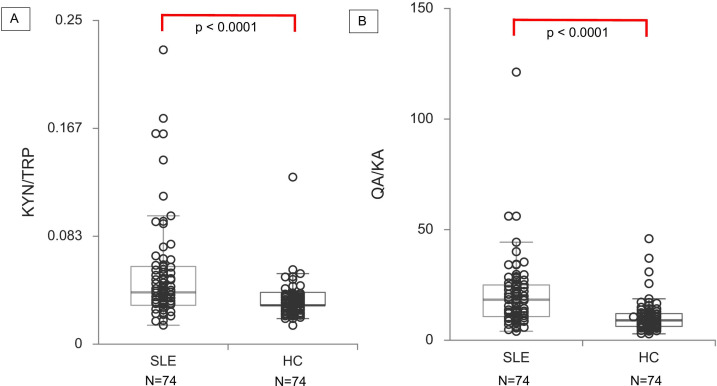
Serum KYN/TRP and QA/KA ratios were elevated in SLE versus HC (p<0.0001). SLE performed worse than HC on four of five ANAM tests (all p≤0.02) and the 2×2 array (p<0.01), and had higher depression scores (p<0.01). In SLE, elevated QA/KA ratios correlated with poor performance on Match to Sample (MTS), a working memory and visuospatial processing task (p<0.05). Subjects with SLE with elevated QA/KA ratios also had slightly higher odds of depression, but this did not reach significance (p=0.09). Multivariable modelling in SLE confirmed an association between QA/KA ratios and poor MTS performance when considering potentially confounding factors (p<0.05).
Elevated serum KYN/TRP and QA/KA ratios confirm KYN/TRP pathway activation in SLE. The novel association between increased QA/KA ratios and poor cognitive performance supports further study of this pathway as a potential biomarker or therapeutic target for SLE-mediated CD.
干扰素-α是系统性红斑狼疮(SLE)发病机制的重要因素,可诱导犬尿氨酸/色氨酸(KYN/TRP)途径中的酶吲哚胺 2,3-双加氧酶。这导致 KYN/TRP 途径代谢物中潜在的神经毒性失衡,喹啉酸(QA)是 N-甲基-D-天冬氨酸谷氨酸能受体(NMDAR)激动剂,犬尿氨酸(KA)是 NMDAR 拮抗剂。我们确定 QA/KA 比值是否与 SLE 中的认知功能障碍(CD)和抑郁相关。
这项横断面研究纳入了 74 例 SLE 患者和 74 例健康对照(HC)患者;所有患者均无神经精神疾病史。同时评估认知功能(自动神经心理评估指标(ANAM)、2×2 数组)、情绪和疼痛,并与 SLE 和 HC 进行比较。SLE 中的多变量模型用于评估代谢物与认知表现和抑郁的相关性。
与 HC 相比,SLE 患者的血清 KYN/TRP 和 QA/KA 比值升高(p<0.0001)。SLE 在五个 ANAM 测试中的四个测试(均 p≤0.02)和 2×2 数组(p<0.01)上的表现均差于 HC,且抑郁评分更高(p<0.01)。在 SLE 中,升高的 QA/KA 比值与匹配样本(MTS)的表现相关,MTS 是一项工作记忆和视空间处理任务(p<0.05)。QA/KA 比值升高的 SLE 患者也有略高的抑郁几率,但未达到统计学意义(p=0.09)。SLE 中的多变量模型在考虑潜在混杂因素时,证实了 QA/KA 比值与 MTS 表现不佳之间的关联(p<0.05)。
升高的血清 KYN/TRP 和 QA/KA 比值证实了 SLE 中 KYN/TRP 途径的激活。增加的 QA/KA 比值与认知表现不佳之间的新关联支持进一步研究该途径作为 SLE 介导的 CD 的潜在生物标志物或治疗靶点。