Department of Genetics, Hyogo College of Medicine, Nishinomiya, Japan.
Department of Urology, Hyogo College of Medicine, Nishinomiya, Japan.
Cancer Sci. 2022 Jan;113(1):297-307. doi: 10.1111/cas.15170. Epub 2021 Nov 3.
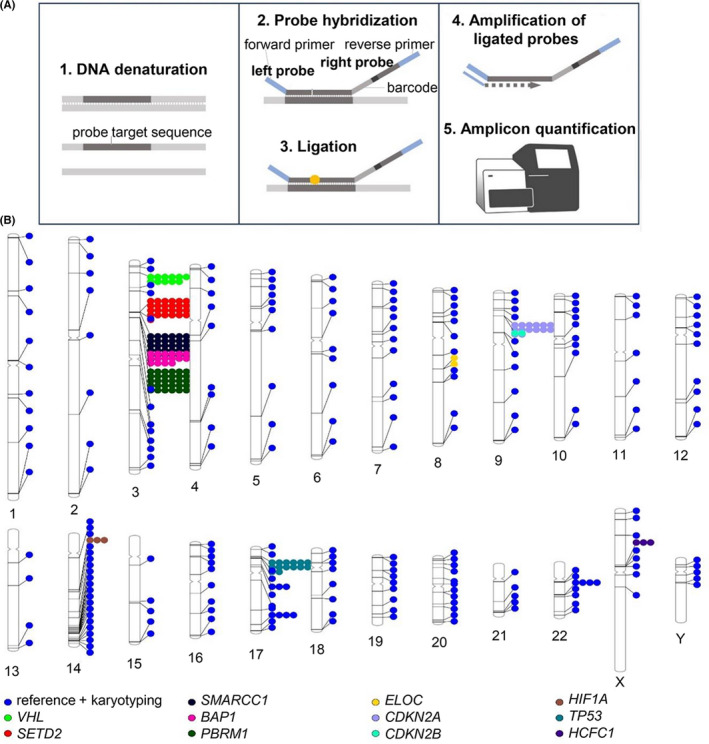
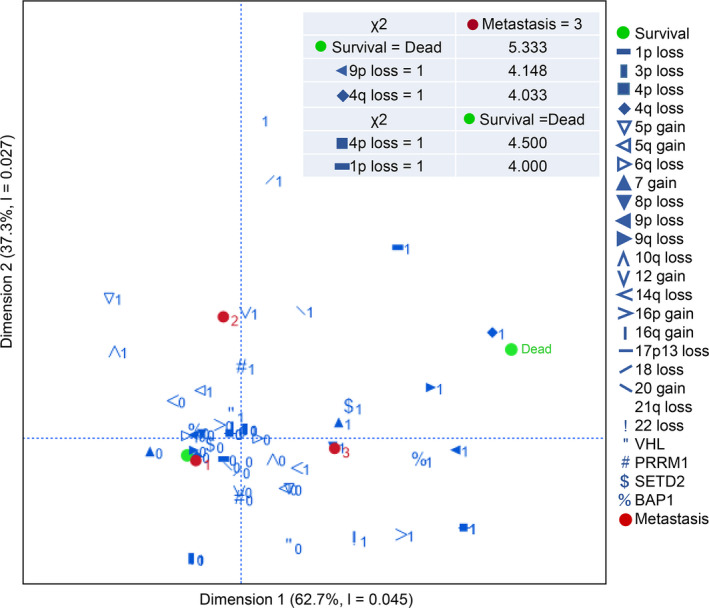
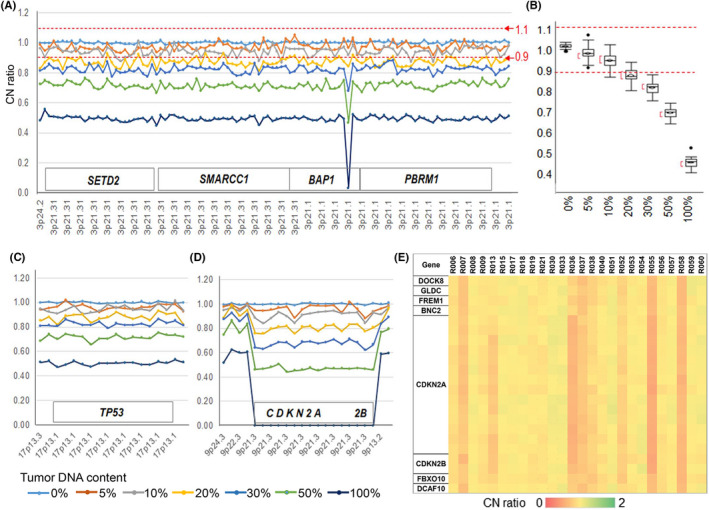
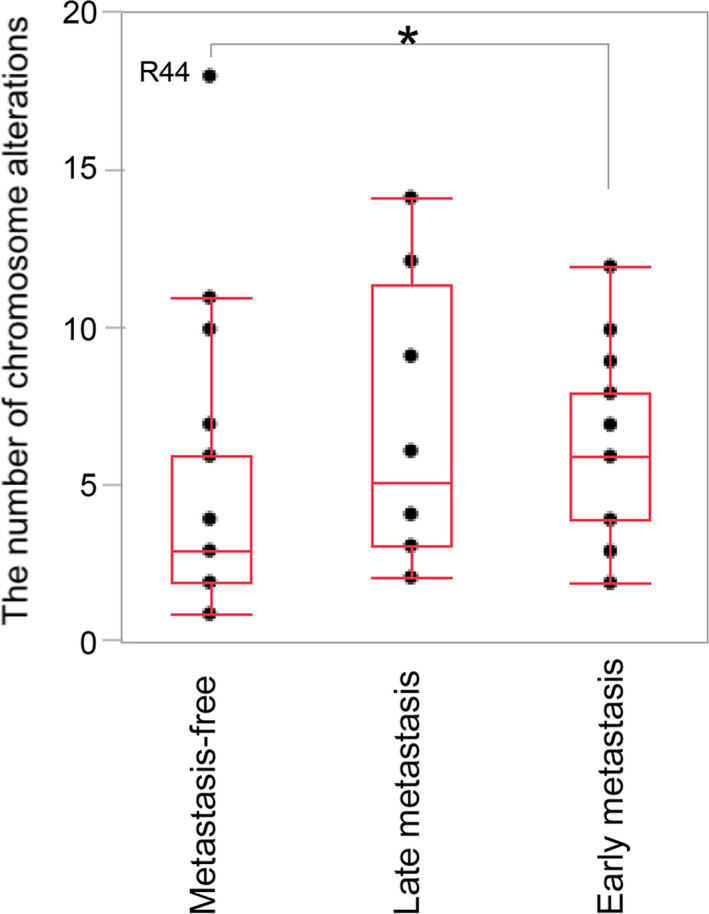
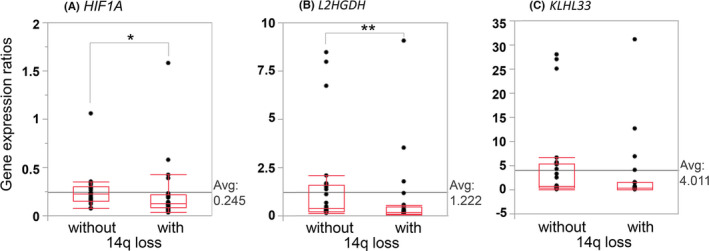
Precise quantification of copy-number alterations (CNAs) in a tumor genome is difficult. We have applied a comprehensive copy-number analysis method, digital multiplex ligation-dependent probe amplification (digitalMLPA), for targeted gene copy-number analysis in clear cell renal cell carcinoma (ccRCC). Copy-number status of all chromosomal arms and 11 genes was determined in 60 ccRCC samples. Chromosome 3p loss and 5q gain, known as early changes in ccRCC development, as well as losses at 9p and 14q were detected in 56/60 (93.3%), 31/60 (51.7%), 11/60 (18.3%), and 33/60 (55%), respectively. Through gene expression analysis, a significant positive correlation was detected in terms of 14q loss determined using digitalMLPA and downregulation of mRNA expression ratios with HIF1A and L2HGDH (P = .0253 and .0117, respectively). Patients with early metastasis (<1 y) (n = 18) showed CNAs in 6 arms (in median), whereas metastasis-free patients (n = 34) showed those in significantly less arms (3 arms in median) (P = .0289). In particular, biallelic deletion of CDKN2A/2B was associated with multiple CNAs (≥7 arms) in 3 tumors. Together with sequence-level mutations in genes VHL, PBRM1, SETD2, and BAP1, we performed multiple correspondence analysis, which identified the association of 9p loss and 4q loss with early metastasis (both P < .05). This analysis indicated the association of 4p loss and 1p loss with poor survival (both, P < .05). These findings suggest that CNAs have essential roles in aggressiveness of ccRCC. We showed that our approach of measuring CNA through digitalMLPA will facilitate the selection of patients who may develop metastasis.
精确量化肿瘤基因组中的拷贝数改变(CNAs)较为困难。我们应用了一种全面的拷贝数分析方法——数字多重连接依赖探针扩增(digitalMLPA),对透明细胞肾细胞癌(ccRCC)中的靶向基因拷贝数进行分析。在 60 例 ccRCC 样本中,确定了所有染色体臂和 11 个基因的拷贝数状态。在 60 例 ccRCC 样本中,检测到了 56/60(93.3%)例染色体 3p 缺失和 5q 获得,这是 ccRCC 发展早期的改变,以及 9p 和 14q 的缺失分别为 31/60(51.7%)、11/60(18.3%)和 33/60(55%)。通过基因表达分析,发现数字 MLPA 检测到的 14q 缺失与 HIF1A 和 L2HGDH 的 mRNA 表达比值下调呈显著正相关(P =.0253 和.0117)。18 例早期转移(<1 年)患者(n=18)的 CNA 涉及 6 条臂(中位数),而无转移患者(n=34)的 CNA 涉及明显较少的臂(中位数 3 条臂)(P =.0289)。特别是,3 例肿瘤中 CDKN2A/2B 的双等位基因缺失与多个 CNA(≥7 条臂)相关。结合 VHL、PBRM1、SETD2 和 BAP1 基因的序列水平突变,我们进行了多元对应分析,发现 9p 缺失和 4q 缺失与早期转移相关(均 P<.05)。该分析表明 4p 缺失和 1p 缺失与不良预后相关(均 P<.05)。这些发现表明 CNA 在 ccRCC 的侵袭性中具有重要作用。我们表明,通过 digitalMLPA 测量 CNA 的方法将有助于选择可能发生转移的患者。