Aga Khan University Hospital, Nairobi (AKUHN), Nairobi, Kenya.
BMC Med Educ. 2021 Oct 23;21(1):537. doi: 10.1186/s12909-021-02974-4.
Evidence based medicine (EBM) helps clinicians to integrate latest research evidence into their daily clinical practice. There is a need for all healthcare professions to adopt it in order to provide safe and most cost-effective care. Postgraduate doctors are at the frontline of healthcare delivery and all medical institutions should strive to produce practitioners of EBM. Studies have shown that physicians are still struggling to adapt to this paradigm shift in the practice of medicine but very few studies have been done in Sub Saharan Africa. This study explored the self-reported knowledge, attitudes, practices and barriers of evidence-based practice among resident physicians in a tertiary teaching hospital.
A mixed methods cross-sectional study that used convergent parallel design was conducted. The quantitative arm was conducted among all residents enrolled in the Master of Medicine programme at Aga Khan University Hospital Nairobi (AKUHN). It included an online survey exploring self-reported knowledge, attitudes, practices and barriers of EBM among all residents. Simultaneously, semi-structured In-Depth Interviews were carried out among 18 purposefully selected residents in order to explore the same themes in more depth.
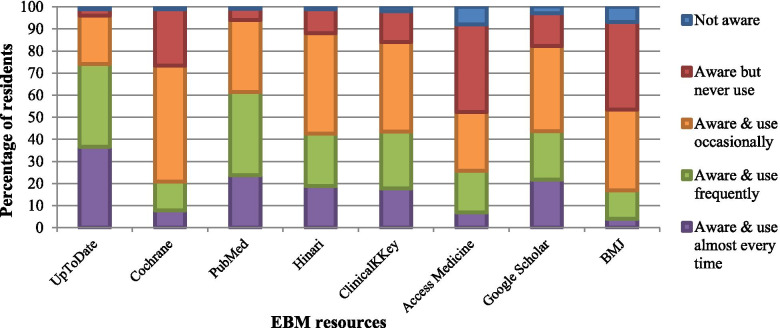
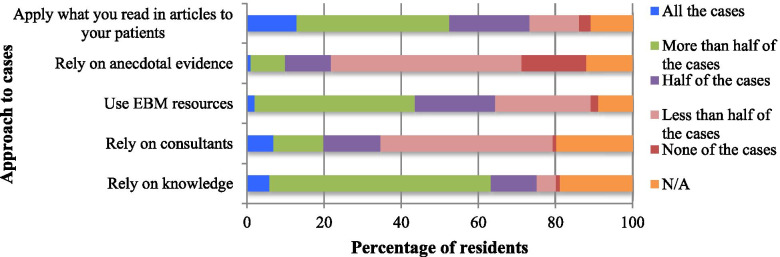
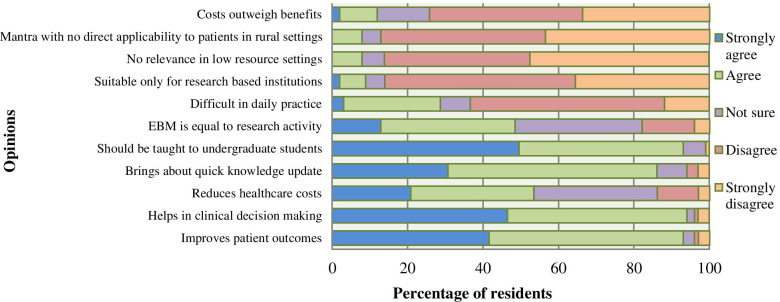
One hundred and one residents (99%) responded to the survey. The mean scores for self-reported knowledge, attitude and practice of EBM among residents were 73.88, 66.96 and 63.19% respectively, which were generally higher than in comparable studies. There was a significant association between year of residency and practice of EBM. The most common barriers faced by residents were lack of time, lack of EBM skills and patients' unawareness about EBM. From the qualitative study, residents demonstrated good knowledge and support of EBM but practice remained relatively poor. Barriers to EBM were characterized by lack of motivation, time, skills and resources, patient overload and fear of challenging consultants.
There was good understanding and support of EBM among residents at AKUHN, though challenges were experienced in regards to practice of EBM because of lack of time and skills. Therefore resources should be allocated towards integrating EBM into undergraduate medical curricula to cultivate critical thinking skills at an early stage before transition into residency.
循证医学(EBM)帮助临床医生将最新的研究证据融入日常临床实践中。所有医疗保健专业人员都需要采用循证医学,以提供安全且最具成本效益的护理。住院医师处于医疗保健服务的第一线,所有医疗机构都应努力培养循证医学的实践者。研究表明,医生仍然在努力适应医学实践中的这种范式转变,但在撒哈拉以南非洲地区,很少有研究涉及这一领域。本研究旨在探讨三级教学医院住院医师对循证医学实践的自我报告知识、态度、实践和障碍。
采用收敛平行设计的混合方法横断面研究。定量部分在肯尼亚内罗毕 Aga Khan 大学医院(AKUHN)攻读医学硕士课程的所有住院医师中进行。它包括一项在线调查,旨在了解所有住院医师自我报告的循证医学知识、态度、实践和障碍。同时,对 18 名有目的地选择的住院医师进行了半结构化深入访谈,以更深入地探讨相同的主题。
101 名住院医师(99%)对调查做出了回应。住院医师自我报告的循证医学知识、态度和实践的平均得分为 73.88、66.96 和 63.19%,这一分数普遍高于类似研究中的分数。住院年限与循证医学实践之间存在显著关联。住院医师面临的最常见障碍是缺乏时间、缺乏循证医学技能和患者对循证医学缺乏了解。从定性研究中可以看出,住院医师对循证医学有很好的了解和支持,但实践仍然相对较差。循证医学的障碍特征是缺乏动机、时间、技能和资源、患者过多以及对挑战顾问的恐惧。
AKUHN 的住院医师对循证医学有很好的理解和支持,尽管在实践循证医学方面存在挑战,因为缺乏时间和技能。因此,应将资源分配用于将循证医学纳入本科医学课程,以便在进入住院医师阶段之前培养批判性思维技能。