Child Study Center, Yale University School of Medicine, New Haven, CT, USA.
Department of Diagnostic Radiology, Yale University School of Medicine, New Haven, CT, USA.
Mol Psychiatry. 2022 Feb;27(2):985-999. doi: 10.1038/s41380-021-01317-5. Epub 2021 Oct 25.
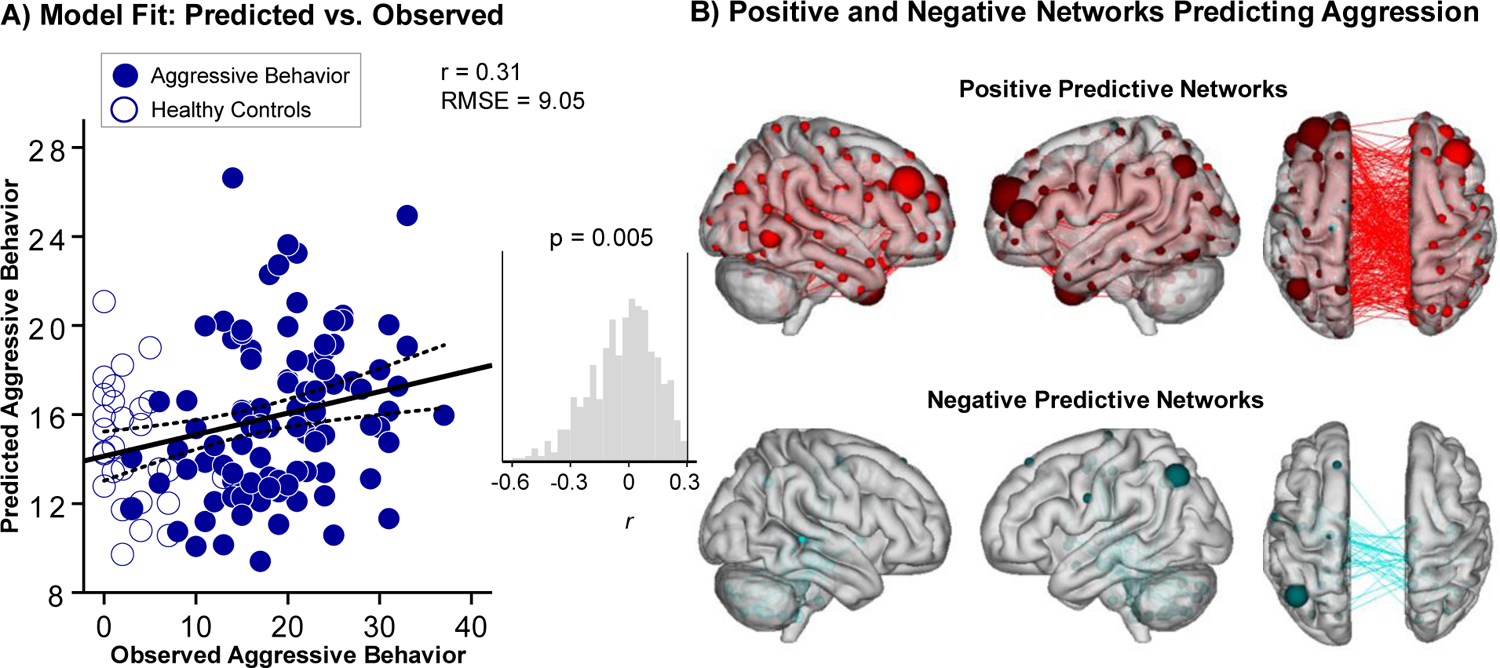
Disruptions in frontoparietal networks supporting emotion regulation have been long implicated in maladaptive childhood aggression. However, the association of connectivity between large-scale functional networks with aggressive behavior has not been tested. The present study examined whether the functional organization of the connectome predicts severity of aggression in children. This cross-sectional study included a transdiagnostic sample of 100 children with aggressive behavior (27 females) and 29 healthy controls without aggression or psychiatric disorders (13 females). Severity of aggression was indexed by the total score on the parent-rated Reactive-Proactive Aggression Questionnaire. During fMRI, participants completed a face emotion perception task of fearful and calm faces. Connectome-based predictive modeling with internal cross-validation was conducted to identify brain networks that predicted aggression severity. The replication and generalizability of the aggression predictive model was then tested in an independent sample of children from the Adolescent Brain Cognitive Development (ABCD) study. Connectivity predictive of aggression was identified within and between networks implicated in cognitive control (medial-frontal, frontoparietal), social functioning (default mode, salience), and emotion processing (subcortical, sensorimotor) (r = 0.31, RMSE = 9.05, p = 0.005). Out-of-sample replication (p < 0.002) and generalization (p = 0.007) of findings predicting aggression from the functional connectome was demonstrated in an independent sample of children from the ABCD study (n = 1791; n = 1701). Individual differences in large-scale functional networks contribute to variability in maladaptive aggression in children with psychiatric disorders. Linking these individual differences in the connectome to variation in behavioral phenotypes will advance identification of neural biomarkers of maladaptive childhood aggression to inform targeted treatments.
前额顶网络支持情绪调节的中断一直与儿童期适应不良的攻击性有关。然而,尚未测试功能网络之间的连通性与攻击行为的关联。本研究旨在检验连接组的功能组织是否可以预测儿童的攻击性严重程度。这项横断面研究包括了一个有 100 名具有攻击性的儿童(27 名女性)和 29 名没有攻击性或精神疾病的健康对照组儿童(13 名女性)的跨诊断样本。攻击性严重程度由父母评定的反应性-主动性攻击性问卷的总分来衡量。在 fMRI 期间,参与者完成了恐惧和平静面孔的面孔情绪知觉任务。采用内部交叉验证的连接组预测建模来识别预测攻击性严重程度的大脑网络。然后,在来自青少年大脑认知发展(ABCD)研究的儿童的独立样本中测试了攻击性预测模型的复制和泛化能力。在认知控制(内侧额叶、额顶叶)、社会功能(默认模式、突显)和情绪处理(皮质下、感觉运动)中,识别出与攻击性相关的网络内和网络间连通性(r=0.31,RMSE=9.05,p=0.005)。在来自 ABCD 研究的儿童的独立样本中,进行了攻击性预测的功能连接体的样本外复制(p<0.002)和泛化(p=0.007)(n=1791;n=1701)。精神障碍儿童的大尺度功能网络的个体差异导致了适应不良攻击性的变异性。将这些连接组中的个体差异与行为表型的变化联系起来,将有助于确定适应不良儿童攻击性的神经生物标志物,从而为有针对性的治疗提供信息。