Rueda-Ruzafa Lola, Herrera-Pérez Salvador, Campos-Ríos Ana, Lamas J A
CINBIO, Laboratory of Neuroscience, University of Vigo, Vigo, Spain.
Laboratory of Neuroscience, Galicia Sur Health Research Institute (IISGS), Vigo, Spain.
Front Cell Neurosci. 2021 Oct 6;15:744702. doi: 10.3389/fncel.2021.744702. eCollection 2021.
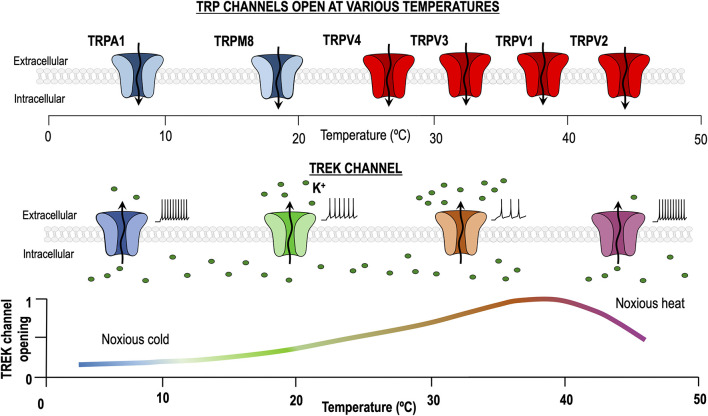
Internal human body normal temperature fluctuates between 36.5 and 37.5°C and it is generally measured in the oral cavity. Interestingly, most electrophysiological studies on the functioning of ion channels and their role in neuronal behavior are carried out at room temperature, which usually oscillates between 22 and 24°C, even when thermosensitive channels are studied. We very often forget that if the core of the body reached that temperature, the probability of death from cardiorespiratory arrest would be extremely high. Does this mean that we are studying ion channels in dying neurons? Thousands of electrophysiological experiments carried out at these low temperatures suggest that most neurons tolerate this aggression quite well, at least for the duration of the experiments. This also seems to happen with ion channels, although studies at different temperatures indicate large changes in both, neuron and channel behavior. It is known that many chemical, physical and therefore physiological processes, depend to a great extent on body temperature. Temperature clearly affects the kinetics of numerous events such as chemical reactions or conformational changes in proteins but, what if these proteins constitute ion channels and these channels are specifically designed to detect changes in temperature? In this review, we discuss the importance of the potassium channels of the TREK subfamily, belonging to the recently discovered family of two-pore domain channels, in the transduction of thermal sensitivity in different cell types.
人体内部的正常体温在36.5至37.5摄氏度之间波动,通常在口腔中测量。有趣的是,大多数关于离子通道功能及其在神经元行为中作用的电生理研究都是在室温下进行的,室温通常在22至24摄氏度之间波动,即使在研究热敏通道时也是如此。我们常常忘记,如果人体核心温度达到那个水平,因心肺骤停而死亡的概率会极高。这是否意味着我们正在研究濒死神经元中的离子通道呢?在这些低温下进行的数千次电生理实验表明,大多数神经元至少在实验期间能够很好地耐受这种侵害。离子通道似乎也是如此,尽管不同温度下的研究表明神经元和通道的行为都有很大变化。众所周知,许多化学、物理以及生理过程在很大程度上取决于体温。温度显然会影响许多事件的动力学,如化学反应或蛋白质的构象变化,但是,如果这些蛋白质构成离子通道,而这些通道又专门设计用于检测温度变化呢?在这篇综述中,我们讨论了TREK亚家族的钾通道在不同细胞类型热敏感性转导中的重要性,该亚家族属于最近发现的双孔结构域通道家族。