Pan Yating, Qian Yunyang, Zheng Xusheng, Chu Sheng-Qi, Yang Yijun, Ding Chunmei, Wang Xi, Yu Shu-Hong, Jiang Hai-Long
Hefei National Laboratory for Physical Sciences at the Microscale, CAS Key Laboratory of Soft Matter Chemistry, Department of Chemistry, University of Science and Technology of China, Hefei 230026, China.
National Synchrotron Radiation Laboratory (NSRL), University of Science and Technology of China, Hefei 230029, China.
Natl Sci Rev. 2020 Sep 3;8(1):nwaa224. doi: 10.1093/nsr/nwaa224. eCollection 2021 Jan.
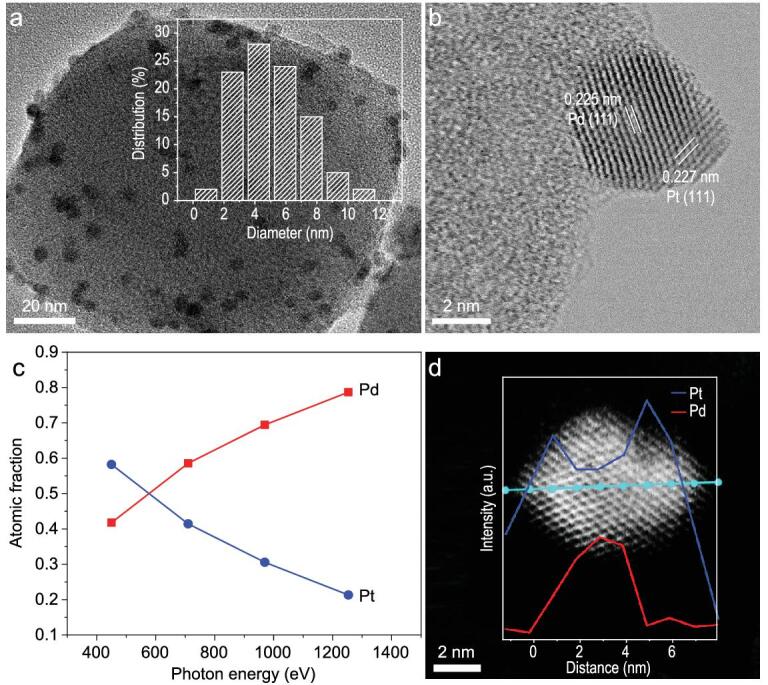
While the surface charge state of co-catalysts plays a critical role for boosting photocatalysis, studies on surface charge regulation via their precise structure control remain extremely rare. Herein, metal-organic framework (MOF) stabilized bimetallic Pd@Pt nanoparticles, which feature adjustable Pt coordination environment and a controlled structure from core-shell to single-atom alloy (SAA), have been fabricated. Significantly, apart from the formation of a Mott-Schottky junction in a conventional way, we elucidate that Pt surface charge regulation can be alternatively achieved by changing its coordination environment and the structure of the Pd@Pt co-catalyst, where the charge between Pd and Pt is redistributed. As a result, the optimized Pd@Pt/MOF composite, which involves an unprecedented SAA co-catalyst, exhibits exceptionally high photocatalytic hydrogen production activity, far surpassing its corresponding counterparts.
虽然助催化剂的表面电荷状态对促进光催化起着关键作用,但通过精确的结构控制来调节表面电荷的研究仍然极为罕见。在此,制备了金属有机框架(MOF)稳定的双金属Pd@Pt纳米颗粒,其具有可调节的Pt配位环境以及从核壳结构到单原子合金(SAA)的可控结构。值得注意的是,除了以传统方式形成莫特-肖特基结外,我们还阐明了通过改变Pt的配位环境和Pd@Pt助催化剂的结构,可实现对Pt表面电荷的调节,其中Pd和Pt之间的电荷会重新分布。结果,优化后的Pd@Pt/MOF复合材料,其中包含前所未有的SAA助催化剂,表现出极高的光催化产氢活性,远远超过其相应的对照物。