
体外膜肺氧合决策的关键因素:一项中德因素调查
Key Factors in Decision Making for ECLS: A Binational Factorial Survey.
机构信息
Institute of Biomedical Ethics and History of Medicine, University of Zurich, Zurich, Switzerland.
IInstitute of Intensive Medicine, University Hospital of Zurich, Zurich, Switzerland.
出版信息
Med Decis Making. 2022 Apr;42(3):313-325. doi: 10.1177/0272989X211040815. Epub 2021 Oct 23.
BACKGROUND
Extracorporeal life support (ECLS) provides support to patients with cardiopulmonary failure refractory to conventional therapy. While ECLS is potentially life-saving, it is associated with severe complications; decision making to initiate ECLS must, therefore, carefully consider which patients ECLS potentially benefits despite its consequences.
OBJECTIVE
To answer 2 questions: First, which medically relevant patient factors influence decisions to initiate ECLS? Second, what are factors relevant to decisions to withdraw a running ECLS treatment?
METHODS
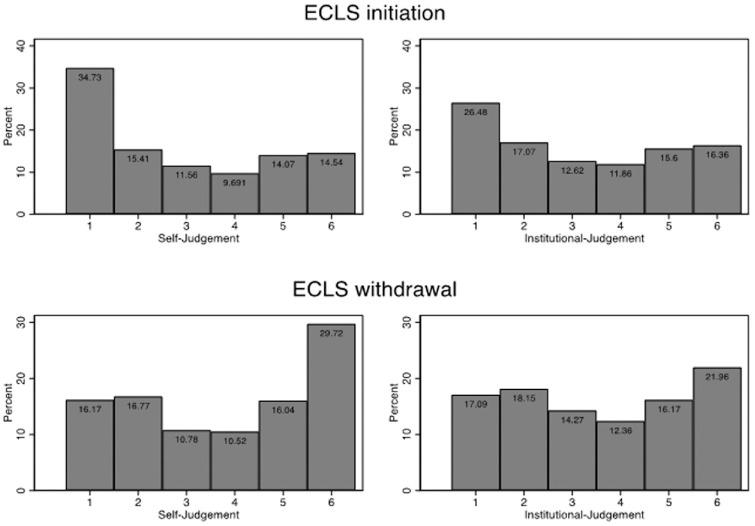
We conducted a factorial survey among 420 physicians from 111 hospitals in Switzerland and Germany. The study included 2 scenarios: 1 explored willingness to initiate ECLS, and 1 explored willingness to withdraw a running ECLS treatment. Each participant responded to 5 different vignettes for each scenario. Vignettes were analyzed using mixed-effects regression models with random intercepts.
RESULTS
Factors in the vignettes such as patients' age, treatment costs, therapeutic goal, comorbidities, and neurological outcome significantly influenced the decision to initiate ECLS. When it came to the decision to withdraw ECLS, patients' age, days on ECLS, criteria for discontinuation, condition of the patient, comorbidities, and neurological outcome were significant factors. In both scenarios, patients' age and neurological outcome were the most influential factors.
CONCLUSIONS
This study provided insights into physicians' decision making processes about ECLS initiation and withdrawal. Patients' age and neurological status were the strongest factors influencing decisions regarding initiation of ECLS as well as for ECLS withdrawal. The findings may contribute to a more refined understanding of complex decision making for ECLS.
背景
体外生命支持(ECLS)为对常规治疗无反应的心肺衰竭患者提供支持。虽然 ECLS 有潜在的救生作用,但它也会引起严重的并发症;因此,启动 ECLS 的决策必须仔细考虑哪些患者可能受益于 ECLS,尽管会有相应的后果。
目的
回答两个问题:首先,哪些医学相关的患者因素会影响启动 ECLS 的决策?其次,哪些因素与正在进行的 ECLS 治疗的撤机决策相关?
方法
我们在瑞士和德国的 111 家医院中对 420 名医生进行了析因调查。该研究包括 2 个场景:一个探索启动 ECLS 的意愿,另一个探索正在进行的 ECLS 治疗的撤机意愿。每个参与者对每个场景的 5 个不同病例进行了回答。病例采用混合效应回归模型进行分析,具有随机截距。
结果
病例中的因素,如患者年龄、治疗费用、治疗目标、合并症和神经功能预后,显著影响启动 ECLS 的决策。当涉及到 ECLS 撤机的决策时,患者年龄、ECLS 治疗天数、停止标准、患者状况、合并症和神经功能预后是重要的因素。在这两种情况下,患者年龄和神经功能预后都是最具影响力的因素。
结论
本研究深入了解了医生在启动和停止 ECLS 方面的决策过程。患者年龄和神经状况是影响启动 ECLS 决策以及 ECLS 撤机决策的最强因素。这些发现可能有助于更深入地了解 ECLS 复杂决策的制定。



 Zotero 插件