EcoHealth Alliance, New York, NY 10001-2320, USA.
Centre for Integrative Ecology, School of Life and Environmental Science, Deakin University, Burwood, VIC 3216, Australia.
Viruses. 2021 Sep 23;13(10):1908. doi: 10.3390/v13101908.
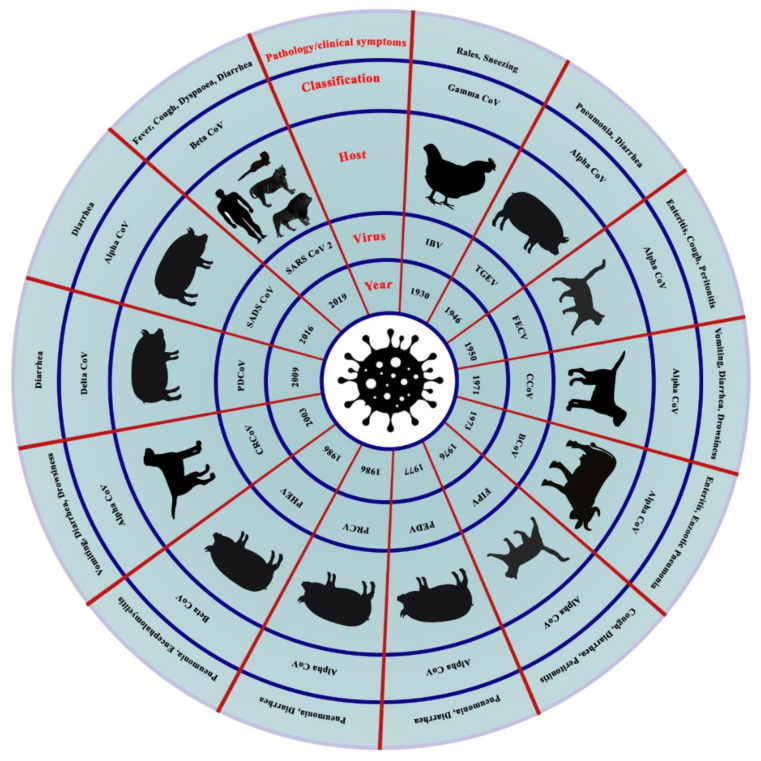
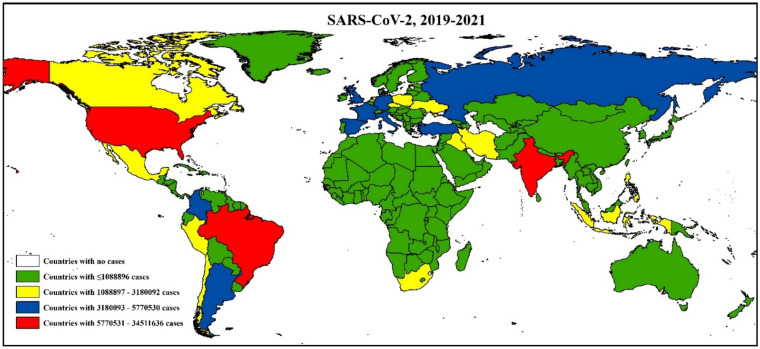
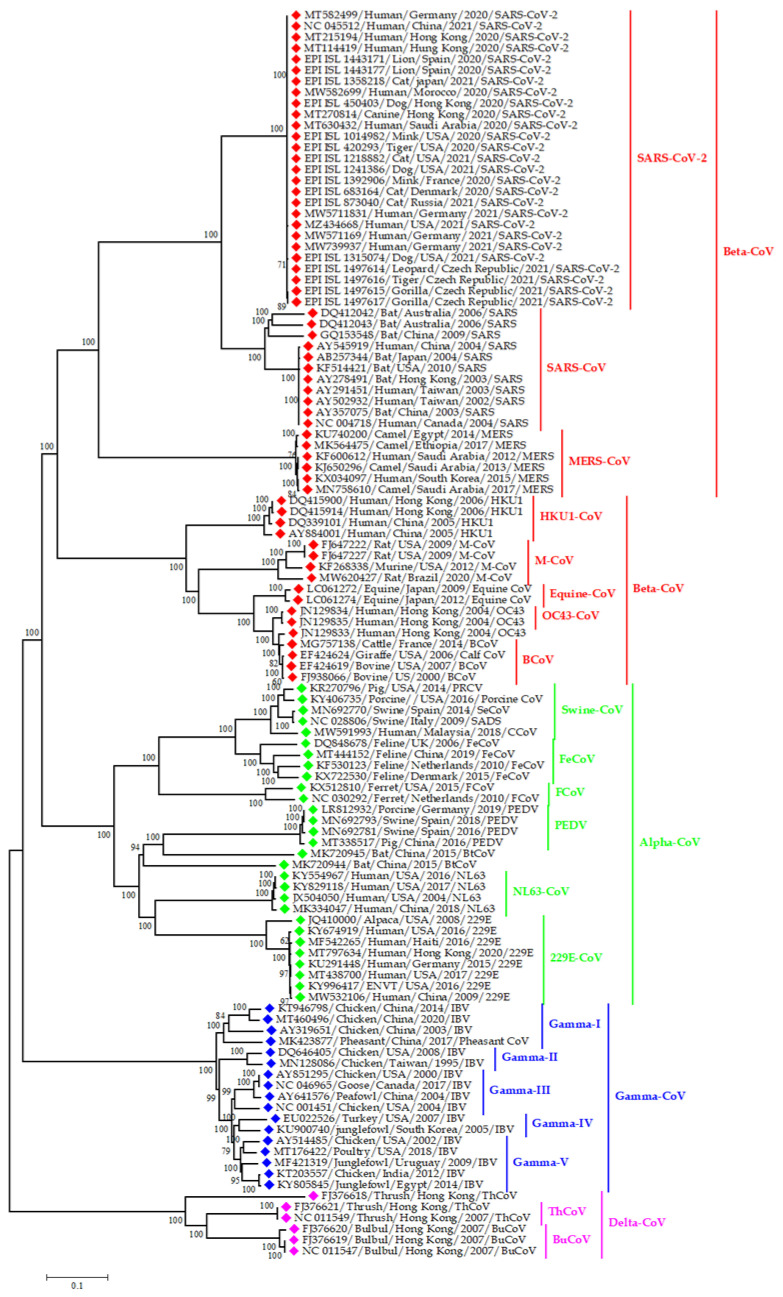
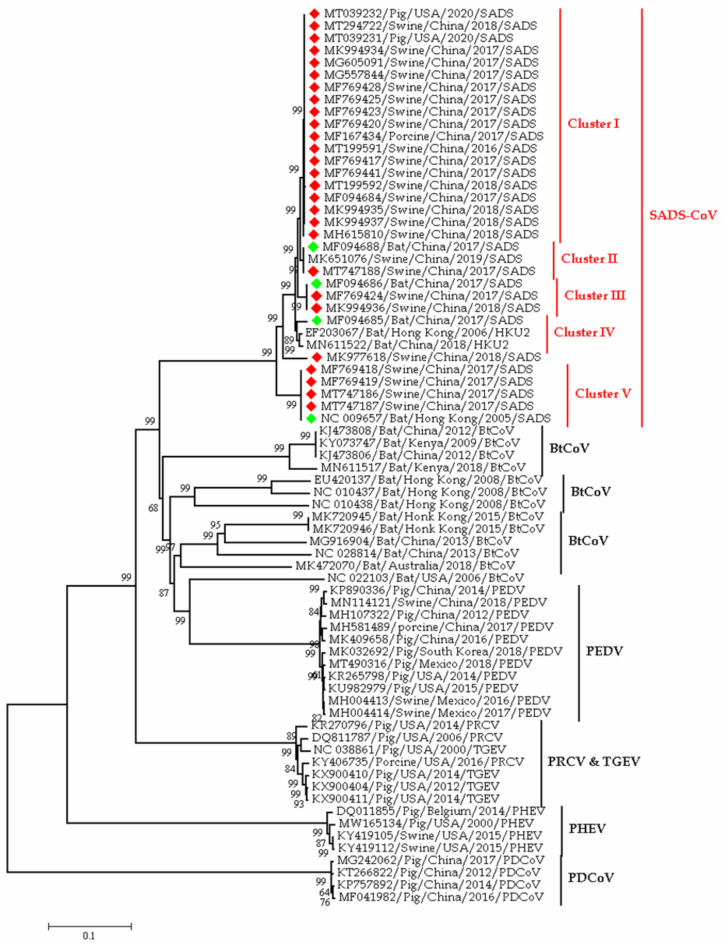
Diverse coronavirus (CoV) strains can infect both humans and animals and produce various diseases. CoVs have caused three epidemics and pandemics in the last two decades, and caused a severe impact on public health and the global economy. Therefore, it is of utmost importance to understand the emergence and evolution of endemic and emerging CoV diversity in humans and animals. For diverse bird species, the Infectious Bronchitis Virus is a significant one, whereas feline enteric and canine coronavirus, recombined to produce feline infectious peritonitis virus, infects wild cats. Bovine and canine CoVs have ancestral relationships, while porcine CoVs, especially SADS-CoV, can cross species barriers. Bats are considered as the natural host of diverse strains of alpha and beta coronaviruses. Though MERS-CoV is significant for both camels and humans, humans are nonetheless affected more severely. MERS-CoV cases have been reported mainly in the Arabic peninsula since 2012. To date, seven CoV strains have infected humans, all descended from animals. The severe acute respiratory syndrome coronaviruses (SARS-CoV and SARS-CoV-2) are presumed to be originated in bats that severely infect humans with spillover to multiple domestic and wild animals. Emerging alpha and delta variants of SARS-CoV-2 were detected in pets and wild animals. Still, the intermediate hosts and all susceptible animal species remain unknown. SARS-CoV-2 might not be the last CoV to cross the species barrier. Hence, we recommend developing a universal CoV vaccine for humans so that any future outbreak can be prevented effectively. Furthermore, a One Health approach coronavirus surveillance should be implemented at human-animal interfaces to detect novel coronaviruses before emerging to humans and to prevent future epidemics and pandemics.
多种冠状病毒(CoV)株可感染人类和动物,并引起多种疾病。在过去的二十年中,CoV 已经引发了三次大流行和全球疫情,对公共卫生和全球经济造成了严重影响。因此,了解人类和动物中地方性和新兴 CoV 多样性的出现和进化至关重要。对于多种鸟类来说,传染性支气管炎病毒是一个重要的病原体,而猫传染性腹膜炎病毒则是由猫肠道冠状病毒和犬冠状病毒重组产生的,感染野生猫科动物。牛冠状病毒和犬冠状病毒具有共同的祖先,而猪冠状病毒,特别是严重急性呼吸综合征冠状病毒,能够跨越物种屏障感染其他动物。蝙蝠被认为是多种α和β冠状病毒的天然宿主。虽然中东呼吸综合征冠状病毒(MERS-CoV)对骆驼和人类都很重要,但人类的感染更为严重。自 2012 年以来,主要在阿拉伯半岛报告了 MERS-CoV 病例。迄今为止,已有七种 CoV 株感染了人类,均来源于动物。严重急性呼吸综合征冠状病毒(SARS-CoV 和 SARS-CoV-2)被认为起源于蝙蝠,能够严重感染人类,并溢出到多种家养和野生动物中。在宠物和野生动物中检测到了 SARS-CoV-2 的新兴α和δ变体。然而,中间宿主和所有易感动物物种仍不清楚。SARS-CoV-2 可能不是最后一种跨越物种屏障的 CoV。因此,我们建议开发一种通用的人类冠状病毒疫苗,以便能够有效预防未来的疫情爆发。此外,应在人类与动物的接触界面实施“同一健康”冠状病毒监测,以在新型冠状病毒传播到人类之前进行检测,并预防未来的大流行。