Department of Biology, Memorial, University of Newfoundland, 232 Elizabeth Ave., St. John's, NL A1B 3X9, Canada.
Department of Veterinary Microbiology, Western College of Veterinary Medicine, University of Saskatchewan, 52 Campus Drive, Saskatoon, SK S7N 5B4, Canada.
Viruses. 2021 Sep 30;13(10):1969. doi: 10.3390/v13101969.
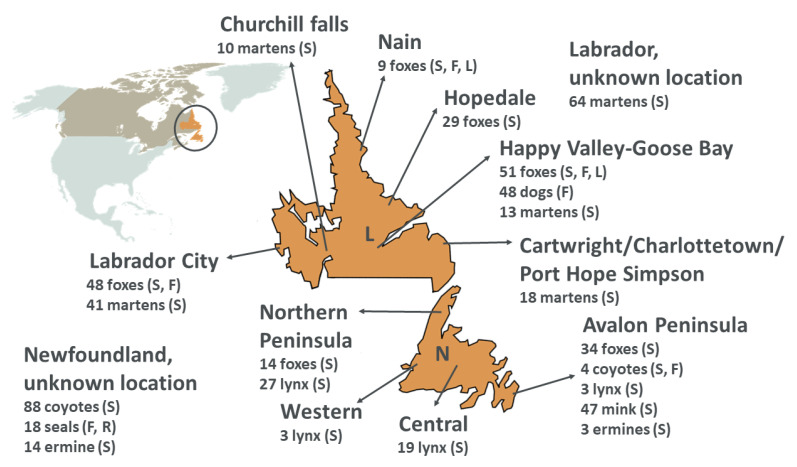
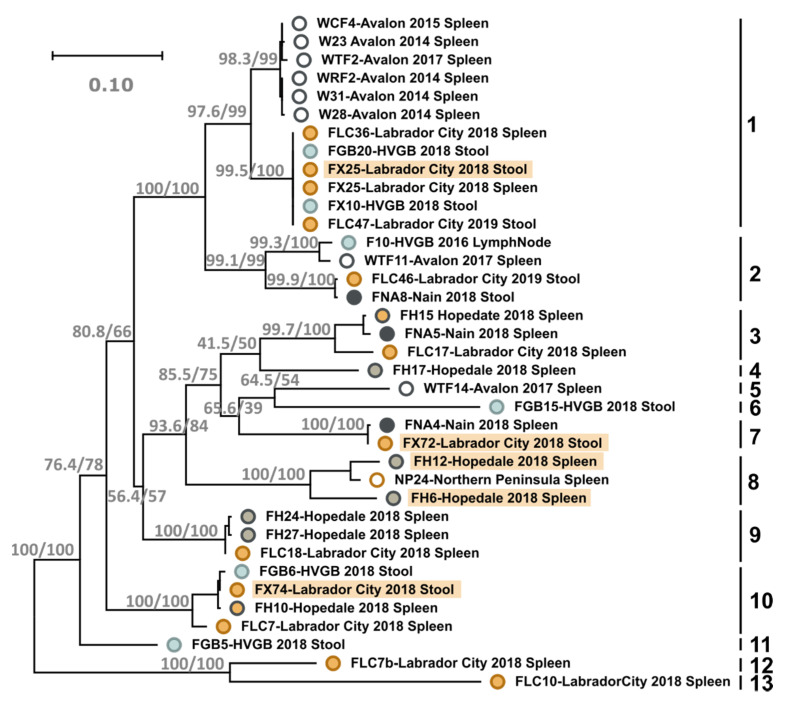
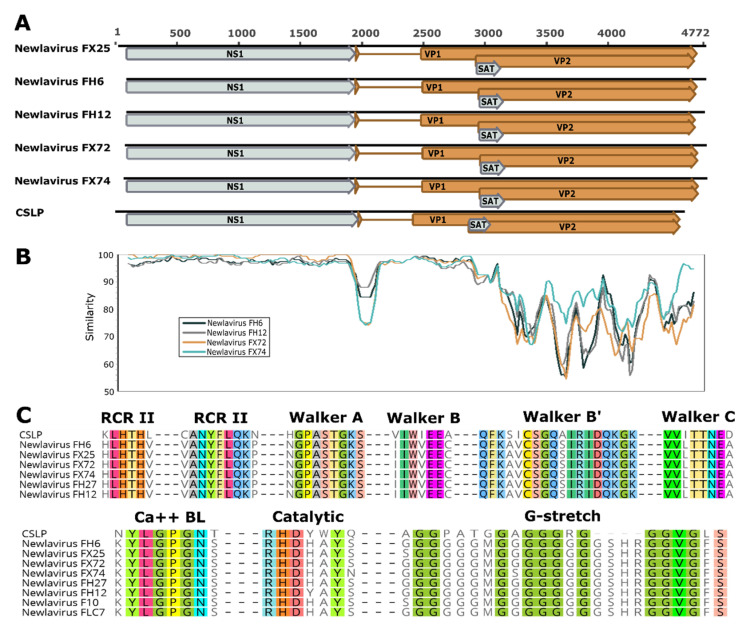
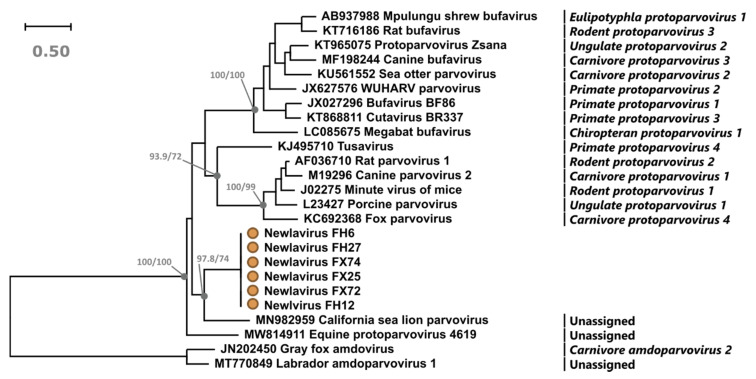
The genus (family ) includes several viruses of carnivores. We describe a novel fox protoparvovirus, which we named Newlavirus as it was discovered in samples from Newfoundland and Labrador, Canada. Analysis of the full non-structural protein (NS1) sequence indicates that this virus is a previously uncharacterized species. Newlavirus showed high prevalence in foxes from both the mainland (Labrador, 54/137, 39.4%) and the island of Newfoundland (22/50, 44%) but was not detected in samples from other carnivores, including coyotes ( = 92), lynx ( = 58), martens ( = 146), mink ( = 47), ermines ( = 17), dogs ( = 48), and ringed ( = 4), harp ( = 6), bearded ( = 6), and harbor ( = 2) seals. Newlavirus was found at similar rates in stool and spleen (24/80, 30% vs. 59/152, 38.8%, = 0.2) but at lower rates in lymph nodes (2/37, 5.4%, < 0.01). Sequencing a fragment of approximately 750 nt of the capsid protein gene from 53 samples showed a high frequency of co-infection by more than one strain (33.9%), high genetic diversity with 13 genotypes with low sequence identities (70.5-87.8%), and no geographic segregation of strains. Given the high prevalence, high diversity, and the lack of identification in other species, foxes are likely the natural reservoir of Newlavirus, and further studies should investigate its distribution.
该属(科)包括几种食肉动物病毒。我们描述了一种新型狐狸细小病毒,我们将其命名为 Newlavirus,因为它是在加拿大纽芬兰和拉布拉多的样本中发现的。对完整的非结构蛋白(NS1)序列的分析表明,该病毒是一种以前未被描述的新种。Newlavirus 在来自大陆(拉布拉多,54/137,39.4%)和纽芬兰岛(22/50,44%)的狐狸中均有较高的流行率,但在其他食肉动物(包括狼(=92)、猞猁(=58)、貂(=146)、水貂(=47)、白鼬(=17)、狗(=48)、环斑海豹(=4)、髯海豹(=6)、格陵兰海豹(=6)和港海豹(=2))的样本中均未检测到。Newlavirus 在粪便和脾脏中的检出率相似(24/80,30% vs. 59/152,38.8%,=0.2),但在淋巴结中的检出率较低(2/37,5.4%,<0.01)。对来自 53 个样本的约 750nt 衣壳蛋白基因片段进行测序显示,多种毒株同时感染的频率很高(33.9%),遗传多样性很高,有 13 种基因型,序列同一性较低(70.5-87.8%),且毒株无地理分离。鉴于其高流行率、高多样性以及在其他物种中未被识别,狐狸可能是 Newlavirus 的天然宿主,进一步的研究应调查其分布情况。