Department of Medical Sciences, Section of Clinical Microbiology, Uppsala University, 751 85 Uppsala, Sweden.
Chester Medical School, University of Chester, Chester CH2 1BR, UK.
Viruses. 2021 Sep 30;13(10):1974. doi: 10.3390/v13101974.
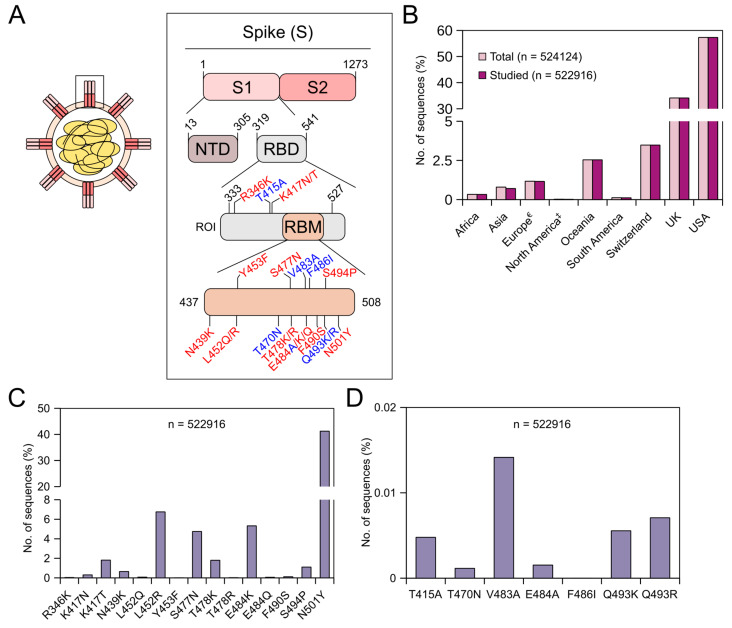
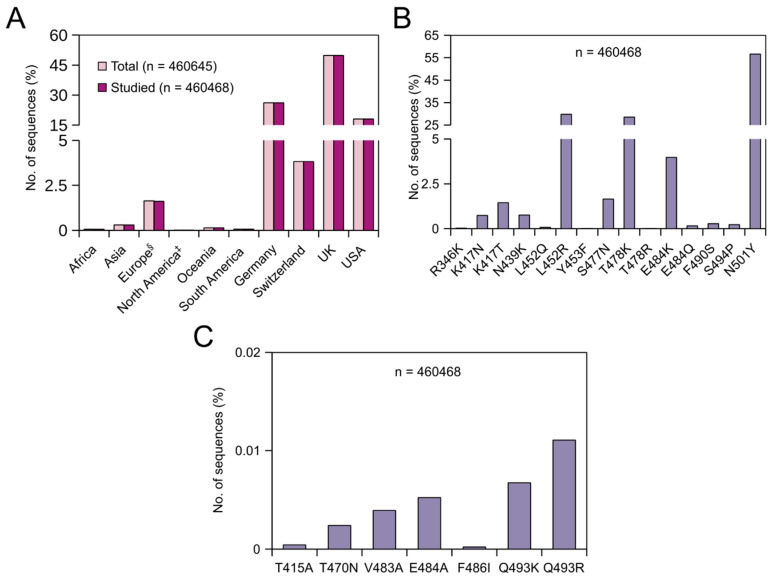
Several vaccines with varying efficacies have been developed and are currently administered globally to minimize the spread of severe acute respiratory syndrome coronavirus 2 (SARS-CoV-2). Despite having an RNA-dependent RNA polymerase with a proofreading activity, new variants of SARS-CoV-2 are on the rise periodically. Some of the mutations in these variants, especially mutations on the spike protein, aid the virus in transmission, infectivity and host immune evasion. Further, these mutations also reduce the effectiveness of some of the current vaccines and monoclonal antibodies (mAbs). In the present study, using the available 984,769 SARS-CoV-2 nucleotide sequences on the NCBI database from the end of 2019 till 28 July 2021, we have estimated the global prevalence of so-called 'adaptive mutations' and 'mutations identified in the prolonged infections', in the receptor-binding domain (RBD) of the spike (S) protein. Irrespective of the geographical region, in the case of the adaptive mutations, N501Y (48.38%) was found to be the dominant mutation followed by L452R (17.52%), T478K (14.31%), E484K (4.69%), S477N (3.29%), K417T (1.64%), N439K (0.7%) and S494P (0.7%). Other mutations were found to be less prevalent (less than 0.7%). Since the last two months, there has been a massive increase of L452R and T478K mutations (delta variant) in certain areas. In the case of prolonged infections' mutations (long-term SARS-CoV-2 infections), V483A (0.009%) was found to be dominant followed by Q493R (0.009%), while other mutations were found in less than 0.007% of the studied sequences. The data obtained in this study will aid in the development of better infection control policies, thereby curbing the spread of this virus.
已经开发出了几种具有不同功效的疫苗,目前正在全球范围内使用,以最大限度地减少严重急性呼吸综合征冠状病毒 2(SARS-CoV-2)的传播。尽管具有具有校对活性的 RNA 依赖性 RNA 聚合酶,但 SARS-CoV-2 的新变体仍在定期出现。这些变体中的一些突变,特别是刺突蛋白上的突变,有助于病毒传播、感染性和宿主免疫逃逸。此外,这些突变还降低了一些当前疫苗和单克隆抗体(mAbs)的有效性。在本研究中,使用 NCBI 数据库中 2019 年底至 2021 年 7 月 28 日期间可用的 984,769 个 SARS-CoV-2 核苷酸序列,我们估计了 Spike(S)蛋白受体结合域(RBD)中所谓的“适应性突变”和“在长时间感染中鉴定出的突变”的全球流行率。无论地理位置如何,在适应性突变的情况下,发现 N501Y(48.38%)是主要突变,其次是 L452R(17.52%)、T478K(14.31%)、E484K(4.69%)、S477N(3.29%)、K417T(1.64%)、N439K(0.7%)和 S494P(0.7%)。其他突变的发生率较低(低于 0.7%)。在过去的两个月中,某些地区 L452R 和 T478K 突变(delta 变体)大量增加。在长时间感染的突变(长期 SARS-CoV-2 感染)中,发现 V483A(0.009%)是主要突变,其次是 Q493R(0.009%),而其他突变的发生率低于研究序列的 0.007%。本研究获得的数据将有助于制定更好的感染控制政策,从而遏制该病毒的传播。