Health Psychology Section, Psychology Department, King's College London, London, UK.
Health Psychology Section, Psychology Department, King's College London, London, UK
BMJ Open. 2021 Oct 25;11(10):e053971. doi: 10.1136/bmjopen-2021-053971.
Approximately 30% of people with long-term physical health conditions (LTCs) experience mental health problems, with negative consequences and costs for individuals and healthcare services. Access to psychological treatment is scarce and, when available, often focuses on treating primary mental health problems rather than illness-related anxiety/depression. The aim of this study is to evaluate the clinical efficacy of a newly developed, therapist-supported, digital cognitive-behavioural treatment (COMPASS) for reducing LTC-related psychological distress (anxiety/depression), compared with standard charity support (SCS).
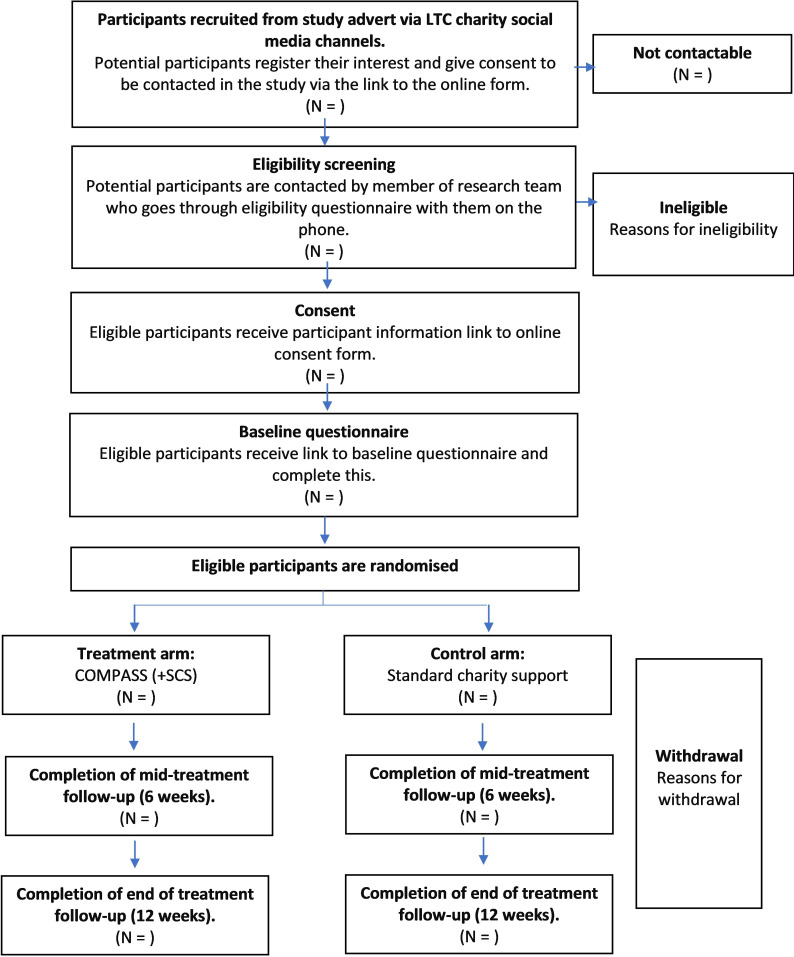
A two-arm, parallel-group randomised controlled trial (1:1 ratio) with nested qualitative study will be conducted. Two-hundred adults with LTC-related anxiety and depression will be recruited through national LTC charities. They will be randomly allocated to receive COMPASS or SCS only. An independent administrator will use Qualtrics randomiser for treatment allocation, to ensure allocation concealment. Participants will access treatment from home over 10 weeks. The COMPASS group will have access to the digital programme and six therapist contacts: one welcome message and five fortnightly phone calls. Data will be collected online at baseline, 6 weeks and 12 weeks post-randomisation for primary outcome (Patient Health Questionnaire Anxiety and Depression Scale) and secondary outcomes (anxiety, depression, daily functioning, COVID-19-related distress, illness-related distress, quality of life, knowledge and confidence for illness self-management, symptom severity and improvement). Analyses will be conducted following the intention-to-treat principle by a data analyst blinded to treatment allocation. A purposively sampled group of COMPASS participants and therapists will be interviewed. Interviews will be thematically analysed.
The study is approved by King's College London's Psychiatry, Nursing and Midwifery Research Ethics Subcommittee (reference: LRS-19/20-20347). All participants will provide informed consent to take part if eligible. Findings will be published in peer-reviewed journals and presented at conferences.
NCT04535778.
约 30%患有长期身体疾病(LTCs)的人会出现心理健康问题,这给个人和医疗保健服务带来了负面影响和成本。获得心理治疗的机会稀缺,而且,当有机会获得治疗时,通常侧重于治疗主要的心理健康问题,而不是与疾病相关的焦虑/抑郁。本研究的目的是评估一种新开发的、由治疗师支持的数字认知行为治疗(COMPASS)对减轻与长期疾病相关的心理困扰(焦虑/抑郁)的临床疗效,与标准慈善支持(SCS)相比。
这是一项采用 1:1 比例、双臂、平行组随机对照试验(RCT),并嵌套定性研究。将通过全国性的长期疾病慈善机构招募 200 名患有与长期疾病相关的焦虑和抑郁的成年人。他们将被随机分配接受 COMPASS 或 SCS。独立管理员将使用 Qualtrics 随机化器进行治疗分配,以确保分配隐藏。参与者将在 10 周内在家中接受治疗。COMPASS 组将可以访问数字计划和六次治疗师联系:一条欢迎信息和五次每两周的电话。参与者将在随机分组后 6 周和 12 周在线收集主要结局(患者健康问卷焦虑和抑郁量表)和次要结局(焦虑、抑郁、日常功能、COVID-19 相关困扰、与疾病相关的困扰、生活质量、疾病自我管理的知识和信心、症状严重程度和改善)的数据。分析将按照意向治疗原则进行,由一名对治疗分配不知情的数据分析师进行。将对一组有目的抽样的 COMPASS 参与者和治疗师进行访谈。访谈将进行主题分析。
该研究已获得伦敦国王学院精神病学、护理和助产研究伦理小组委员会的批准(参考号:LRS-19/20-20347)。如果符合条件,所有参与者都将提供知情同意书参与研究。研究结果将发表在同行评议的期刊上,并在会议上展示。
NCT04535778。