Responsible Innovation Future Science Platform, Commonwealth Scientific and Industrial Research Organisation, Brisbane, Queensland, Australia
Australian National Centre for the Public Awareness of Science, Australian National University, Canberra, Australian Capital Territory, Australia.
BMJ Open. 2021 Oct 25;11(10):e056938. doi: 10.1136/bmjopen-2021-056938.
To determine progress and gaps in global precision health research, examining whether precision health studies integrate multiple types of information for health promotion or restoration.
Scoping review.
Searches in Medline (OVID), PsycINFO (OVID), Embase, Scopus, Web of Science and grey literature (Google Scholar) were carried out in June 2020.
Studies should describe original precision health research; involve human participants, datasets or samples; and collect health-related information. Reviews, editorial articles, conference abstracts or posters, dissertations and articles not published in English were excluded.
The following data were extracted in independent duplicate: author details, study objectives, technology developed, study design, health conditions addressed, precision health focus, data collected for personalisation, participant characteristics and sentence defining 'precision health'. Quantitative and qualitative data were summarised narratively in text and presented in tables and graphs.
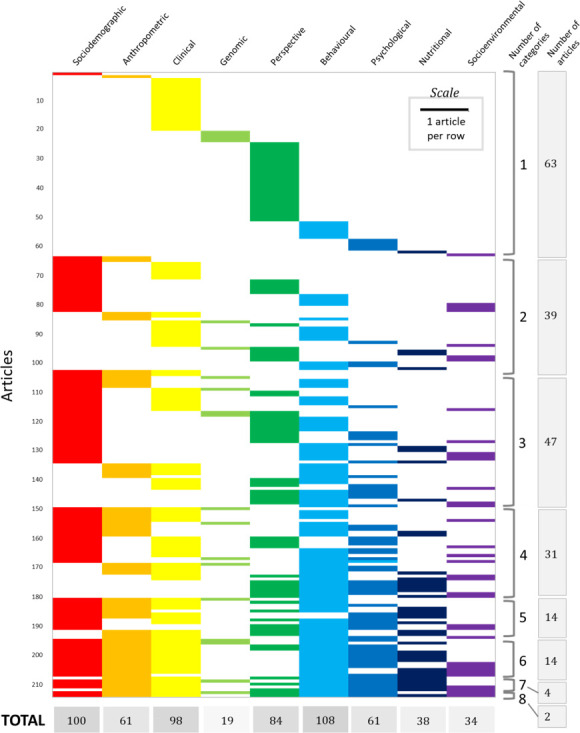
After screening 8053 articles, 225 studies were reviewed. Almost half (105/225, 46.7%) of the studies focused on developing an intervention, primarily digital health promotion tools (80/225, 35.6%). Only 28.9% (65/225) of the studies used at least four types of participant data for tailoring, with personalisation usually based on behavioural (108/225, 48%), sociodemographic (100/225, 44.4%) and/or clinical (98/225, 43.6%) information. Participant median age was 48 years old (IQR 28-61), and the top three health conditions addressed were metabolic disorders (35/225, 15.6%), cardiovascular disease (29/225, 12.9%) and cancer (26/225, 11.6%). Only 68% of the studies (153/225) reported participants' gender, 38.7% (87/225) provided participants' race/ethnicity, and 20.4% (46/225) included people from socioeconomically disadvantaged backgrounds. More than 57% of the articles (130/225) have authors from only one discipline.
Although there is a growing number of precision health studies that test or develop interventions, there is a significant gap in the integration of multiple data types, systematic intervention assessment using randomised controlled trials and reporting of participant gender and ethnicity. Greater interdisciplinary collaboration is needed to gather multiple data types; collectively analyse big and complex data; and provide interventions that restore, maintain and/or promote good health for all, from birth to old age.
确定全球精准健康研究的进展和差距,考察精准健康研究是否整合了多种类型的信息以促进或恢复健康。
范围综述。
2020 年 6 月,在 Medline(OVID)、PsycINFO(OVID)、Embase、Scopus、Web of Science 和灰色文献(Google Scholar)中进行了搜索。
研究应描述原始的精准健康研究;涉及人类参与者、数据集或样本;并收集与健康相关的信息。综述、社论文章、会议摘要或海报、论文和非英文发表的文章被排除在外。
独立重复提取以下数据:作者详细信息、研究目标、开发的技术、研究设计、所解决的健康状况、精准健康重点、为个性化收集的数据、参与者特征和定义“精准健康”的句子。定量和定性数据以文字形式进行叙述性总结,并以表格和图形呈现。
经过筛选 8053 篇文章后,共审查了 225 项研究。近一半(105/225,46.7%)的研究专注于开发干预措施,主要是数字健康促进工具(80/225,35.6%)。只有 28.9%(65/225)的研究至少使用了四种类型的参与者数据进行定制,个性化通常基于行为(108/225,48%)、社会人口统计学(100/225,44.4%)和/或临床(98/225,43.6%)信息。参与者的中位年龄为 48 岁(IQR 28-61),解决的前三大健康状况是代谢紊乱(35/225,15.6%)、心血管疾病(29/225,12.9%)和癌症(26/225,11.6%)。只有 68%的研究(153/225)报告了参与者的性别,38.7%(87/225)提供了参与者的种族/民族,20.4%(46/225)包括来自社会经济弱势背景的人。超过 57%的文章(130/225)的作者来自一个学科。
尽管有越来越多的精准健康研究测试或开发干预措施,但在整合多种数据类型、使用随机对照试验进行系统的干预评估以及报告参与者的性别和种族方面存在显著差距。需要更多的跨学科合作,以收集多种数据类型;共同分析大数据和复杂数据;并为所有人提供干预措施,从出生到老年,促进、维持和/或促进健康。