Department of Radiology and Research Institute of Radiology, Cardiac Imaging Center, Asan Medical Center, University of Ulsan College of Medicine, Olympic-ro 43 gil, 88, Song-pa gu, Seoul, 05505, South Korea.
Cardiovascular Surgery, Asan Medical Center, University of Ulsan College of Medicine, Seoul, South Korea.
Sci Rep. 2021 Oct 25;11(1):21005. doi: 10.1038/s41598-021-00406-3.
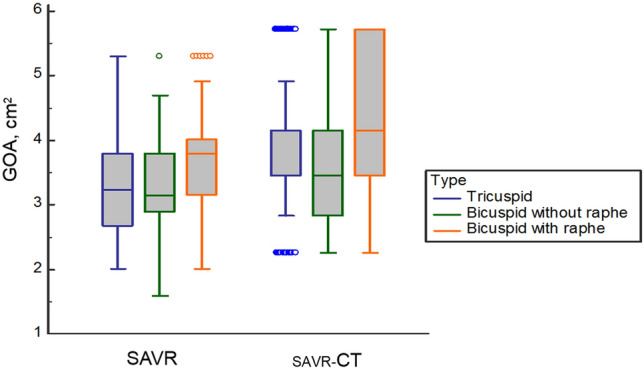
The purpose of this study was to evaluate whether bicuspid anatomy affects the discrepancy between CT-derived annular size and intraoperative size. We retrospectively analyzed annular measurements in 667 patients who underwent surgical aortic valve replacement (AVR). Preoperative CT measurements of the aortic annulus were compared to surgically implanted valve sizes. To evaluate whether the bicuspid valve affects the differences between CT annulus diameter and surgical AVR size, patients with diameter larger by > 10% (CT-Lg group) on CT, compared to surgical AVR size, were compared with those having size difference < 10% (CT-Sim group). Propensity score matching yielded 183 matched patients from each group. Bicuspid aortic valve annulus parameters significantly correlated with surgical aortic valve size (r = 0.52-0.71; for all, p < 0.01). The most representative measurements corresponded to surgical aortic valve size were area-derived diameters in tricuspid aortic valve (r = 0.69, p < 0.001) and bicuspid without raphe (r = 0.71, p < 0.001), and perimeter-derived diameter in bicuspid with raphe (r = 0.63, p < 0.001). After propensity score matching, native valve type was not different between CT-Sim and CT-Lg groups. In multivariable analysis, the difference between CT-derived diameter and surgical AVR size was affected by the operator factor and types of prosthesis. Bicuspid aortic annulus diameters measured on CT showed a significant correlation with surgical aortic valve size. The difference between CT-derived diameter and surgical AVR size is affected by operator factor and the types of prosthesis but not affected by the bicuspid valve.
本研究旨在评估二叶式主动脉瓣解剖结构是否会影响 CT 测量的瓣环直径与术中瓣环直径之间的差异。我们回顾性分析了 667 例行外科主动脉瓣置换术(AVR)患者的瓣环测量值。比较了主动脉瓣环的术前 CT 测量值与术中植入的瓣口尺寸。为了评估二叶瓣是否会影响 CT 瓣环直径与外科 AVR 尺寸之间的差异,我们将 CT 直径大于外科 AVR 尺寸 10%以上的患者(CT-Lg 组)与直径差值小于 10%的患者(CT-Sim 组)进行比较。倾向评分匹配得到每组 183 例匹配患者。二叶瓣主动脉瓣环参数与外科主动脉瓣尺寸显著相关(r=0.52-0.71;所有 p<0.01)。与外科主动脉瓣尺寸最具代表性的测量值是三尖瓣主动脉瓣的面积测量直径(r=0.69,p<0.001)和无嵴的二叶瓣(r=0.71,p<0.001),以及有嵴的二叶瓣的周长测量直径(r=0.63,p<0.001)。倾向评分匹配后,CT-Sim 组和 CT-Lg 组的原生瓣膜类型无差异。多变量分析显示,CT 测量的瓣环直径与外科 AVR 直径的差异受术者因素和人工瓣膜类型的影响。CT 上测量的二叶瓣瓣环直径与外科主动脉瓣尺寸有显著相关性。CT 测量的瓣环直径与外科 AVR 直径的差异受术者因素和人工瓣膜类型的影响,但不受二叶瓣的影响。